Beyond Ego vs. Nervous System: How Context Shapes Burnout, Belonging, and Behavior
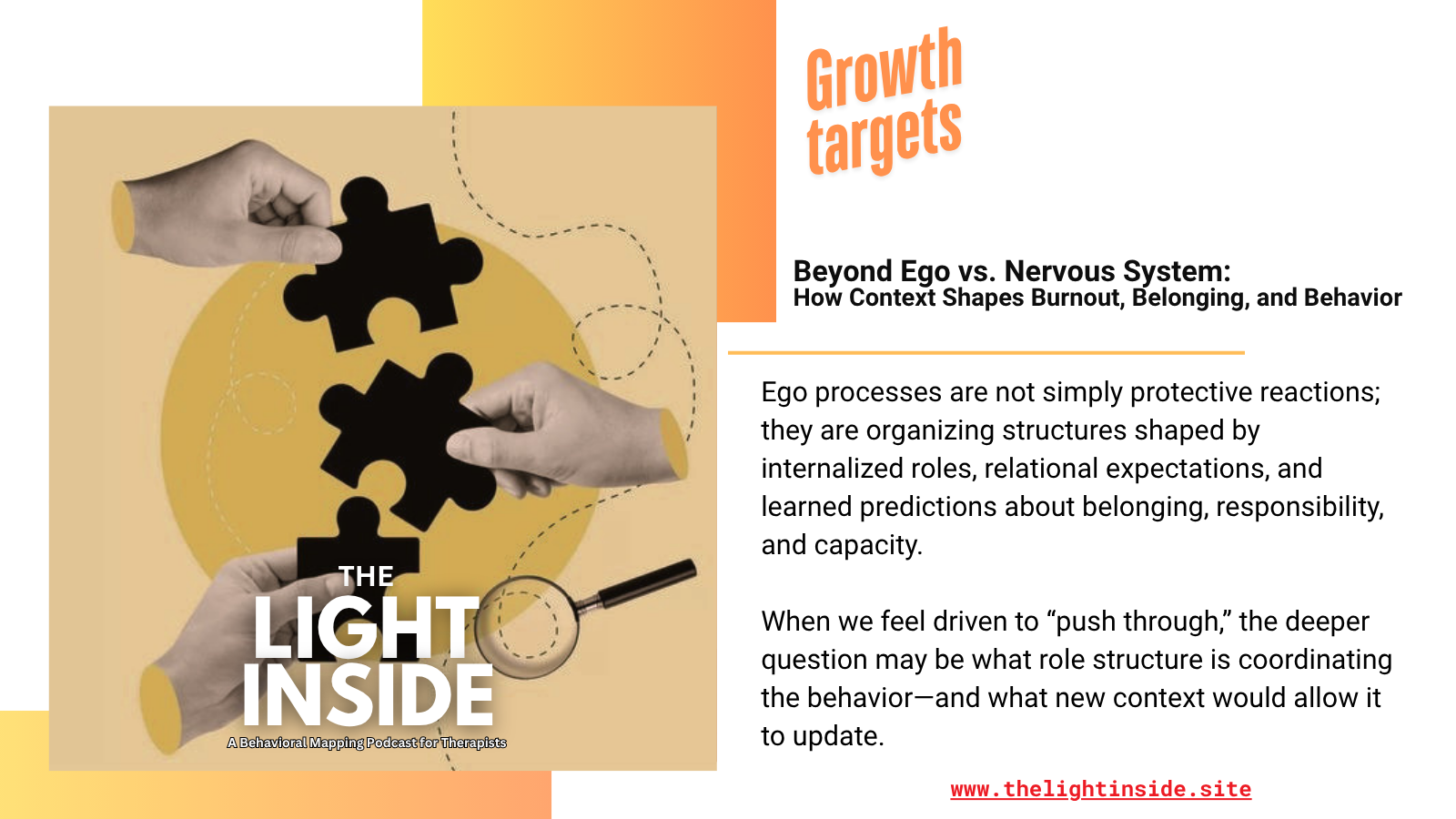
When we frame ego as something to reject under stress, we may turn an essential organizing function into something to stigmatize instead of asking what it is helping organize across stress, belonging, identity, responsibility, and capacity.
If ego processes are not simply identity defenses, but organizing structures helping the organism maintain coherence, what biological-relational questions might they be trying to answer when we feel stress, threat, shame, belonging pressure, or the need to stay composed?
The core issue is that the burnout statement creates a useful tension, but it also splits the organism into two competing agents:
“Your nervous system is screaming for a break, and your ego is yelling, ‘Just push through.’”
That framing is emotionally legible, but etiologically compressed. It treats “nervous system” as the wise biological truth and “ego” as the harsh psychological oppressor. Clinically, that can flatten the very borderland where ego processes, executive function, interoception, attachment learning, affect regulation, relational prediction, and embodied adaptation are working together.
Ego as a Coordinating System, Not a Competing Force
Ego processes are not merely an abstraction of identity. They are organizing functions that help the organism maintain coherence across internal state, external demand, social contact, memory, threat prediction, belonging, shame, agency, and consequence.
Classically, ego functions include reality testing, judgment, impulse control, affect regulation, defensive organization, synthesis, object relations, self-other differentiation, and adaptive functioning.
Contemporary neuroscience does not include “ego organization” in the same way psychoanalytic theory does, but many of these functions sit adjacent to executive control, interoception, allostasis, mentalization, attachment regulation, and self-other distinction.
Stress research shows that executive functions such as working memory, attention, inhibition, and cognitive flexibility are especially vulnerable under stress, which means the “push through” response may not be ego versus nervous system; it may be an overtaxed regulatory network narrowing its options under perceived demand. (PMC)
The epistemic conundrum
The conundrum is this: when we say “the ego is yelling,” what exactly are we naming?
Are we naming identity protection? Shame avoidance? Superego demand? executive persistence? relational appeasement? inherited role obligation? fear of collapse? social comparison? financial pressure? attachment threat? unresolved default cue data?
If we collapse all of that into “ego,” we create an etiological error. The behavior becomes morally or spiritually framed as “ego-driven,” when it may actually be a multi-system adaptation: interoceptive strain, prefrontal overload, autonomic activation, attachment prediction, role-based identity preservation, and learned belonging strategy converging into one command: keep functioning.
Interoception research shows that the brain continuously models internal bodily signals and uses those signals to anticipate and regulate bodily needs through allostasis; affective experience is not separate from these predictive bodily loops. (PMC)
So “I must push through” may be less an ego failure and more a predictive regulatory shortcut formed around prior consequences: If I stop, I lose belonging, competence, control, approval, income, dignity, or relational access.
Why ego processes are biological imperatives
Role internalization gives ego processes a broader organizing context: the person is not only defending against threat, but coordinating behavior around learned identity roles and relational expectations. This helps prevent the clinical formulation from reducing ego processes to “protective parts” alone, while preserving the more precise language of prediction, belonging, obligation, responsibility, and adaptation.
Supporting context: identity-value research links identity with valuation and self-regulation, while attachment research describes internal working models as organizing structures that guide attachment behavior and adaptation. (pmc.ncbi.nlm.nih.gov)
Ego processes help the organism answer essential biological-relational questions:
Reality testing: What is happening outside me, and what am I predicting from inside me?
Judgment: What action protects future consequence?
Impulse modulation: What can I delay, inhibit, express, or redirect?
Affect regulation: Can I metabolize this state without becoming flooded, collapsed, or reactive?
Self-other differentiation: Is this my feeling, your feeling, or the relational field between us?
Mentalization: What might I be feeling, and what might you be experiencing?
Defensive organization: What protects me from overwhelm when direct contact is too much?
Synthesis: Can I hold competing truths without fragmenting?
Mentalization research describes the capacity to understand one’s own and others’ mental states, and self-other distinction is central to empathy because empathy requires differentiating another person’s state from one’s own. (PMC)
This means ego processes are not merely “self-centered.” They are part of how humans form mutuality, repair rupture, regulate proximity, and remain relationally available without fusing, collapsing, or controlling.
Where the burnout statement compresses causality
The phrase “operating with your nervous system, not your ego” implies a false binary.
A cleaner formulation would be:
Your organism may be signaling overload, while learned ego functions are trying to preserve coherence, role, belonging, competence, and future consequence. The clinical question is not how to defeat the ego, but how to differentiate which ego functions are protecting adaptation, which are overworking, and which need updated relational and biological data.
Burnout often emerges when persistence, identity, responsibility, belonging, and physiological depletion become fused. The person is not simply “ignoring the body.” They may be obeying an older predictive contract: I remain valued when I remain useful. Under stress, prefrontal systems involved in executive control can become disrupted, shifting behavior toward more reflexive, narrowed, habit-based responses. (Nature)
Key examples
- A person who keeps working while exhausted may not be “ego-driven” in a simplistic sense. Their ego functions may be trying to maintain employment, reputation, competence, and relational approval.
- A parent who cannot rest may not lack awareness. Their judgment, attachment prediction, and responsibility schema may be organized around: If I stop scanning, something will go wrong.
- A clinician who over-functions may not be acting from superiority. Their empathy, role identity, defensive control, and unresolved responsibility cues may have fused into rescue.
- A partner who pushes through conflict may not be “in their ego.” They may be using synthesis, appeasement, inhibition, and belonging-preservation to prevent abandonment, escalation, or shame.
- A leader who cannot delegate may not simply need nervous system regulation. Their self-other differentiation, trust prediction, consequence forecasting, and role-based identity may be organized around: If I release control, the system becomes unsafe or I become unnecessary.
The wider differentiation
The clinically useful move is not to subjugate ego processes, but to differentiate them.
Some ego processes protect contact. Some contextualize coherence. Some contextualize dignity. Some contextualize role continuity. Some contextualize the body from overwhelm. Some contextualize the person from shame. Some contextualize belonging by suppressing need. Some contextualize agency by overusing control.
When these functions are honored rather than stigmatized, the inquiry changes from:
“Why is my ego sabotaging me?”
to:
“Which protective function is overworking, what biological or relational data is it responding to, and what new experience would allow it to update?”
Context matters.
Clinically cleaner reframe
From the outside, it may look like you are holding everything together. Inside, your body may be signaling depletion while older organizing functions are still trying to preserve competence, belonging, responsibility, and control.
That is not simply your nervous system versus your ego. It is a whole organism trying to predict what will happen if you stop, need, rest, disappoint, or let others see the strain.
The work is not to override the ego, but to listen more precisely.
For example:
Which function is protecting you?
Which one is overworking?
Which one is guiding you towards compassion?
Which one is signaling rest?
And what would help your system update from survival-based persistence into a more differentiated form of capacity, agency, and relational support?
I wonder if the conundrum here is what gets lost when we frame burnout as “nervous system versus ego,” rather than a whole organism trying to coordinate stress, belonging, role, capacity, and consequence at once.
In Sum
Ego processes are not simply barriers to regulation or identity patterns to overcome; they are organizing structures that help the organism coordinate stress, belonging, role, memory, prediction, empathy, agency, and consequence.
When we meet them with curiosity, we can begin to notice which function is helping us stay coherent, which one is overworking, and which one may need updated biological or relational data to respond with more flexibility.
A coachable inquiry might be:
When stress activates the part of me that wants to push through, control, explain, withdraw, appease, or stay composed, what organizing structure is trying to help me maintain coherence—and what would allow that function to soften without losing its purpose?
Three ways to bring this into focus: name the function before judging the behavior; track what the response is organizing around, such as shame, belonging, duty, uncertainty, or consequence; and ask what new support, boundary, pacing, or relational data might help the system update.
The nervous system is not operating in isolation; it is working in tandem with the ego functions that help us reality-test, regulate affect, preserve identity, differentiate self from other, sustain empathy, and predict what might happen if we stop, need, rest, or disappoint. This matters because “push through” may not simply be ego resistance—it may be an overworked protective function trying to preserve coherence, dignity, and relational access when the system is already depleted.
So maybe the cleaner inquiry is not, “How do I stop operating from ego?” but, “Which organizing function is protecting me, which one is overworking, and what new biological or relational data would help my system update from survival-based persistence into a more differentiated form of capacity, agency, and support?”
We’d love to hear your input. How does that land?
PEER SUPPORT DATA
Below are five peer-supported data points that support the central context: ego processes are not simply “identity defenses” opposing the nervous system; they overlap with biological, relational, predictive, and executive systems that help the organism organize behavior.
1. Self-regulation is hierarchical, not singular
Blair’s hierarchical model of self-regulation describes regulation as an integrated system involving executive function, emotion, behavior, physiology, and genetics, all reciprocally influencing each other. This supports the idea that what we casually call “ego control” may actually be a coordinated regulatory process distributed across multiple organismic systems. (Frontiers)
Why it matters in context: This matters because “push through” is not merely ego stubbornness; it may reflect executive control, role-based prediction, emotional inhibition, and physiological stress management attempting to preserve coherence.
Clinically: it asks us to assess which layer of regulation is overworking rather than flattening the response into “ego versus nervous system.”
Reference summary: Blair’s model positions executive function as one component within a broader self-regulatory architecture, alongside emotional, behavioral, physiological, and genetic components. The model emphasizes recursive influence, meaning stress, emotion, physiology, and behavior continually shape one another rather than operating in isolation.
2. Burnout involves executive, emotional, and physiological disruption
A neurophysiological review of burnout links burnout with impaired executive functioning, attention control, working memory, emotional dysregulation, irritability, anxiousness, and stress-related physiological changes. This reinforces that burnout is not simply a failure to listen to the body or a problem of ego-driven overcontrol; it is a multi-system disruption affecting cognition, affect, physiology, and behavior. (PMC)
Why it matters in context: When a person says, “I just have to push through,” that statement may be emerging from a narrowed cognitive-emotional field, not a clean act of willpower. The ego-like function may be attempting to maintain continuity while the organism’s regulatory systems are already compromised.
Reference summary: Khammissa and colleagues describe burnout as involving psychological, neurophysiological, and clinical dimensions. Their review highlights cognitive impairment and dysregulation, which helps clinicians avoid moralizing persistence as mere ego resistance.
3. Interoception and allostasis show that bodily signals are predictive and regulatory
Feldman’s review on interoception and affect describes interoception as central to how the brain models internal bodily states and supports affective experience. This aligns with the idea that stress responses, emotion, and self-organization emerge through predictive bodily regulation, not through a simple split between the “true nervous system” and the “false ego.” —both offering context. (PMC)
Why it matters in context: A person’s felt sense of pressure, depletion, urgency, or shame is not just a psychological story; it is linked to predictive regulation of bodily need and anticipated consequence. Ego processes may help translate those bodily predictions into meaning: “I can’t stop,” “I’ll disappoint them,” “I’ll lose control,” or “I have to stay useful.”
Reference summary: Feldman reviews the neurobiology of interoception and affect, emphasizing how bodily signals contribute to emotion and mental experience. The paper supports a formulation where affective and cognitive self-processes emerge through embodied predictive regulation.
4. HRV and interoception are associated with emotion regulation capacity
A systematic review found that higher heart-rate variability and interoceptive ability are associated with more adaptive emotion regulation, including reappraisal, acceptance, downregulation of recalcitrant emotion, and handling social uncertainty. This supports the idea that ego functions such as appraisal, affect modulation, and social prediction are deeply tied to biological regulation. (Frontiers)
Why it matters in context: If someone cannot soften, rest, or differentiate emotional states under pressure, the issue may not be ego failure; it may reflect reduced regulatory flexibility across autonomic and interoceptive systems. The clinical task becomes helping the system build enough capacity to appraise, feel, name, and choose differently.
Reference summary: Pinna and Edwards reviewed studies connecting HRV, interoception, and emotion regulation. Their findings suggest that physiological flexibility and bodily awareness support adaptive regulatory strategies, especially in emotionally and socially uncertain contexts.
5. Attachment patterns shape emotion regulation across biological measures
A 2023 systematic review found that attachment representation is significantly related to emotion regulation measured through autonomic nervous system activity, brain activity, biochemistry, and nonverbal behavior. Secure attachment was associated with more balanced regulation, while insecure and unresolved attachment patterns were linked with impaired or dysfunctional regulation. (MDPI)
Why it matters in context: This directly supports the “behavior has a context” frame: a push-through pattern may be organized around belonging, approval, abandonment prediction, role safety, or relational consequence. Ego processes may be coordinating attachment-based predictions, not merely defending pride or resisting rest.
Reference summary: Eilert and colleagues reviewed objective measures of attachment-related emotion regulation across nervous system, brain, biochemical, and behavioral domains. Their findings show that relational history becomes biologically relevant in how people regulate stress, proximity, uncertainty, and emotional expression.
Clinically clean synthesis
Taken together, these studies support a more precise formulation: ego processes are not separate from biology; they are adjacent organizing functions that help translate bodily state, relational prediction, memory, role, threat, shame, and consequence into behavior. The question is not whether the nervous system or ego is “right,” but which coordinating function is carrying the load, what context shaped its prediction, and what updated biological-relational data might help it reorganize with more capacity.

Behavior Counselor/Executive Producer/Host
Jeffrey Besecker is a trauma-informed behavioral practitioner, educator, and host of The Light Inside, a clinician-facing educational platform exploring the subconscious and unconscious patterns that shape human behavior, relational response, and adaptive growth.
His career has moved through hospitality leadership, culinary culture, brand development, community-building, entertainment marketing, and clinical behavioral education—each chapter deepening his study of how people form mutual trust, respond to cues, create shared meaning, and organize behavior within relational systems. Rather than viewing these transitions as separate careers, Jeffrey sees them as one continuous thread: a lifelong inquiry into how humans connect, adapt, protect, belong, and change.
At The Light Inside, Jeffrey’s work focuses on illuminating the unresolved emotional, cognitive, somatic, and relational data that often operates beneath conscious awareness. His educational approach examines how primary causal cues, implicit memory, predictive patterns, emotional biases, and conditioned responses influence the behaviors people repeat, even when those behaviors conflict with their stated values or desired outcomes.
Blending behavioral science, trauma-informed care, cognitive-behavioral principles, somatic awareness, and relational formulation, Jeffrey helps translate complex clinical concepts into clear, practical, and context-sensitive frameworks. His work emphasizes that behavior does not emerge in isolation; it is shaped through nervous system capacity, relational contex… Read More
Beyond Arousal: Recovering the Context That Organizes Human Behavior