“Discover the Subconscious Forces Driving Your Behavior with The Light Inside—Your Pathway to Empowered Change and Growth.”

Blog Posts

April 29, 2026

The Introspection Illusion: Cue-Driven Appraisal and the Early Loss of Contact

The Introspection Illusion: Cue-Driven Appraisal and the Early Loss of Contact

-Common Cue-Based Communication Gaps or GatesWhen communication strain begins to build, the problem is often not simply poor wording or failed intent, but the speed at which cue-driven appraisal, embodied state, and prior relational learning begin…

View more
April 17, 2026

The Many Selves We Inhabit: Identity Foreclosure, Fragmentation, and the Borrowed Self

The Many Selves We Inhabit: Identity Foreclosure, Fragmentation, and the Borrowed Self

Sometimes the search for authenticity can quietly turn into a pressure to secure, purify, or prove a finished self before you feel allowed to live with congruence, and that urgency can close inquiry before the fuller sequence of your experience has …

View more
April 15, 2026

Healing as Reintegration, Not Erasure: Predictive Regulation, Memory Updating, and the Brain-Body Supersystem

Healing as Reintegration, Not Erasure: Predictive Regulation, Memory Updating, and the Brain-Body Supersystem

What if healing is not the disappearance of distress or past experiences, but the growing capacity to remain in contact with what once organized us through fear, collapse, over-control, or compression?Why this mattersThis matters in the therapeu…

View more
April 9, 2026

Not Irrational, but Organized: How Protective Cue Stacks Preserve Coherence Under Load

Not Irrational, but Organized: How Protective Cue Stacks Preserve Coherence Under Load

We are often told in various social and therapeutic contexts that trauma “doesn’t live in the logical part of the brain” and that it only lives in the part of your brain that’s more instinctual and reactive. The part that&r…

View more
March 26, 2026

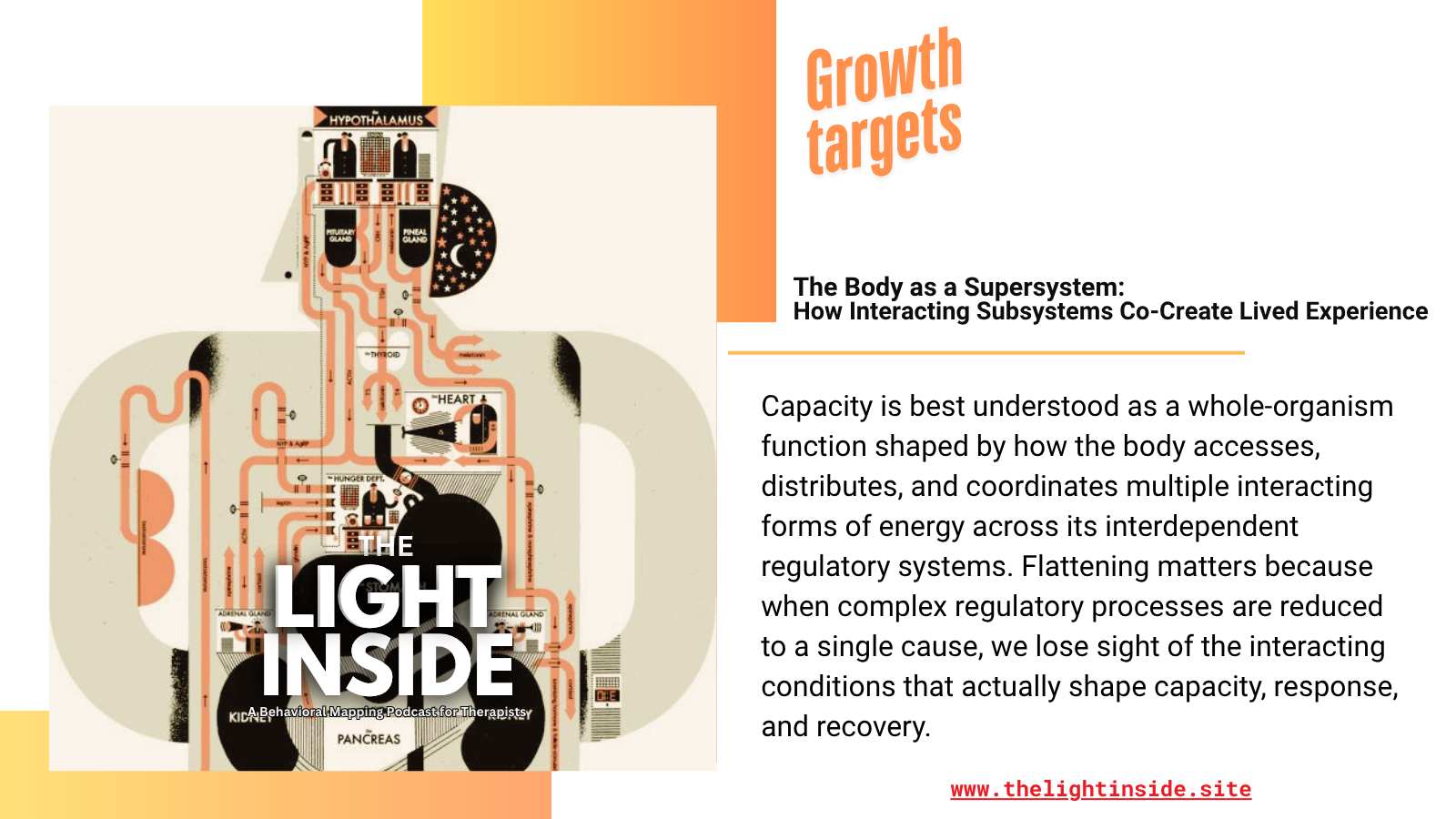
The Body as a Supersystem: How Interacting Subsystems Co-Create Lived Experience

The Body as a Supersystem: How Interacting Subsystems Co-Create Lived Experience

Common pop cultural perspectives often paint our internal systems as a brain vs. body fight for supremacy.A more clinically accurate view is that our internal systems are not engaged in a brain-versus-body struggl…

View more
March 25, 2026

Mirror Neurons Fallacy: Why Observational Forecasting Is Often Over-Inferred

Mirror Neurons Fallacy: Why Observational Forecasting Is Often Over-Inferred

How accurately do we really read another person’s inner state when both social perception and self-perception are shaped by attentional bias, predictive inference, and the introspective limits we bring to our own unresolved patterns?Mirror s…

View more
March 11, 2026

Insight Without Capacity Becomes Explanation: Why Lasting Change Depends on Linkage Across the Full Cue Stack

Insight Without Capacity Becomes Explanation: Why Lasting Change Depends on Linkage Across the Full Cue Stack

What is often mistaken for a lack of follow-through is frequently a state-dependent reduction in usable capacity, where declarative insight remains intact but interoceptive precision, regulatory range, attentional breadth, executive flexibility, and…

View more
March 7, 2026

Beyond Survival Mode: How Nervous System Load Becomes Self-Story

Beyond Survival Mode: How Nervous System Load Becomes Self-Story

There are moments when the uncertainty of being human feels almost unbearable—when fragility becomes impossible to ignore, when the body seems to register risk before language can make sense of it, and when our search for steadiness reveals ju…

View more
March 6, 2026

Tending the Relational Field: Clinical Alliance, Contraindications, and the Quiet Drift Toward Coercion

Tending the Relational Field: Clinical Alliance, Contraindications, and the Quiet Drift Toward Coercion

In trauma-informed care, the client alliance is not a secondary aspect of treatment but the living relational structure through which consent, pacing, power, and repair determine whether therapeutic contact becomes integrative or destabilizing.Thi…

View more
Feb. 21, 2026

Social Imperatives: How Cultural “Rules” Quietly Push Us into Distance or Mutuality

Social Imperatives: How Cultural “Rules” Quietly Push Us into Distance or Mutuality

-How internalized social imperatives scaffold belonging, shape differentiation—and fracture identity when capacity is strainedMutuality, belonging, and cooperative collaboration are the nervous system’s relational scaffold—how hu…

View more
Feb. 13, 2026

When Progress Becomes Pressure: Moral Gating, Threshold Work, and the Relational Field in Clinical Change

When Progress Becomes Pressure: Moral Gating, Threshold Work, and the Relational Field in Clinical Change

Lincoln Stoller conversation excerpt) | Feb 4, 2026In everyday therapeutic practice, the real challenge isn’t pushing for insight—it’s staying steady enough to witness what unfolds, honoring the client’s pace and sequencing…

View more
Feb. 12, 2026

Where Habits Break: Mapping the Cue-to-Narrative Chain That Keeps Change From Sticking

Where Habits Break: Mapping the Cue-to-Narrative Chain That Keeps Change From Sticking

-How Load, Capacity, and Affective Forecasting Quietly Drive Adaptive AvoidanceWe all tend to stumble or experience miscues in our attempts to form healthy adaptive habits. Being human has a natural ebb and flow.I’ve got generative news: Y…

View more
Feb. 3, 2026

Not Resistance, but Capacity: How Moral Gating Turns Pacing into Self-Erasure

Not Resistance, but Capacity: How Moral Gating Turns Pacing into Self-Erasure

We often treat failure and confidence as gateways to success, which can quietly turn hesitation or overwhelm into self-erasure and lead us to ignore what we’re actually feeling—just to stay acceptable or intact.When does self-sealing c…

View more
Jan. 30, 2026

When Authority Becomes Risk: How Containment and Taxonomy Shape Embodied Agency

When Authority Becomes Risk: How Containment and Taxonomy Shape Embodied Agency

Biased power dynamics reward dominance, punish dissent, and quietly teach capable individuals that visibility is a relational risk. We’re often told that when leadership feels heavy or hesitant, it’s because we lack confid…

View more
Jan. 23, 2026

Dissociative Identity Disorder: How Coherence Emerges Through Respectful Pacing

Dissociative Identity Disorder: How Coherence Emerges Through Respectful Pacing

Dissociative Identity Disorder presents a very clear, and distinctive challenge within the core of therapeutic interventions.Could it be that the core challenge of Dissociative Identity Disorder is that interoceptive signals are protective and sta…

View more
Jan. 15, 2026

Redefining Diagnosis: How Dissonance and Reduced Regulatory Capacity Transform Feedback into Threat

Redefining Diagnosis: How Dissonance and Reduced Regulatory Capacity Transform Feedback into Threat

What if our aversion to diagnosis is not a fear of insight, but a protective reflex—revealing how the nervous system trades complexity for coherence when contact with ourselves begins to feel too destabilizing to hold?In moments of strain, t…

View more
Jan. 8, 2026

When Calm Is Over-Performance: Adaptive Dissociation, Over-Resourcing, and the Misidentification of Regulation

When Calm Is Over-Performance: Adaptive Dissociation, Over-Resourcing, and the Misidentification of Regulation

When a client’s “I’m fine” sounds like a closing statement, what markers of coherence—oscillation, recovery time, interoceptive access, and relational availability—suggest this composure is adaptive dissociation r…

View more
Jan. 2, 2026

The Quiet Shame of Overthinking: How Mislabeling Mental Load Obscures Nervous System Coherence

The Quiet Shame of Overthinking: How Mislabeling Mental Load Obscures Nervous System Coherence

Framing complex, recursive cognitive–somatic activity as “overthinking” reflects a social attitude that moralizes mental load and prioritizes rapid quieting over integration, thereby privileging cognitive suppression in a culture t…

View more
Dec. 18, 2025

Interpretive Intrusion, Belief Rigidity, and Relational Collapse

Interpretive Intrusion, Belief Rigidity, and Relational Collapse

Even the most compassionate explanations can quietly destabilize connection when they arrive as regulation rather than accompaniment.What changes if we ask not whether an interpretation is accurate or caring, but whether it is emerging from suffic…

View more
Dec. 13, 2025

When the Mind Shrinks the World: How Epistemic Narrowing Undermines Trauma Integration

When the Mind Shrinks the World: How Epistemic Narrowing Undermines Trauma Integration

When our interpretations collapse into certainty, humility becomes the first casualty—leaving us trapped in single-loop somatic narrowing where the body repeats old rules the mind believes it has already outgrown.Where might your certainty b…

View more
Dec. 13, 2025

RAD-F Relational Scale: A Procedural Framework for Understanding How Connection Is Formed, Distorted, and Repaired

RAD-F Relational Scale: A Procedural Framework for Understanding How Connection Is Formed, Distorted, and Repaired

Human relationship is defined by reciprocal action—what we do together, how it is received, and how it shapes what happens next.Connection is not determined by intention, belief, or internal certainty, but by whether actions are accurately e…

View more
Nov. 20, 2025

Limerence, Attachment Trauma & Over-Functioning: How Hypervigilant ‘Serial Fixing’ Shapes Our Relationships

Limerence, Attachment Trauma & Over-Functioning: How Hypervigilant ‘Serial Fixing’ Shapes Our Relationships

When we see someone we care about struggling, an almost automatic pull can rise within us to rush in, repair the moment, and step into the familiar role of savior— the serial fixer.What if that instinctive rush to rescue someone in pain isn&…

View more
Nov. 18, 2025

The Safety–Threat Illusion: How Past Experiences Disguise Themselves as Arousal and Intuition

The Safety–Threat Illusion: How Past Experiences Disguise Themselves as Arousal and Intuition

What we often call intuition—based on the constructs of safety and threat—is really our nervous system replaying old patterns that feel ‘true’ long before we ever question them.But what if our body is echoing old patterns&m…

View more
Nov. 18, 2025

From Sensation to Survival Mode: How Early Threat Learning Distorts Identity and Intuition

From Sensation to Survival Mode: How Early Threat Learning Distorts Identity and Intuition

Throughout the course of our human developmental arc—the concept of threat is often a looming specter.What if the “threat” we think we’re sensing isn’t danger at all—but simply our body assess the degree of arou…

View more