Interpretive Intrusion, Belief Rigidity, and Relational Collapse
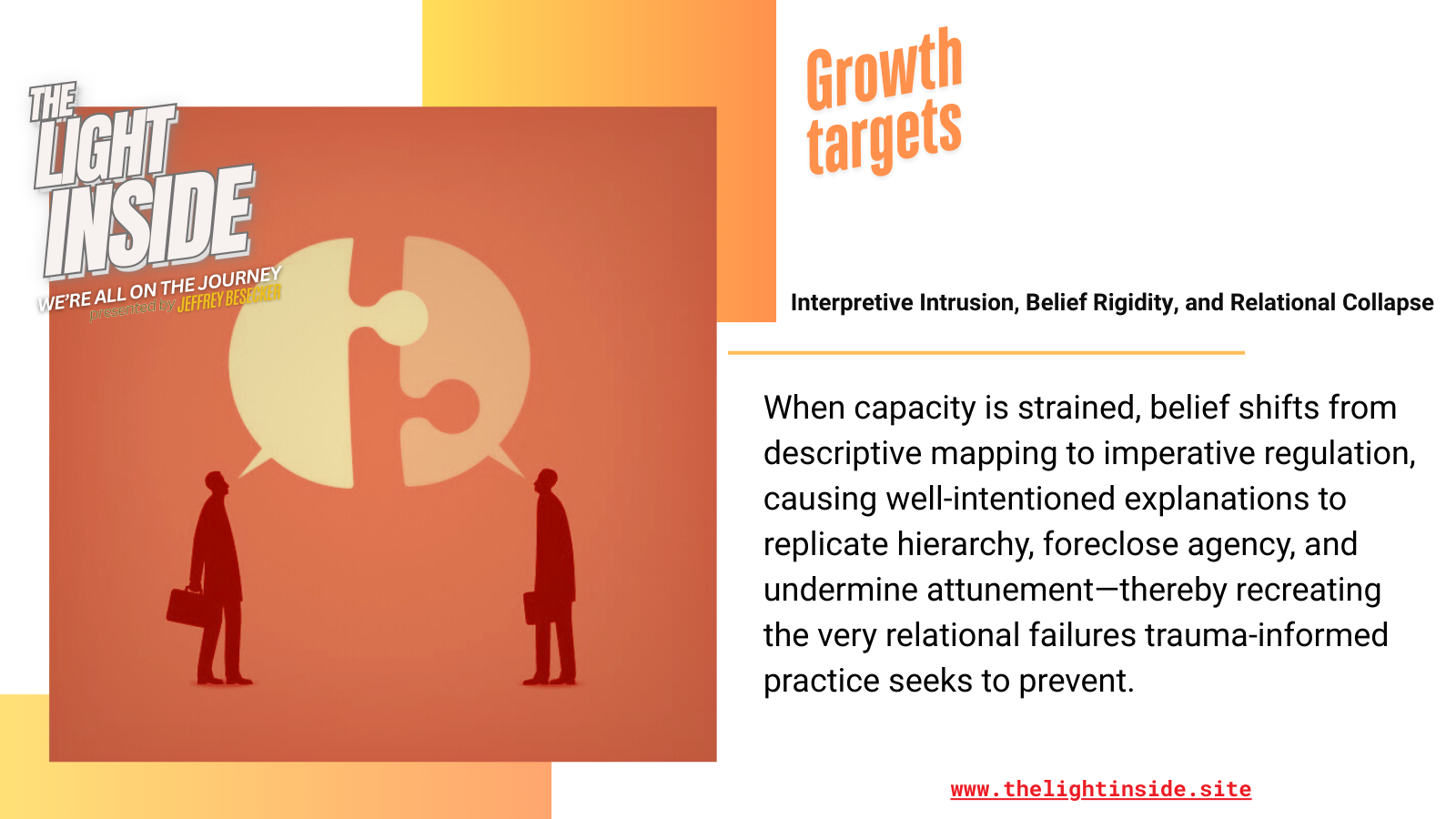
Even the most compassionate explanations can quietly destabilize connection when they arrive as regulation rather than accompaniment.
What changes if we ask not whether an interpretation is accurate or caring, but whether it is emerging from sufficient coherence—or being recruited to manage what the system cannot yet hold?
The core problem is not that clinicians or partners misunderstand experience, but that meaning-making itself becomes a load-management strategy under pressure.
When capacity is strained, belief shifts from descriptive mapping to imperative regulation, causing well-intentioned explanations to replicate hierarchy, foreclose agency, and undermine attunement—thereby recreating the very relational failures trauma-informed practice seeks to prevent.
Expanded Research Question (Inferred)
While this overview explicitly asks how interpretive intrusion and belief-form shifts erode attunement under load, it implicitly investigates a deeper problem:
Why do well-intentioned meaning-making practices—especially in trauma-informed and therapeutic contexts—so often reproduce the very relational and regulatory failures they aim to resolve?
Why Meaning-Making Fails When It Becomes Regulation
Interpretive intrusion: is best understood not as a communication mistake or an epistemic error, but as a state-dependent regulation strategy recruited when load exceeds adaptive capacity.
Under these conditions, belief shifts from declarative (mapping and tracking experience) to imperative (commanding experience), and relational hierarchy begins to function as a regulatory variable that compresses interpretive space.
This reframes interpretive intrusion not as a communication error, but as a predictable regulatory outcome when belief is recruited to manage coherence rather than accompany experience.
The resulting “clarity” may reduce ambiguity quickly, but it does so by constricting agency, diminishing epistemic trust, and increasing rupture risk. Relational repair, therefore, depends less on improving interpretation and more on restoring coherence—sufficient physiological and relational bandwidth for beliefs to return to their proper role as provisional tools rather than governing mechanisms.
Interpretive intrusion as regulation, not miscommunication
Interpretive intrusion is often framed as an interpersonal excess: too much analysis, too soon; certainty delivered without tact; insight offered without attunement.
These descriptions are accurate but incomplete. They treat intrusion as a stylistic problem rather than a functional one. The more analytically coherent claim is that interpretive intrusion occurs when explanation is conscripted to stabilize the system. It is a compensatory response to ambiguity, affective intensity, or relational uncertainty—an attempt to resolve what cannot yet be integrated.
This reframing yields a sharper distinction:
-Intrusion is rarely explained by “bad interpretation.”
-Intrusion is more reliably explained by belief used to regulate load.
-When capacity is limited, the system does not primarily optimize for truth; it optimizes for closure.
-Meaning becomes a mechanism for rapidly narrowing variance.
Competing signals are compressed into a single story, not necessarily because that story is more accurate, but because it is more stabilizing. In this sense, intrusion is often adaptive in the moment—yet structurally costly, because it substitutes resolution for metabolization.
Belief as a relational instrument: mapping versus commanding
A second argument follows directly: belief is not neutral content.
Belief is a relational instrument that organizes power, pace, agency, and permissible uncertainty.
The declarative–imperative distinction is therefore not semantic; it describes two different regulatory functions.
Declarative belief: a map
Declarative belief answers: What appears to be true?
It tends to preserve:
- provisionality and revision
- dialogue and shared inquiry
- interpretive space that can hold ambiguity
Held flexibly, declarative belief supports integration because it orients without compelling. It describes patterns while leaving authorship with the person encountering them.
Imperative belief: a command
Imperative belief answers: What must happen now?
It tends to mobilize:
- urgency and threat reduction
- action-forcing logic
- relational compression (less room to disagree, pause, or revise)
Imperative belief is not inherently maladaptive. In states of threat or dependency it can preserve coherence and attachment.
The risk: emerges when imperative functioning becomes unconscious default—when command logic is mistaken for truth logic, and urgency is misrecognized as insight.
1. Declarative Belief
“This is how reality works.”
Core Structure
Declarative beliefs are descriptive claims about the world, the self, or human nature. They function as maps—attempts to name patterns, causes, or regularities.
- Cognitive role: Meaning-making, prediction, coherence
- Neural bias: Left-hemisphere language networks; semantic memory
- Developmental origin: Later childhood → adolescence, as abstraction develops
- Attachment function: Often stabilizing; reduces uncertainty through explanation
Examples
- “Early childhood shapes adult attachment.”
- “Beliefs influence behavior.”
- “Trauma affects the nervous system.”
Strengths
- Supports learning, integration, and shared understanding
- Allows revision with new data (when held flexibly)
- Facilitates dialogue and collaboration
Risks (when rigid)
- Epistemic flattening: Treating probabilistic models as universal truths
- Introspection illusion: Confusing explanation with transformation
- Relational distance: Talking about experience instead of with it
Declarative belief answers: “What is true?”
2. Imperative Belief
“This must happen / You must change this.”
Core Structure
Imperative beliefs carry felt necessity. They are not merely descriptions but commands—often implicit—that organize behavior, emotion, and identity.
- Cognitive role: Action-forcing, threat reduction
- Neural bias: Limbic and salience networks; autonomic regulation
- Developmental origin: Early childhood, under conditions of dependency and threat
- Attachment function: Load adaptation; preserves connection or containment
Examples:
- “I must fix this now.”
- “If this doesn’t change, something is wrong with me.”
- “Uncertainty is dangerous.”
Strengths:
- Mobilizes action under threat
- Maintains coherence in unstable environments
- Preserves attachment when choice is limited
Risks (when unconscious)
- Compulsion disguised as insight
- Over-certainty and urgency
- Relational coercion: Others feel pushed, corrected, or collapsed into solutions
Imperative belief answers: “What must be done to survive?”

4. Why This Distinction Matters Clinically & Relationally
A belief can sound declarative while functioning imperatively
Example:
“Beliefs formed before age seven determine your life.”
- Declarative form → statement of fact
- Imperative function → You must change this now or remain constrained
This is where rupture often occurs:
- The speaker feels helpful and certain
- The listener feels reduced, pressured, or unseen
Trauma-informed practice hinges on detecting when explanation becomes enforcement.
5. Healthy Integration
Adaptive systems allow declarative beliefs to inform without commanding, and imperative beliefs to soften once capacity increases.
Markers of integration:
- Curiosity replaces urgency
- Meaning follows sensation, not the reverse
- Beliefs remain tools, not identities
In short:
- Declarative belief maps the terrain
- Imperative belief moves the body
- Healing requires knowing which one is speaking—and why
Declarative form, imperative function: the rupture mechanism
The most clinically consequential dynamic is not the presence of imperative beliefs, but their camouflage: declarative language carrying imperative force.
A statement can look descriptive while operating coercively by foreclosing alternative meanings and pressuring action.
“Beliefs formed before age seven determine your life.”
This may sound like a factual claim, yet it often functions as an injunction:
“This explains you.”
“This is the cause.”
“You must fix it now.”
The predictable outcome is asymmetrical experience: the speaker feels helpful and organized; the receiver feels reduced, pressured, or managed. The rupture does not require hostility. It only requires that certainty arrives faster than capacity.
Hierarchy as a regulatory variable: who knows, who sets the pace
A third claim strengthens the model’s explanatory power: hierarchy is not merely an interpersonal style; it is a state-shaping condition. “Who knows” and “who explains” modifies nervous-system response and governs whether meaning is metabolized as collaboration or received as control.
Hierarchy compresses interpretive space through three interlocking mechanisms:
Agency contraction
When one person occupies the “knower” position, the other’s authorship narrows. This can be subtle: even benevolent certainty can reduce the receiver’s felt freedom to disagree, pause, or reframe.
Attunement bypass
Hierarchical certainty tends to displace state-tracking. The receiver’s timing, readiness, and internal differentiation are subordinated to the speaker’s coherence narrative.
Epistemic threat activation
For many trauma-shaped systems, authority and certainty are historically paired with misattunement, coercion, or exposure without protection. The body responds to relational position before cognition evaluates accuracy.
This clarifies an important boundary condition: hierarchy becomes most destabilizing when it couples with imperative belief under low capacity. The issue is not hierarchy in the abstract; it is hierarchy + closure pressure + urgency, which transforms meaning into regulation.
Why interpretive intrusion “works” and still harms
The model is strongest when it explains the paradox clinicians routinely observe: interpretations can be accurate and still rupture connection. That paradox dissolves once we treat intrusion as a high-efficiency strategy for uncertainty management rather than as an informational defect.
Interpretive intrusion is “efficient” because it:
- narrows option-space rapidly
- reduces ambiguity without requiring differentiation
- produces immediate coherence sensations (a felt “click”)
But it is relationally expensive because it:
- overrides consent and pacing
- compresses curiosity
- increases defensive coping (withdrawal, appeasement, confrontation)
- degrades epistemic trust
Accuracy does not guarantee metabolizability. Meaning is not integrated because it is correct; it is integrated because the system has sufficient coherence to hold it without bracing. Where coherence is insufficient, even accurate meaning functions like pressure.
Tracking without coherence: when awareness becomes surveillance
The tracking framework implies a further analytic claim: awareness is not inherently therapeutic.
Without coherence, awareness becomes load. This is a predictable failure mode in trauma work: increased attention to sensation or emotion intensifies distress because the system lacks discrimination bandwidth.
Under low capacity, tracking can collapse into:
- self-monitoring and performance
- rumination and certainty-seeking
- urgency-driven meaning-making
- shame-based evaluation (“What’s wrong with me?”)
In that state, interpretation tends to rush in as relief—an attempt to stabilize ambiguity by assigning meaning. The ethical and clinical responsibility is therefore not merely to invite tracking, but to monitor whether tracking is increasing or decreasing load. Tracking becomes therapeutic only when nested inside coherence; otherwise it becomes surveillance.
Stage mismatch and the mislabeling of “resistance”
The Rogerian overlay sharpens the model’s clinical relevance: many ruptures attributed to resistance are better explained as access-window violations. Pressuring meaning at early stages (defensive organization, externalized narrative, conceptual self-reference) demands capacities associated with later stages (felt contact, ambiguity tolerance, reciprocal collaboration).
When systems are asked to metabolize what they cannot yet hold, protective responses follow: bracing, withdrawal, appeasement, or confrontation.
Reframing “resistance” as coherence protection changes the clinical task. Instead of arguing with content, the therapist restores capacity: pacing, consent, differentiation, and relational anchoring.
Empirical commitments: what should be observable if the thesis holds
A thesis-level argument must imply empirical consequences. If interpretive intrusion is a regulation strategy rather than a knowledge error, the following should be observable across contexts:
- Alliance rupture should correlate more strongly with certainty density than with interpretive accuracy.
- “Rightness” will not protect against rupture when delivery carries imperative force and compresses agency.
- Repair should occur faster when pacing mismatches are named than when interpretations are defended.
- Defense escalates hierarchy and closure; naming timing restores mutual influence.
- So-called resistant clients should show improved engagement when belief authority softens before content changes.
- If the threat is epistemic dominance, restoring authorship should reopen epistemic trust.
These are not rhetorical flourishes; they are the model’s accountability conditions.
Addressing objections without weakening the argument
A polished thesis anticipates objections without conceding its core mechanism.
“Isn’t this anti-interpretation?”
No. The argument targets interpretation as regulation, not interpretation as clinical craft. Interpretation is clinically productive when it follows coherence restoration and is offered with consent and provisionality.
“Does this risk relativism or therapeutic drift?”
No. Provisionality is not relativism. It is an epistemic stance suited to complex systems. The model preserves rigor by sequencing: stabilization enables mapping; mapping becomes collaborative when agency is intact.
“Some clients need directiveness.”
Agreed. The framework explains why directiveness can be containing when it is consented to and capacity-matched. The destabilizer is not direction; it is imperative belief delivered without attunement, pacing, and choice.
Conclusion: coherence first, meaning second
Interpretive intrusion becomes intelligible once we treat it as a coherence-management strategy. When load exceeds adaptive capacity, belief shifts from mapping to commanding; hierarchy organizes interaction; certainty replaces contact.
Relational collapse follows not because meaning is offered, but because meaning arrives before the relationship can metabolize it.
Repair is therefore not the triumph of better explanation.
It is the restoration of enough coherence—physiological and relational—that beliefs no longer have to govern the exchange. When coherence returns, beliefs soften naturally into provisional tools, curiosity becomes available again, and meaning can emerge with the relationship rather than being imposed upon it.
The guiding principle is straightforward:
- Do not race coherence with meaning.
- Restore coherence, and meaning becomes usable.
When coherence is given time to return, meaning no longer has to manage the moment—it can arise as something shared rather than imposed.
Coachable inquiry:
If we pause the analysis and attend to your present state, what subtle shift—of breath, tension, or tone—signals where your system is leaning right now?
Call to action
Set the explanation down briefly and stay with what’s here.
- notice your breath, your posture, or any areas of tension or ease.
Without explaining or fixing, allow whatever quiet impulses, wants, or hesitations are present to be felt and acknowledged—and see what they might be inviting you to gently name, or simply remain with, in this moment.
Resources:
I. Coherence, Load, Capacity, and Nervous-System Regulation
- Porges, S. W. (2011). The Polyvagal Theory: Neurophysiological Foundations of Emotions, Attachment, Communication, and Self-Regulation. Norton. → Establishes state-dependent regulation and why relational cues precede cognitive appraisal.
- Schore, A. N. (2012). The Science of the Art of Psychotherapy. Norton. → Links affect regulation, right-hemisphere dominance, and relational attunement under stress.
- Siegel, D. J. (2012). The Developing Mind (2nd ed.). Guilford Press. → Defines integration vs. rigidity; coherence as alignment across neural systems.
- McEwen, B. S., & Wingfield, J. C. (2003). The concept of allostasis in biology and biomedicine. Hormones and Behavior, 43(1), 2–15. → Empirical basis for load, capacity depletion, and adaptive collapse.
II. Predictive Processing, Uncertainty, and Closure Under Load
- Friston, K. (2010). The free-energy principle: A unified brain theory? Nature Reviews Neuroscience, 11, 127–138. → Explains why systems collapse interpretation under uncertainty.
- Barrett, L. F. (2017). How Emotions Are Made. Houghton Mifflin Harcourt. → Emotion and meaning as constructed under predictive constraints.
- Kruglanski, A. W. (2004). The psychology of closed mindedness. Psychology Press. → Need for cognitive closure as a driver of certainty and rigidity.
- Kahneman, D. (2011). Thinking, Fast and Slow. Farrar, Straus and Giroux. → Fast cognition as ambiguity-reducing, not truth-optimizing.
III. Belief, Introspection Illusion, and Epistemic Flattening
- Nisbett, R. E., & Wilson, T. D. (1977). Telling more than we can know. Psychological Review, 84(3), 231–259. → Empirical foundation for the introspection illusion.
- Dennett, D. C. (1987). The Intentional Stance. MIT Press. → How “as-if” explanations harden into perceived mechanisms.
- Haidt, J. (2001). The emotional dog and its rational tail. Psychological Review, 108(4), 814–834. → Post-hoc meaning-making masquerading as causal insight.
IV. Attachment, Hierarchy, and Epistemic Trust
- Bowlby, J. (1988). A Secure Base. Routledge. → Attachment as a regulator of exploration vs. threat response.
- Mikulincer, M., & Shaver, P. R. (2016). Attachment in Adulthood (2nd ed.). Guilford Press. → Attachment threat, authority, and defensive meaning-making.
- Fonagy, P., et al. (2015). Affect regulation, mentalization, and the development of the self. Routledge. → Epistemic trust and the relational conditions for learning.
- Safran, J. D., & Muran, J. C. (2000). Negotiating the Therapeutic Alliance. Guilford Press. → Rupture/repair dynamics and the cost of hierarchical certainty.
V. Rogers, Process, and Stage-Dependent Capacity
- Rogers, C. R. (1957). The necessary and sufficient conditions of therapeutic personality change. Journal of Consulting Psychology, 21(2), 95–103. → Attunement as the primary catalyst of change.
- Rogers, C. R. (1961). On Becoming a Person. Houghton Mifflin. → Process orientation over insight delivery.
- Cain, D. J. (2010). Person-Centered Psychotherapies. APA. → Stage-sensitive responsiveness and timing of interpretation.
VI. Tracking, Interoception, and Degree of Access
- Craig, A. D. (2009). How do you feel—now? Nature Reviews Neuroscience, 10, 59–70. → Interoception as layered, state-dependent signal processing.
- Mehling, W. E., et al. (2012). The Multidimensional Assessment of Interoceptive Awareness (MAIA). PLOS ONE. → Differentiation vs. overwhelm in bodily awareness.
- Ogden, P., Minton, K., & Pain, C. (2006). Trauma and the Body. Norton. → Tracking without titration as destabilizing.
- van der Kolk, B. (2014). The Body Keeps the Score. Viking. → Why awareness without capacity amplifies distress.
VII. Hierarchy, Power, and Relational Compression
- Foucault, M. (1980). Power/Knowledge. Pantheon. → Knowledge as a relational force, not neutral content.
- Miller, J.-B., & Stiver, I. P. (1997). The Healing Connection. Beacon Press. → Mutuality vs. dominance in relational repair.
- Brown, L. S. (2018). Feminist Therapy (2nd ed.). APA. → Power asymmetry and epistemic authority in clinical settings.
VIII. Systems, Recursion, and Self-Maintaining Patterns
- Bateson, G. (1972). Steps to an Ecology of Mind. Chandler. → Recursive loops and double binds in human systems.
- Schore, A. N. (2003). Affect Dysregulation and Disorders of the Self. Norton. → Developmental trauma as self-reinforcing regulation loops.
- Main, M., & Solomon, J. (1990). Procedures for identifying disorganized attachment. → Collapse of strategy under relational threat.
IX. Integrative & Clinical Synthesis (Directly Supporting the Blog’s Thesis)
- Siegel, D. J. (2020). Aware. TarcherPerigee. → Coherence as the condition for insight.
- Linehan, M. (2014). DBT Skills Training Manual (2nd ed.). Guilford Press. → Sequencing regulation before meaning.
- Norcross, J. C., & Lambert, M. J. (2019). Psychotherapy relationships that work. Oxford University Press. → Alliance over technique; timing over interpretation.
Bottom-Line Bibliographic Synthesis
Across neuroscience, attachment theory, predictive processing, and psychotherapy research, a consistent pattern emerges: when load exceeds capacity, systems recruit certainty to stabilize coherence. In relational contexts, that certainty often arrives as belief, explanation, or insight—producing interpretive intrusion not because the meaning is wrong, but because it is mis-timed.
This literature collectively supports the blog’s core claim: Coherence is the condition for meaning; belief becomes therapeutic only when it no longer has to regulate the interaction.

Behavior Counselor/Executive Producer/Host
Jeffrey Besecker is a dynamic and multifaceted content creator, podcast host, and behavioral therapist who is deeply dedicated to unraveling the complexities of human psychology, particularly focusing on subconscious and unconscious patterns that shape human behavior and influence decision-making.
His career path has traversed a variety of fields, including brand development, hospitality management, and the restaurant industry, each contributing to his holistic understanding of human dynamics and behavior.
Jeffrey specializes in addressing the unresolved psychological material that influences human responses and personal growth, with a mission to illuminate the unseen forces shaping behavior.
Jeffrey Besecker, as a Trauma-Informed Behavioral Practitioner, has a distinct approach to subconscious and unconscious patterns compared to the traditional approach and practices of his cognitive contemporaries when addressing these deeper-rooted patterns.
* His focus goes beyond addressing automatic behaviors or cognitive patterns by looking at the intricate psychological and emotional undercurrents that drive them.
This approach incorporates both primary subconscious patterns (root beliefs, emotional memories) and secondary behaviors (habitual responses and conditioned reactions) to examine how they impact behavior at a deeper level.
Holistic Integration: Unlike some methods that focus specifically on habit formation or self-talk, Jeffrey’s work combines aspects of neurobiology, psychology, somatic integration, and Jungian concept…Read More

Social Imperatives: How Cultural “Rules” Quietly Push Us into Distance or Mutuality