Redefining Diagnosis: How Dissonance and Reduced Regulatory Capacity Transform Feedback into Threat
What if our aversion to diagnosis is not a fear of insight, but a protective reflex—revealing how the nervous system trades complexity for coherence when contact with ourselves begins to feel too destabilizing to hold?
In moments of strain, the organism does not ask, “What is most accurate?” It asks, “What will stabilize me now?” This distinction is not philosophical; it is biological. Under threat, ambiguity becomes metabolically expensive. The psyche seeks rapid coherence. Labels, judgments, and categorical explanations become scaffolding for a system struggling to remain intact.
Yet diagnosis, etymologically, means discernment—from the Greek diágnōsis, “to know apart.” Its original function is orienting, not condemning. It is meant to clarify, not to collapse. The tragedy is that when regulatory capacity is reduced, diagnostic language no longer serves attunement. It becomes a coherence-preserving defense.
This essay advances a central claim:
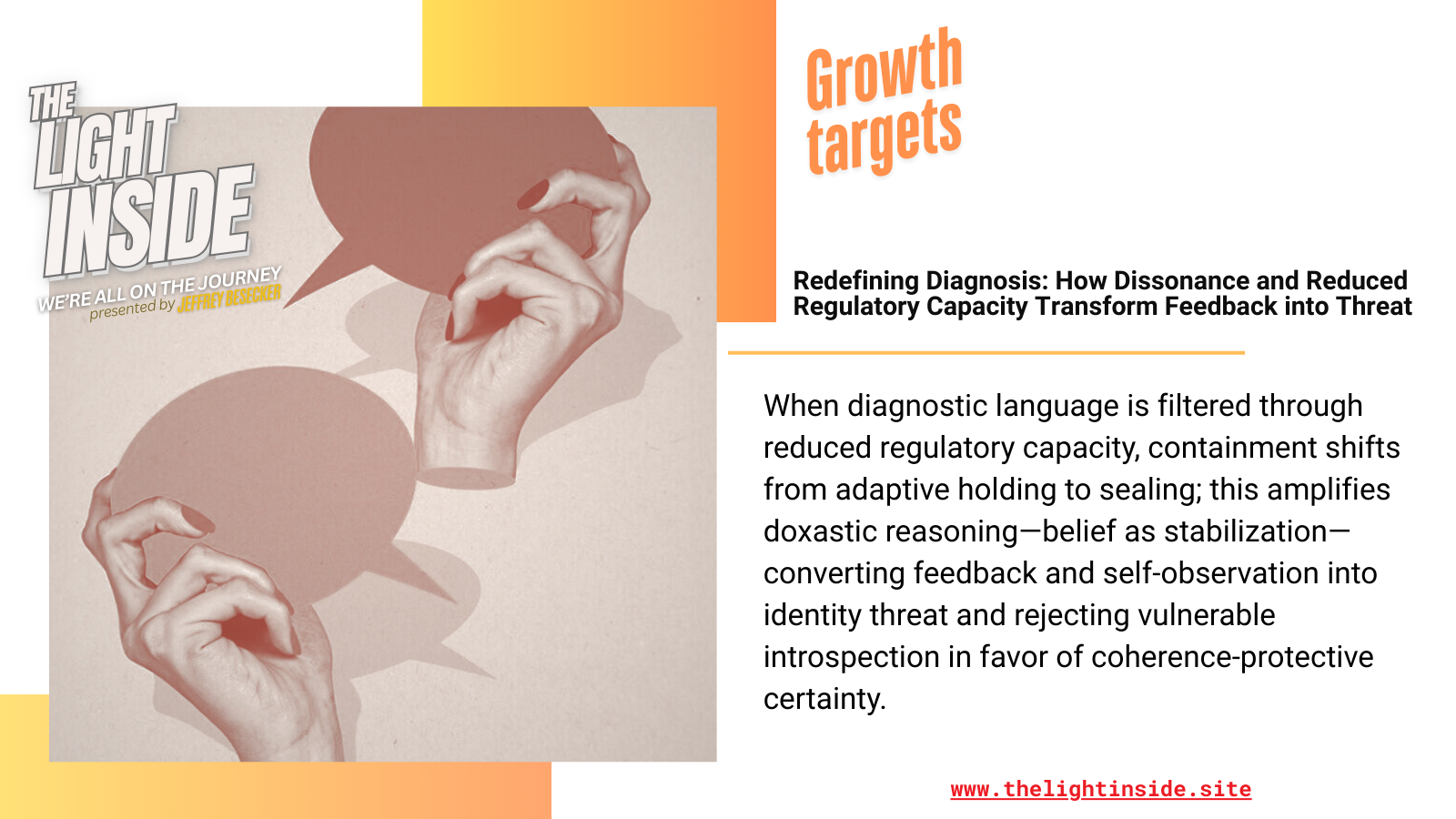
When diagnostic language is filtered through reduced regulatory capacity, containment shifts from adaptive holding to sealing; this amplifies doxastic reasoning—belief as stabilization—converting feedback and self-observation into identity threat and rejecting vulnerable introspection in favor of coherence-protective certainty.
What we often call “resistance” is not opposition to truth. It is the organism protecting itself from identity fracture.
Dissonance Under Load: Why the Mind Trades Accuracy for Stability
Empirical work on cognitive dissonance, threat processing, and motivated reasoning converges on a simple principle: under load, the nervous system prioritizes stabilization over accuracy. As emotional arousal rises, interpretive range narrows. Ambiguity becomes dangerous. Experience is compressed into legible form—traits, labels, verdicts.
A transient state—fear, withdrawal, vigilance—becomes who I am. A moment of overwhelm becomes what’s wrong with me.
This is the pivot from discernment to defense.
Dissonance is not merely cognitive discomfort. It is the felt incompatibility between identity (“who I believe I am”) and experience (“what I did, felt, allowed, or could not prevent”). In morally ambiguous contexts—where right and wrong cannot be cleanly resolved—dissonance becomes chronic. There is no narrative that fully restores coherence.
Under such conditions, the system seeks closure. Heuristics emerge as adaptive defaults: binary moral sorting, scapegoating, just-world reasoning, confirmation filtering.
These are not random errors—They are coherence updates. They reduce arousal by collapsing complexity into certainty. What is stabilized, however, is not truth—it is identity.
Containment: From Adaptive Holding to Sealing and Riddance
At the heart of this process lies containment.
Containment is an early, nervous-system-mediated strategy to preserve coherence under load. When interoceptive ambiguity, emotional dissonance, or relational uncertainty exceed regulatory capacity, the system narrows. Attention constricts. Complexity becomes intolerable.
What begins as protection quietly becomes riddance: the reflex to expel what feels destabilizing rather than metabolize it.
This is where diagnosis subtly shifts from discernment into defense. Under diminished capacity, the psyche seeks rapid coherence. “What is this?” becomes “What’s wrong with me?” or “What’s wrong with them?” Diagnosis is no longer a map—it becomes a discharge valve. Dissonance is converted into identity. Sensation becomes pathology. Ambiguity becomes threat.
Containment no longer holds experience; it seals it.
The system trades permeability for certainty. The self is no longer in relationship with experience; it is positioned against it. Emotions are pushed away. Parts are exiled. States are moralized. Complexity collapses into fixed meaning:
- “This feeling means I am broken.”
- “This pattern defines who I am.”
- “This discomfort must be eliminated.”
A recursive loop emerges:
- Reduced regulatory capacity heightens threat perception.
- Threat narrows interpretive range.
- Narrowing converts experience into diagnostic identity.
- Diagnostic identity reinforces containment.
- Containment amplifies resistance to contact, repair, and integration.
What appears as avoidance, defensiveness, or lack of insight is often the system protecting itself from further destabilization.
Doxastic Reasoning and Parataxic Distortion: The Epistemology of Threat
Under load, cognition reorganizes around survival. Two processes become dominant.
Doxastic reasoning is the movement from experience to belief without sufficient mediation. A transient state—“I feel threatened”—becomes a proposition: “I am unsafe,” “They are dangerous,” “I am broken.” These beliefs are not adopted because they are true, but because they close the loop on uncertainty. They provide epistemic shelter.
Parataxic distortion functions in parallel. It is the nervous system’s tendency to link present cues with unresolved past templates—this feels like then, therefore it is the same. A neutral tone becomes rejection. Feedback becomes indictment. Ambiguity becomes threat.
Together they form an interpretive circuit:
- Arousal arises.
- Parataxis maps the present onto the past.
- Doxastic closure converts resemblance into belief.
- Belief stabilizes the system.
- Stabilization reinforces the pattern as “how things are.”
This is how diagnosis, feedback, and self-observation become adversarial. The organism is no longer discerning what is happening; it is defending who it must be to remain coherent.
What looks like conviction is often containment under strain.
Moral Ambiguity and the Fear of Multiplicity
Moral ambiguity exposes internal multiplicity. It reveals that we are composed of parts—protector, loyalist, dissenter, appeaser, survivor—each shaped by context and history. Dissonance is the felt presence of these parts in conflict.
Heuristics function to stymie that meeting.
Instead of holding, “A part of me acted to belong, another knew this was wrong, another froze,” the system chooses a shortcut:
- “They are evil.”
- “I am broken.”
- “It meant nothing.”
- “That’s just how the world is.”
Each conclusion seals experience into a single narrative channel. From a post-conventional lens, this is not pathology—it is load management.
The task is not to eliminate dissonance or heuristics, but to restore capacity: the ability to remain in relationship with ambiguity without collapsing into verdict.
Toward Post-Conventional Discernment: Restoring Capacity
Research on emotional regulation, reflective functioning, and integrative meaning-making consistently shows that coherence does not emerge from speed, but from holding. When arousal is titrated and relational context is present, dissonance can be metabolized rather than expelled.
Healthy introspection begins with a structural shift:
- From resolution to contact
- From judgment to orientation
- From identity defense to internal dialogue
A capacitated system can ask:
- “What parts of me were active here?”
- “What was each one trying to protect?”
- “What values were in conflict?”
- “What did the system need that it couldn’t access?”
This is not self-indulgence. It is integrative ethics. It allows moral complexity to be held as experience rather than collapsed into self-concept.
In this frame, recursive patterns are no longer enemies. They are signals of unresolved load. Each reactivation becomes an invitation to widen the window of tolerance around contradiction.
Diagnosis regains its original function: orientation rather than verdict.
Traits return to being processes. States return to being signals. Identity becomes dialogical rather than defended.
Counterarguments: Isn’t Diagnosis Necessary for Clarity?
A common concern is that loosening diagnostic certainty risks relativism or paralysis.
Without firm categories, how do we act, treat, or intervene?
The answer is not to abandon diagnosis, but to contextualize it within capacity.
Diagnosis is indispensable in medicine, psychology, and social systems. What this framework challenges is not classification, but premature foreclosure. When labels become identity rather than orientation, they cease to serve adaptation.
Post-conventional discernment does not reject structure; it restores permeability. It allows naming without annihilation, clarity without collapse, accountability without identity erasure.
When Insight Feels Dangerous
How Containment and Doxastic Reasoning Block Vulnerable Introspection
A one-page teaching handout for trainees
Core Premise
When regulatory capacity is low, the nervous system prioritizes stability over accuracy.
In this state, feedback and diagnosis are easily experienced as identity threat rather than orientation. What looks like “resistance” is often a protective coherence strategy.
The Pattern in Motion
Load rises (stress, shame, moral ambiguity, relational threat)
⬇ Capacity drops (less tolerance for ambiguity)
⬇ Containment narrows (protective holding)
⬇ Containment seals (premature closure)
⬇ Doxastic reasoning spikes (“I know what this means”)
⬇ Vulnerable introspection is rejected (contact feels destabilizing)
⬇ Identity rigidity increases (state → trait, process → essence)
Key Concepts
- Containment Adaptive: holds experience so it can be metabolized Maladaptive: seals experience to stop destabilization
- Riddance The reflex to expel destabilizing affect, parts, or meaning (avoid, suppress, moralize, control)
- Doxastic Reasoning Belief formed for stability, not accuracy
“I feel threatened” → “I am unsafe”
“This hurts” → “I am broken”
Vulnerable Introspection
Reflective contact with inner states, parts, and values Requires tolerance for ambiguity and mixed motives
Clinical Markers of “Sealing”
Listen for:
- Absolute language: always / never / just tell me what I am
- Rapid self-labeling: I’m broken / I’m avoidant / I’m too much
- Urgency to conclude
- Shame spikes or collapse
- Defensiveness framed as certainty
- Intellectualization that replaces contact
These are capacity signals, not character flaws.
Therapeutic Stance
- Capacity before content
- Curiosity before conclusion
- Diagnosis as map, not verdict
- Treat certainty as a state, not a truth claim
- Normalize protection before inviting change
Six Coachable Inquiries
- “How activated does this feel in your body right now?”
- “What might this reaction be trying to stabilize?”
- “Could we hold this as a hypothesis instead of a conclusion?”
- “What parts of you are showing up here?”
- “What value or need feels touched?”
- “What would it be like to let this be information, not identity?”
Teaching Takeaway
Vulnerable introspection is not rejected because people fear truth.
It is often rejected because the system is protecting coherence when capacity is low.
Our work is not to dismantle protection—but to restore permeability so that:
- Diagnosis becomes orientation again
- States return to being signals
- Identity becomes dialogical, not defended
- Insight becomes contact, not verdict
Conclusion: From Verdict to Dialogue
Dissonance is not a flaw in cognition. It is a developmental signal. When experience is held rather than sealed, the psyche regains its capacity for reflection, feedback, and adaptive consideration.
Moral ambiguity ceases to be a threat to identity and becomes an invitation to integration.
What heals is not the removal of protective mechanisms, but the expansion of the system’s capacity to hold what they were built to avoid.
In this light, a trigger is not a verdict. It is a message.
Feedback is not an indictment. It is information. Diagnosis is not a sentence. It is a map.
And discernment becomes what it was always meant to be:
a form of contact, a practice of knowing apart, and a doorway back into relationship with ourselves.
When a label or piece of feedback feels destabilizing, what might become possible if you paused to ask—not “What does this say about me?”—but “What is my system trying to stabilize right now, and what would help me stay in relationship with this rather than seal against it?”
Context-Relevant Bibliography
Selected peer-reviewed and scholarly works supporting the core constructs in this thesis: dissonance under load, identity-protective cognition, uncertainty and closure, relational threat, containment, and paratactic distortion.
Dissonance, Identity Threat, & Motivated Reasoning
- Festinger, L. (1957). A Theory of Cognitive Dissonance. Stanford University Press.
- Kunda, Z. (1990). The case for motivated reasoning. Psychological Bulletin, 108(3), 480–498.
- Taber, C. S., & Lodge, M. (2006). Motivated skepticism in the evaluation of political beliefs. American Journal of Political Science, 50(3), 755–769.
- Ditto, P. H., et al. (2019). At least bias is bipartisan: A meta-analytic comparison of partisan bias in liberals and conservatives. Perspectives on Psychological Science, 14(2), 273–291.
- Sherman, D. K., & Cohen, G. L. (2006). The psychology of self-defense: Self-affirmation theory. Advances in Experimental Social Psychology, 38, 183–242.
Uncertainty, Need for Closure, & Heuristic Compression
- Kruglanski, A. W., & Webster, D. M. (1996). Motivated closing of the mind: “Seizing” and “freezing.” Psychological Review, 103(2), 263–283.
- Kruglanski, A. W., et al. (2010). The need for cognitive closure and the freezing of knowledge. Journal of Personality and Social Psychology, 98(3), 356–374.
- Van den Bos, K., et al. (2005). The psychology of uncertainty management. Journal of Personality and Social Psychology, 88(4), 626–641.
- Hogg, M. A. (2007). Uncertainty–identity theory. Advances in Experimental Social Psychology, 39, 69–126.
Threat, Arousal, and Interpretive Narrowing
- Pessoa, L. (2009). How do emotion and motivation direct executive control? Trends in Cognitive Sciences, 13(4), 160–166.
- Arnsten, A. F. T. (2009). Stress signalling pathways that impair prefrontal cortex structure and function. Nature Reviews Neuroscience, 10, 410–422.
- Barrett, L. F. (2017). How Emotions Are Made. Houghton Mifflin Harcourt.
Relational Safety, Attunement, & Reflective Function
- Fonagy, P., & Target, M. (1997). Attachment and reflective function. Development and Psychopathology, 9, 679–700.
- Schore, A. N. (2012). The Science of the Art of Psychotherapy. W. W. Norton.
- Siegel, D. J. (2012). The Developing Mind (2nd ed.). Guilford Press.
- Safran, J. D., & Muran, J. C. (2000). Negotiating the Therapeutic Alliance. Guilford Press.
Containment, Multiplicity, and Integration
- Bion, W. R. (1962). Learning from Experience. Heinemann.
- Bromberg, P. M. (1998). Standing in the Spaces. Analytic Press.
- Schwartz, R. C. (1995). Internal Family Systems Therapy. Guilford Press.
- van der Kolk, B. (2014). The Body Keeps the Score. Viking.
Paratactic Distortion & Interpersonal Templates
- Sullivan, H. S. (1953). The Interpersonal Theory of Psychiatry. W. W. Norton.
- Benjamin, L. S. (1996). Interpersonal Diagnosis and Treatment of Personality Disorders. Guilford Press.
- Downey, G., & Feldman, S. I. (1996). Implications of rejection sensitivity. Journal of Personality and Social Psychology, 70(6), 1327–1343.
Moral Ambiguity, Injury, & Meaning Fracture
- Litz, B. T., et al. (2009). Moral injury and moral repair in war veterans. Clinical Psychology Review, 29(8), 695–706.
- Shay, J. (2014). Moral Injury. Psychoanalytic Psychology, 31(2), 182–191.
- Haidt, J. (2012). The Righteous Mind. Pantheon.
This bibliography situates the essay within four intersecting scholarly domains:
- Dissonance & identity-protective cognition
- Uncertainty, closure, and heuristic compression
- Relational attunement and reflective capacity
- Containment, multiplicity, and interpersonal distortion
Together, these sources empirically and theoretically support the central claim: that under reduced regulatory capacity, the mind trades accuracy for coherence, converts feedback into threat, and replaces vulnerable introspection with stabilizing certainty—unless relational context restores the capacity to hold experience without sealing it.

Behavior Counselor/Executive Producer/Host
Jeffrey Besecker is a dynamic and multifaceted content creator, podcast host, and behavioral therapist who is deeply dedicated to unraveling the complexities of human psychology, particularly focusing on subconscious and unconscious patterns that shape human behavior and influence decision-making.
His career path has traversed a variety of fields, including brand development, hospitality management, and the restaurant industry, each contributing to his holistic understanding of human dynamics and behavior.
Jeffrey specializes in addressing the unresolved psychological material that influences human responses and personal growth, with a mission to illuminate the unseen forces shaping behavior.
Jeffrey Besecker, as a Trauma-Informed Behavioral Practitioner, has a distinct approach to subconscious and unconscious patterns compared to the traditional approach and practices of his cognitive contemporaries when addressing these deeper-rooted patterns.
* His focus goes beyond addressing automatic behaviors or cognitive patterns by looking at the intricate psychological and emotional undercurrents that drive them.
This approach incorporates both primary subconscious patterns (root beliefs, emotional memories) and secondary behaviors (habitual responses and conditioned reactions) to examine how they impact behavior at a deeper level.
Holistic Integration: Unlike some methods that focus specifically on habit formation or self-talk, Jeffrey’s work combines aspects of neurobiology, psychology, somatic integration, and Jungian concept…Read More
Social Imperatives: How Cultural “Rules” Quietly Push Us into Distance or Mutuality