Tending the Relational Field: Clinical Alliance, Contraindications, and the Quiet Drift Toward Coercion
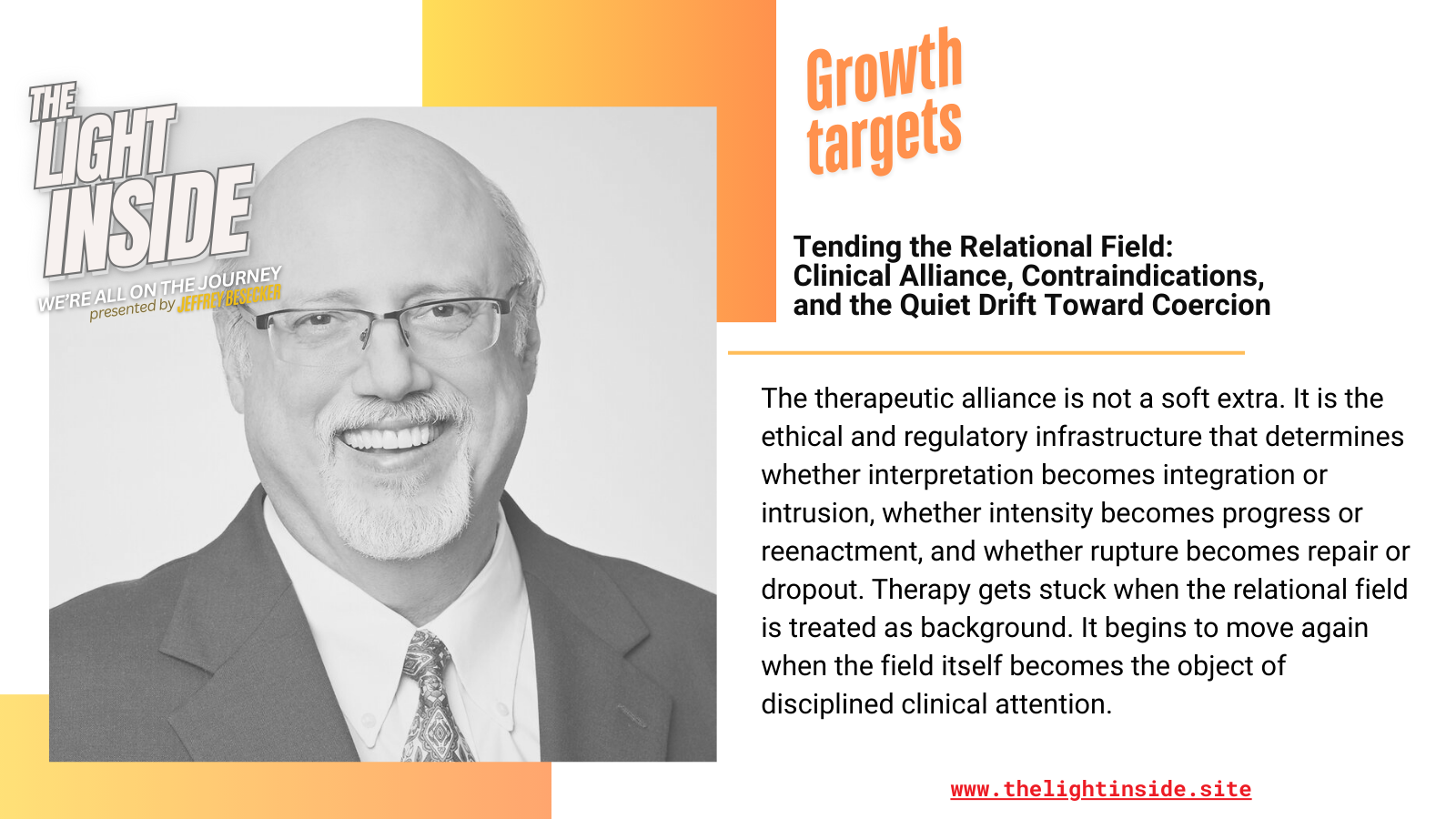
In trauma-informed care, the client alliance is not a secondary aspect of treatment but the living relational structure through which consent, pacing, power, and repair determine whether therapeutic contact becomes integrative or destabilizing.
This week I shared a peer-to-peer conversation with Psychotherapist, and EMDR Clinician, Scott Stolarick, LCPC, CCTP as we engage in this essential discussion exploring several of the key factors that hinder client alliance, and relational attunement—reinforcing the core gaps in therapeutic intervention.
Were we discuss:
- Minding the alliance gap: how holding the relational field, consent, and pacing prevent rupture, reduce interpretive intrusion, and strengthen therapy outcomes.
What happens to treatment outcomes when moments of rupture, misattunement, or uneven power are not tracked as relational data, but instead absorbed as client noncompliance, confusion, or withdrawal?
Therapy does not usually stall because a single intervention failed, a single insight did not land, or a single client “resisted.” It stalls more often because the relational field has been misread. The central clinical error is not only technical but interpretive: clinicians infer collaboration from compliance, mistake surface calm for capacity, or deliver meaning faster than the dyad can metabolize it. When that happens, therapy drifts from collaborative inquiry toward subtle management. MetaTherapy’s public framing is useful because it names stuckness as a process problem rather than as evidence of client deficiency, emphasizing that therapy becomes more useful when people understand how it works and how to make sessions count. (PubMed)
The stronger thesis, however, is more demanding: therapy becomes unusable when the alliance is treated as background rather than infrastructure.
The alliance is not a soft relational extra layered on top of technique; it is the condition that determines whether technique can function at all. Flückiger and colleagues’ 2018 meta-analysis, covering 295 independent studies and more than 30,000 patients, found a consistent association between alliance and psychotherapy outcome across both face-to-face and internet-based treatment. That finding does not merely show that relationship matters in a general sense. It shows that outcome is inseparable from the relational conditions under which intervention is delivered. (PubMed)
This week’s episode of The Light Inside extends the blog’s central claim by showing that strong client alliances are not built through clinical certainty alone, but through responsive attunement to consent, pacing, rupture, and repair.
Let’s be transparent—and vulnerable: Alliance is not rapport; it is a strain-bearing process
A persistent conceptual weakness in clinical discourse is the reduction of alliance to warmth, trust, or mutual liking. That account is too thin to explain either therapeutic success or therapeutic failure. Alliance is better understood as the negotiated capacity of clinician and client to coordinate goals, tasks, and bond under strain. Its real test is not whether therapy feels smooth, but whether the relationship remains workable when confusion, shame, disagreement, disappointment, or threat enters the room.
This offers an important clue as to why therapeutic work can sometimes struggle to support the reintegration of unresolved biopsychological material, limiting the deeper integrative process many people associate with healing.
This is precisely where rupture-repair findings sharpen the argument. Eubanks, Muran, and Safran define rupture as a deterioration in the alliance marked by disagreement on goals, lack of collaboration on tasks, or strain in the emotional bond, and their meta-analysis found that rupture resolution was positively associated with treatment outcome. (PubMed) The implication is clinically significant: therapeutic success depends less on avoiding strain than on whether strain remains repairable. Once that is understood, a “good session” can no longer be defined by calmness alone. Calm may reflect collaboration, but it may also reflect appeasement, deference, or quiet withdrawal.
That distinction matters because many clinical failures are failures of process masquerading as successes of tone. A client may look coherent while internally bracing. A client may sound reflective while dissociating from immediate experience. A client may say, “That makes sense,” while the alliance is already thinning. The appearance of order is not evidence of mutuality; often it is evidence that the client has shifted from participation to management.
The real clinical problem is not interpretation, but premature certainty
Most therapy models rely on interpretation in some form, so the relevant question is not whether interpretation is inherently good or bad. The more clinically useful question is when interpretation becomes coercive. Interpretive intrusion is not merely a stylistic error or an issue of poor bedside manner. It is a process failure in which explanatory meaning arrives before enough shared observation, consent, or regulation has been established to hold it.
That is why the central problem is not interpretation itself, but premature certainty. When the therapist’s explanation begins organizing the encounter faster than the client’s experience can be contacted, the client is no longer using the relationship to explore meaning. The client is adapting to the therapist’s frame. Therapy then shifts from co-constructed inquiry to subtle compliance training.
The literature does not always name this directly as coercive control, but the pattern is recognizable. Coercion in therapy is often quiet rather than dramatic. It appears when vulnerability is welcomed only if it is narratable, when anger is acceptable only if it is reflective, when dissent is tolerated only if it does not strain the therapist’s coherence, and when readiness is inferred from presentation rather than collaboratively assessed. These are not neutral habits. They are mechanisms by which access to legitimacy becomes conditional.
Contraindications do not belong only to diagnoses; they belong to field conditions
Clinical training often treats contraindications as properties of diagnoses, protocols, or symptom clusters. That approach remains necessary, but it is incomplete. A more defensible argument is that contraindications are also relational. An intervention may be broadly evidence-based and still be poorly indicated in a particular field state.
Detailed trauma narration, for example, is not only poorly indicated when a diagnosis suggests risk; it may also be poorly indicated when the client is losing present orientation. Interpretation is not only poorly timed when the model is wrong; it may be poorly timed when shame, collapse, or deference is organizing the room.
For example: Couples work is not only risky because of conflict severity; it may be unsafe when coercive control remains active and disclosure itself escalates danger. Once contraindications are understood this way, clinical precision shifts. The question becomes not simply, “Is this intervention supported?” but, “Can this relationship hold what this intervention will evoke?”
That is a different standard. It requires clinicians to track load, consent, shame, pacing, and signal degradation in the dyad, rather than relying on protocol adherence alone.
The most common therapeutic failures are process errors, not knowledge deficits
Several recurring breakdowns are routinely described as isolated technical mistakes. They are better understood as field failures.
Overtitration and undertitration are not merely dosage errors; they are failures to calibrate intervention to capacity. Pacing and sequencing errors are not minor stylistic issues; they determine whether therapy becomes coping-only, insight-only, or genuinely integrative. Relational field blindness is not simple inattentiveness; it is the inability to notice when the dyad has shifted from collaboration to management. Rupture avoidance is not merely discomfort with conflict; it is a failure to recognize that unspoken micro-misses are outcome-relevant because rupture resolution itself predicts better outcome. (PubMed)
Epistemic flattening belongs in the same category. When trauma, attachment, cognition, nervous system, or personality is treated as a sufficient explanation rather than as one conditional lens among several, theory begins to replace inquiry. The problem is not having a framework. The problem is allowing the framework to stop revision. Once that happens, the client’s live data must either be forced into the model or quietly dropped from view.
Capacity precedes meaning
This is the strongest practical claim emerging from the literature: capacity precedes meaning—safety narrative occur past ad hoc. Insight is not useless, but it is not primary. It becomes therapeutically useful only when the client can remain in contact with experience without compensating through compliance, self-blame, over-intellectualization, certainty, or withdrawal.
This claim helps reconcile alliance research with public-facing therapy literacy models like those supported at the MetaTherapy podcast. The latter emphasizes making therapy more usable and more actionable, not merely more explanatory. (PubMed) The research deepens that point by showing that movement depends less on better explanation alone and more on whether the client can stay present to what explanation evokes. When capacity is low, meaning-making frequently becomes defensive. It restores coherence, but not integration.
Seen this way, many supposed client barriers are misdescribed. Hesitation is not necessarily resistance. Quietness is not necessarily reflection. Agreement is not necessarily alliance. What appears avoidant may actually be a field-sensitive refusal of an intervention the relationship cannot yet hold.
Humility is not virtue language; it is a clinical method
The cultural humility literature is especially important because it clarifies why therapist stance is not an ornamental ethical feature. Hook and colleagues defined cultural humility as an other-oriented interpersonal stance marked by respect and lack of superiority toward another person’s background and experience. (PubMed) More recent psychotherapy research continues to show that higher client ratings of therapist cultural humility are associated with stronger alliance-related benefits and better functioning, particularly for ethnoracially diverse clients. (PubMed)
The implication is straightforward: humility is not just a moral preference. It is a process variable. It keeps formulations revisable. It slows premature closure. It lowers the chance that the therapist’s need for certainty will organize the encounter. In practical terms, humility means treating observation and inference as different acts. It means asking whether a hypothesis fits rather than installing it as reality. It means preserving the client’s authorship.
That is why humility should be understood less as interpersonal niceness and more as clinical method. It preserves the epistemic openness the alliance requires in order to remain collaborative under strain.
Good intentions are not a sufficient safeguard against harm
A final analytical correction is needed around adverse effects. Psychotherapy is still too often discussed as if harms are rare, peripheral, or mostly the result of egregious misconduct. Recent research argues otherwise. A 2024 study on positive and negative psychotherapy experiences found that negative experiences during treatment were common and associated with poorer outcomes, underscoring the importance of monitoring them during care. (PubMed Central) A 2026 narrative review likewise argues that negative events in psychotherapy remain under-recognized and insufficiently integrated into routine clinical guidance. (PubMed Central)
This matters because it removes a common clinical defense: the assumption that good intent plus model fidelity is enough. It is not. If adverse experiences are common, then process errors cannot be treated as side concerns. They must be treated as central to responsible care. In that sense, restraint is not passivity. It is an active method of protecting the conditions under which therapeutic meaning can become metabolizable rather than coercive.
The stronger thesis
The descriptive version of this discussion says that alliance matters, rupture repair matters, humility matters, and adverse experiences should be monitored. The stronger thesis is more demanding: therapy works when the relational field remains sufficiently collaborative, revisable, and capacity-matched to metabolize intervention under strain. Therapy fails when those same conditions are assumed rather than tracked.
That is why the therapeutic alliance should be treated as the primary infrastructure through which all other interventions must pass. The clinician’s task is not merely to choose a sound method. It is to determine whether the dyad can currently hold what that method will evoke. A clinically cleaner stance therefore tracks capacity before offering meaning, separates observation from interpretation, treats rupture as normal rather than exceptional, and understands contraindications as relational as well as procedural.
MetaTherapy is right that many clients are missing process information rather than effort. (PubMed) But the deeper version of that claim is this: what clients and clinicians are often missing is not merely a better explanation of why therapy feels stuck, but a framework for recognizing when therapy has quietly become misattuned, over-certain, or structurally non-collaborative while still sounding thoughtful and caring.
The therapeutic alliance is not a soft extra. It is the ethical and regulatory infrastructure that determines whether interpretation becomes integration or intrusion, whether intensity becomes progress or reenactment, and whether rupture becomes repair or dropout. Therapy gets stuck when the relational field is treated as background. It begins to move again when the field itself becomes the object of disciplined clinical attention.
“Minding The Gap: Client Alliance and Tending The Relational Field”—Episode 234
In this episode of The Light Inside, Jeffrey Besecker and Scott Stolarick explore why the client alliance remains one of the most consequential dimensions of trauma-informed care. Their conversation examines how power dynamics, consent, pacing, and relational attunement shape whether therapy feels collaborative, workable, and metabolizable under strain. Rather than treating rupture or misattunement as peripheral disruptions, they frame these moments as clinically meaningful signals that call for responsive repair, careful pacing, and renewed mutuality. If you are interested in the real conditions that support effective therapeutic contact—and the subtle ways those conditions can fracture—tune in for a grounded, clinically relevant discussion on why alliance is the ethical and relational foundation of trauma-informed treatment.
Clinically clean supervisory coachable inquiry
When you reflect on your own clinical or relational practice, what cues help you distinguish genuine collaboration from polite compliance, and how do you adjust your pace, language, or repair efforts when the field begins to narrow?
Why it matters
It matters because treatment outcomes are shaped not only by what is said or done, but by whether the relationship can hold consent, strain, and repair without collapsing into certainty, withdrawal, or subtle coercion.
Closing reflection
When we begin to treat alliance not as background rapport but as the active structure through which trust, pacing, and repair are negotiated, we move closer to a model of care where therapeutic contact supports adaptation rather than reenacting the very disruptions it hopes to heal.
Peer-reviewed bibliography listicle
Below is a context-relevant peer-reviewed bibliography listicle you can use to support the blog’s central claims about alliance, rupture/repair, interpretive timing, humility, informed consent, and adverse effects in trauma-informed therapeutic care.
1. Flückiger, C., Del Re, A. C., Wampold, B. E., & Horvath, A. O. (2018). The alliance in adult psychotherapy: A meta-analytic synthesis. Psychotherapy, 55(4), 316–340. This is the core anchor for the blog’s central argument that the therapeutic alliance is not peripheral but one of the strongest pantheoretical predictors of psychotherapy outcome across face-to-face and internet-based modalities. It supports the claim that treatment effectiveness is inseparable from the relational conditions under which interventions are delivered. (PubMed)
2. Eubanks, C. F., Muran, J. C., & Safran, J. D. (2018). Alliance rupture repair: A meta-analysis. Psychotherapy, 55(4), 508–519. This source directly supports the blog’s argument that alliance is a strain-bearing process rather than a static bond. It shows that rupture is not an anomaly but an expected disruption in treatment, and that successful rupture repair is positively associated with better outcomes. It is especially useful for the sections on micro-misses, misattunement, and why calm sessions are not always collaborative sessions. (PubMed)
3. Hook, J. N., Davis, D. E., Owen, J., Worthington, E. L., Jr., & Utsey, S. O. (2013). Cultural humility: Measuring openness to culturally diverse clients. Journal of Counseling Psychology, 60(3), 353–366. This article provides the foundational definition of cultural humility as an other-oriented stance marked by respect and lack of superiority. It supports the blog’s claim that humility is not merely an ethical preference but a clinically relevant stance that protects openness, reduces therapist over-certainty, and helps preserve client authorship. (PubMed)
4. Dixon, K. M., Grzanka, P. R., & Hook, J. N. (2022). Cultural humility, working alliance, and Outcome Rating Scale in psychodynamic psychotherapy. This study strengthens the blog’s argument that humility functions as a process variable, not just a value statement. It links client-perceived therapist cultural humility with working alliance and clinical functioning over the course of treatment, supporting the claim that humility has outcome relevance inside the therapeutic field. (PubMed)
5. Mehra, L. M., et al. (2026). Therapist cultural humility in early psychotherapy. This more recent study adds temporal depth to the humility argument by examining therapist cultural humility early in treatment. It supports the blog’s contention that therapist stance matters from the start, especially when alliance formation, interpretive timing, and client trust are still fragile. (PubMed)
6. Verkooyen, R., et al. (2024). No pain, no gain revisited: The impact of positive and negative psychotherapy experiences on treatment outcome. This study is highly relevant for the blog’s section on harm, misattunement, and why good intentions are not enough. It found that negative psychotherapy experiences during treatment were common and associated with poorer outcomes, supporting the claim that difficult or adverse treatment experiences must be monitored rather than dismissed as incidental. (PubMed Central)
7. Vybíral, Z., Ogles, B. M., Řiháček, T., Urbancová, B., & Gocieková, V. (2024). Negative experiences in psychotherapy from clients’ perspective: A qualitative meta-analysis. Psychotherapy Research, 34(3), 279–292. This qualitative meta-analysis is especially useful for supporting the blog’s argument that harms in therapy are not limited to dramatic misconduct. It synthesizes client-reported negative experiences across studies and helps ground claims about relational hindrance, poor fit, therapist misattunement, and treatment-generated distress. (PubMed)
8. Ram, D. (2026). Negative events in psychotherapy: A narrative review. This review supports the blog’s claim that adverse effects in psychotherapy remain under-recognized and insufficiently integrated into routine clinical guidance. It is useful for concluding sections that argue for more systematic monitoring of relational harm, misattunement, and unintended treatment deterioration. (PubMed Central)
9. Gerke, L., et al. (2022). Optimized informed consent for psychotherapy. This article supports the blog’s broader argument that consent is not a static intake procedure but an ongoing ethical and clinical process. It is especially helpful for claims that truthful informed consent in psychotherapy must include discussion of possible negative effects, uncertainty, and the live conditions under which interventions may or may not be workable. (PubMed Central)
10. Allison, S., et al. (2024). Mostly harmless? Clinical practice guidelines need further development regarding psychotherapy adverse effects. This source reinforces the claim that psychotherapy’s potential harms are often under-measured and insufficiently addressed in guidelines. It supports the blog’s argument that process failures, overtitration, misattunement, and relational coercion should not be treated as fringe concerns but as central to ethical care. (PubMed Central)
11. Saxler, E., et al. (2024). Therapeutic alliance in individual adult psychotherapy. This recent review supports the blog’s use of alliance as a robust pantheoretical construct and helps contextualize why alliance should be treated as infrastructure rather than a secondary variable. It is useful for readers who want a more current overview of how alliance is conceptualized and measured. (PubMed Central)
12. Eubanks, C. F., Muran, J. C., & Safran, J. D. (2017). Clinical consensus strategies to repair ruptures in the therapeutic alliance. This paper is a strong practice-facing companion to the 2018 meta-analysis. It supports the blog’s supervisory emphasis on rupture literacy, repair, and the idea that tension in treatment is not the problem; unrecognized or unrepaired tension is. (PubMed Central)
Reference summary for the end of the blog
Taken together, these studies support a clear conclusion: psychotherapy outcomes are shaped not only by model fidelity or technical intervention, but by the quality, timing, and repair capacity of the relational field itself. Meta-analytic evidence shows that alliance remains one of the strongest predictors of outcome, rupture-repair research demonstrates that strain is expected and repairable rather than exceptional, cultural humility studies show that openness and non-superiority strengthen alliance and client functioning, and newer work on negative psychotherapy experiences makes clear that adverse process events are common enough to require active monitoring. In combination, this literature supports the blog’s central thesis that trauma-informed care works best when clinicians treat alliance as the primary ethical and regulatory infrastructure through which meaning, pacing, consent, and interpretation must pass. (PubMed)

Executive Program Director/Freelancer/Dog Lover
Meet Anna, the whimsical whirlwind of words and wonders! As a twenty-something, she roams the world as a freelance writer, content creator, and managing editor extraordinaire. With her trusty pen in one hand and a steaming cup of coffee in the other, Anna crafts captivating tales that dance off the page and into the hearts of readers.
When she's not conjuring up literary magic, you'll find Anna in her cozy loft kitchen, her sanctuary of sugar and spice. Baking is not just a hobby for her; it's an obsession. From enchanting cupcakes to spellbinding pies, Anna’s kitchen is a portal to a sugary wonderland.
But don't be fooled by her baking adventures alone. Anna is a bibliophile with a penchant for the obscure. She devours novels like a famished bookworm, seeking out hidden gems that transport her to mystical realms and spark her imagination.
Winter holds a special place in Anna’s heart, and she embraces the chilly season with a passion for extreme sports. You'll often find her conquering mountains on her snowboard or trekking 14’ers in the Western Rockies. The exhilarating rush of cold air against her cheeks and the thrill of mastering daring tricks fuel her winter adventures.
But amidst all her pursuits, one thing remains constant—Anna’s boundless love for dogs. She adores these furry companions with all her heart, showering them with endless belly rubs, playful games of fetch, and cozy snuggles by the fireplace. Her four-legged friends bring a smile to her face and a wag to her heart, reminding her to live in the…Read More
Social Imperatives: How Cultural “Rules” Quietly Push Us into Distance or Mutuality