The Body as a Supersystem: How Interacting Subsystems Co-Create Lived Experience
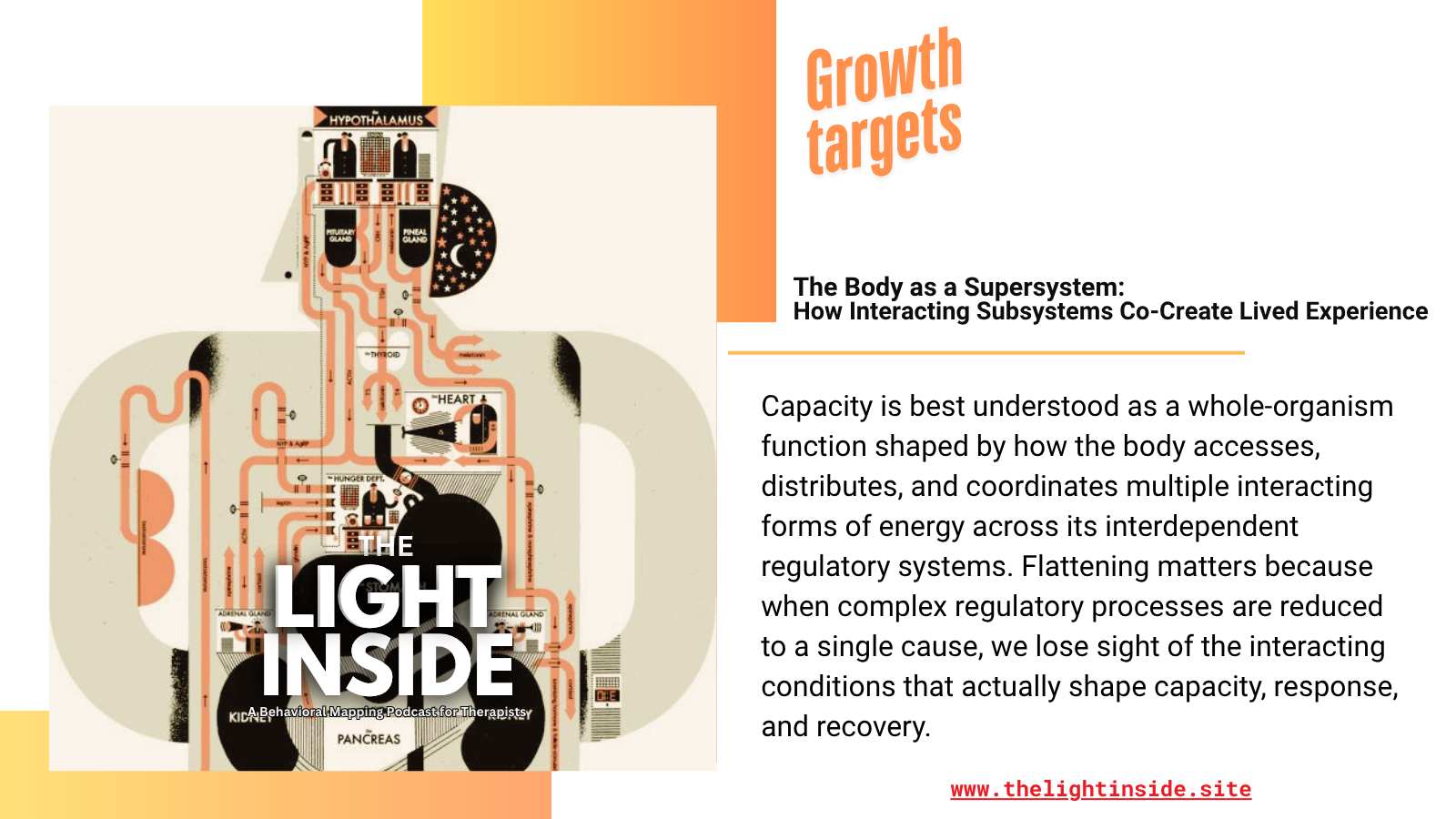
Common pop cultural perspectives often paint our internal systems as a brain vs. body fight for supremacy.
A more clinically accurate view is that our internal systems are not engaged in a brain-versus-body struggle for control, but are continuously working in reciprocal coordination to organize perception, state, and response.
What becomes possible when we stop treating our internal experience like a battle between mind and body, and begin recognizing it as a dynamic whole shaped by interacting systems?
When we move beyond a brain-versus-body framework, a more accurate picture begins to emerge:
The body functions as a supersystem made up of interdependent subsystems that continuously exchange information, update one another, and shape lived experience in real time.
What we feel as tension, urgency, clarity, fatigue, dread, relief, or shutdown is not generated by one isolated mechanism. It is the momentary expression of multiple systems coordinating around prediction, regulation, and adaptation.
The Neural System: The Organizing Hub
The neural system helps integrate sensation, memory, salience, prediction, and action planning across the organism. Rather than merely observing the body, the brain helps organize bodily state and then revises itself based on the signals that return from the body. The central autonomic network literature places cortical, limbic, hypothalamic, and brainstem regions inside this shared regulatory architecture.
Core role: integrates sensory input, memory, prediction, salience, motor planning, and regulation across the organism.
Key feedback loops: cortex ↔ limbic system ↔ hypothalamus ↔ brainstem ↔ body; interoceptive afferents from the body return to update cortical and subcortical appraisal.
Why this matters: What we call a “response” is not happening outside neural dynamics; it is being assembled through them; then revises its own predictions based on the body’s returning signals. The central autonomic network literature places the insula, anterior cingulate, amygdala, hypothalamus, periaqueductal gray, parabrachial complex, nucleus tractus solitarius, and ventrolateral medulla inside this integrated control architecture. (PubMed)
I’m pulling together the main neural circuits and reciprocal loops so this stays grounded in mechanism rather than treating the nervous system like a standalone “body-only” system. Then I’ll map how cortical, limbic, brainstem, autonomic, endocrine, and immune processes continuously co-organize responses.
A central theme is already clear in the academic literature: autonomic responses are not peripheral events happening outside the brain.
They are assembled through reciprocal loops linking appraisal, interoception, prediction, motor output, endocrine signaling, and immune feedback.
The evidence strongly supports treating nervous system responses as brain-body network events, not as a sealed peripheral system operating outside neural dynamics. The most accurate model is a recursive, multi-level control system in which cortical appraisal, limbic salience, hypothalamic coordination, brainstem autonomic patterning, endocrine signaling, immune signaling, and ascending interoceptive feedback continuously shape one another.
That fits closely with our ongoing through line that responses are best understood as cue → appraisal → state shift → behavior → reinforcement, because the “state shift” itself is being assembled through these varying strata of reciprocal loops rather than delivered by a single standalone subsystem. (PubMed)
The Autonomic System: Rapid State Adjustment
The autonomic nervous system rapidly shifts arousal, heart rate, vascular tone, respiration, digestion, and mobilization. These changes are not sealed reflexes. They are shaped by ongoing input from brain networks involved in appraisal, salience, and regulation, and they also send information back that alters attention, feeling, and decision-making.
Core role: rapidly adjusts arousal, cardiovascular tone, respiration, digestion, pupil response, and mobilization or conservation of energy.
Key feedback loops: sympathetic and parasympathetic output ↔ cardiovascular and respiratory state ↔ vagal and baroreceptor afferents ↔ brainstem and cortical autonomic networks.
Why it matters: Arousal is not just a body event; it is part of a larger loop linking physiology, interpretation, and behavior. Autonomic shifts are not isolated “body reactions.” Neuroimaging and neurovisceral integration work show that autonomic flexibility is linked with insula, cingulate, medial prefrontal, amygdala, and related regulatory networks, meaning arousal and regulation are tightly bound to appraisal and executive function. (PubMed)
At the broadest level, the literature describes a central autonomic network linking the insula, anterior cingulate, amygdala, hypothalamus, periaqueductal gray, parabrachial complex, nucleus tractus solitarius, and ventrolateral medulla. This network is not just “about autonomic output”; it integrates visceromotor control, pain, neuroendocrine regulation, behavior, and context-sensitive survival responding. The defining feature is reciprocity: ascending bodily signals influence brain processing, and descending brain signals shape sympathetic, parasympathetic, respiratory, endocrine, and behavioral outputs. (PubMed)
The insula is central because it helps map the internal condition of the body and transform bodily input into subjective feeling, salience, and action relevance. Work on interoception places the posterior insula closer to primary bodily representation and the anterior insula closer to integrated awareness, salience, and coordinated response selection. Studies show insular activity tracks cardiorespiratory arousal, heartbeat processing, and threat anticipation, which is one reason interoceptive disturbance can alter emotional meaning, certainty, and perceived control rather than simply changing “body symptoms.” (PubMed)
The anterior cingulate cortex, especially dorsal and midcingulate regions, works closely with the insula as part of a salience and control interface. It helps allocate attention, organize effort, detect conflict, and couple internal state to action. This is why autonomic arousal is not separate from cognition: cingulate-insula systems help decide whether rising internal activation is treated as danger, demand, motivation, pain, or something to be tolerated and sequenced through. (PubMed)
The amygdala is a major relevance detector, but not a lone “fear center.” It participates in assigning significance to cues and interacts with the prefrontal cortex, hypothalamus, brainstem, and hippocampus to influence autonomic, endocrine, attentional, and mnemonic processes. Meta-analytic and review work ties amygdala-prefrontal relationships to vagally mediated heart rate variability and flexible regulation, showing that what looks like a “body reaction” is often an expression of how cortical-subcortical regulation is or is not holding under uncertainty. (PubMed)
The prefrontal cortex—especially ventromedial, medial, and related regulatory sectors—does not merely “think about” the response after the fact. It helps shape descending control over autonomic and endocrine responding, in part through inhibitory pathways involving the amygdala and downstream medullary systems. When prefrontal regulation is compromised by load, chronic stress, sleep disruption, or overwhelming uncertainty, autonomic responding can become more rigid, threat-biased, or state-bound. (PubMed)
The hippocampus contributes contextual memory and temporal discrimination—helping the system determine whether a cue belongs to present reality, prior learning, or generalized expectancy. Along with medial prefrontal regions, it participates in regulating the HPA axis and in contextualizing amygdala-driven salience. This means nervous system responses are partly memory-shaped predictions: past encoded context helps determine whether the current cue stack is treated as manageable, uncertain, or threatening. (PubMed)
The hypothalamus is one of the major translation hubs between brain interpretation and body-wide response. It helps coordinate autonomic output and endocrine signaling, including the HPA axis. In practical terms, it links salience and appraisal circuits to glucocorticoid release, metabolic shifts, temperature regulation, feeding, reproductive priorities, and circadian organization. It is therefore inaccurate to treat stress responses as “just autonomic”; the hypothalamus makes them neuroendocrine, metabolic, and behavioral at once. (PubMed)
The HPA axis itself is not outside neural dynamics; it is one of their extensions. Stress-related glucocorticoid signaling feeds back into the brain, influencing the hippocampus, amygdala, and prefrontal cortex, which then alters future appraisal, learning, retrieval, vigilance, and regulation. That is one of the clearest examples of a recursive feedback loop: brain networks launch endocrine responses, endocrine signals reshape brain processing, and the altered brain state changes the next response. (PubMed)
We often profess to be ‘reading’ and tracking all of this data—both in ourselves and when observing others—making it readily apparent how easily we tend to falter; over-estimating our ability to accurately forecast or predict the full range and breadth of these interactions.
Interoception: The Body’s Internal Sensing Network
Interoception is the broad signaling architecture through which the organism senses its internal condition. This includes visceral, cardiovascular, respiratory, metabolic, inflammatory, and thermal signals. These signals are used to update prediction, regulate response, and shape what becomes subjectively felt.
Core role: senses and models the internal condition of the organism across visceral, cardiovascular, respiratory, metabolic, immune, and thermal channels.
Key feedback loops: organ state → visceral afferents → brainstem/thalamic/insular processing → predictive updating → regulatory output back to organs.
Why it matters: What we feel internally is not random noise; it is part of how the organism tracks itself and organizes adaptive response. Interoception is the organism’s internal information architecture. It is a major route through which bodily condition becomes feeling, salience, motivation, and adaptive action. Contemporary reviews emphasize that interoception is inseparable from predictive processing and allostatic control. (PMC)
The brainstem is not a passive relay. Structures such as the periaqueductal gray, parabrachial nuclei, nucleus tractus solitarius, and ventrolateral medulla are core patterning centers for cardiovascular, respiratory, nociceptive, orienting, and defensive responses. The NTS is especially important because it receives major visceral afferent input, including vagal information, and participates in sending that information upward while also contributing to descending autonomic coordination. Brainstem-cortical work increasingly shows these nuclei are deeply integrated with higher-order networks rather than isolated “lower centers.” (PubMed)
The vagus nerve is best understood as part of this bidirectional architecture, not as a one-way calming cable. Vagal afferents carry information from organs to the brainstem and onward into larger interoceptive and regulatory networks; vagal efferents influence heart rate, digestion, inflammatory activity, and recovery. This is why markers such as heart rate variability are often interpreted as indirect indices of how well cortical-subcortical regulation is coupling with peripheral physiology. (PubMed)
The Endocrine System: Extending Regulation Across Time
The endocrine system coordinates slower but broader changes through hormones that affect stress response, metabolism, circadian timing, growth, and reproduction. Hormonal output is not separate from neural regulation; it extends it. Those same hormones then feed back into brain networks and alter memory, vigilance, energy use, and future response thresholds.
Core role: coordinates slower but wider-reaching regulation through hormones affecting energy, stress response, metabolism, growth, reproduction, circadian timing, and tissue readiness.
Key feedback loops: hypothalamus ↔ pituitary ↔ peripheral glands ↔ circulating hormones ↔ brain regions such as hippocampus, amygdala, and prefrontal cortex.
Why it matters: The body does not only regulate in the moment; it also changes its operating conditions over time via plasticity and neural imprinting. Endocrine signaling extends neural regulation across time. Hormonal outputs do not sit outside nervous system dynamics; they feed back into brain circuits and alter vigilance, learning, memory, and future stress responsivity as part of an integrated internal regulation system. (PubMed)
The BNST and extended amygdala are especially relevant when the system is dealing with ambiguity, poor predictability, or sustained apprehension rather than a simple immediate threat. Reviews suggest BNST circuitry is heavily connected with amygdala, hypothalamus, and brainstem targets that organize autonomic and behavioral responses. That makes it highly relevant to your repeated emphasis on how uncertainty, anticipatory load, and predictive forecasting can maintain prolonged state shifts even after the original cue is gone. (PubMed)
The locus coeruleus–norepinephrine system and related neuromodulatory systems also matter because they adjust gain, vigilance, attentional selectivity, and readiness across the whole network. In plain terms, they help set how strongly cues are amplified, how much surprise matters, and how narrow or broad the system’s search and response patterns become under stress. Even when not foregrounded in simpler models, these neuromodulators are part of how uncertainty becomes embodied as heightened scanning, urgency, or rigidity. (PubMed)
The Immune System: Protection, Signaling, and Behavioral Influence
The immune system does more than defend against infection or injury. Immune activity affects pain, fatigue, energy allocation, attention, and motivational narrowing, while neural and autonomic pathways also help regulate inflammatory processes. Newer work on immunoception shows that immune-state information can become part of the organism’s broader interoceptive and behavioral organization.
Core role: monitors injury, infection, inflammation, and tissue integrity while influencing energy allocation, sickness behavior, pain sensitivity, and motivational priorities.
Key feedback loops: immune signals ↔ vagal and humoral pathways ↔ brainstem/interoceptive networks ↔ autonomic and endocrine modulation of inflammation.
Why it matters: Inflammation and immune load can shape mood, perception, and behavioral readiness, not just physical symptoms. The immune system is not just a background defense layer. Brain-body physiology and immunoception research show that immune activity can be sensed, represented, and regulated within broader brain-body loops, shaping behavior, mood, attention, and perceived bodily threat. (PMC)
The immune system and nervous system are also in continuous dialogue. The inflammatory reflex literature shows neural pathways can regulate inflammatory activity, and newer work on immunoception argues that brain systems—especially the insula—represent and help organize immune-state information. So sickness behavior, fatigue, pain sensitivity, threat sensitivity, and motivational narrowing are not merely “body states” later interpreted by the brain; they are co-constructed through neuroimmune signaling loops. (PubMed)
The same is true for pain and visceral discomfort. Interoceptive and nociceptive pathways converge with affective and autonomic circuits, which is why pain, air hunger, nausea, temperature changes, gut discomfort, and cardiovascular shifts can rapidly reshape salience, certainty, mood, and action tendency. Craig’s and Critchley’s work is especially helpful here because it shows how visceral representation becomes part of subjective feeling and motivational organization rather than remaining a purely peripheral event. (PubMed)
The Body as a Supersystem: Major Subsystems and Their Key Feedback Loops
A useful way to organize the major feedback loops is this:
- Cue detection loop: sensory and contextual cues are evaluated through amygdala, insula, cingulate, hippocampal, and prefrontal systems. (PubMed)
- Visceromotor output loop: hypothalamic and brainstem nuclei shape sympathetic, parasympathetic, respiratory, endocrine, and behavioral responses. (PubMed)
- Interoceptive return loop: bodily changes feed back through visceral afferents, vagal pathways, NTS, thalamic and insular processing, updating the brain’s model of the body. (PubMed)
- Appraisal revision loop: prefrontal, hippocampal, and cingulate systems reinterpret whether the state means danger, demand, grief, effort, safety, shame, or opportunity. (PubMed)
- Reinforcement/plasticity loop: repeated coupling among cue, appraisal, endocrine load, autonomic patterning, and behavior alters future thresholds and response probabilities. (PubMed)
So the major correction to the “sealed system” error is this: the nervous system is not an isolated stress-response machine sitting outside neural meaning-making.
Neural dynamics are intrinsic to it. Autonomic shifts are assembled within distributed brain networks; bodily changes then feed back to alter perception, emotion, and decision-making; endocrine and immune outputs recursively modify those same networks; and repeated use changes the thresholds and conditional priors of the whole system. (PubMed)
In clinically clean language, that means a nervous system response is not just “the body reacting.” It is a whole-organism predictive regulation event in which capacity, appraisal, interoception, context, and prior learning are continuously shaping one another.
That is why mechanistically clean formulations usually work better than flattened ones: they preserve the fact that what emerges behaviorally is the output of nested neural, autonomic, endocrine, immune, and relational feedback loops rather than a single “trigger caused a body reaction” story. (PubMed)
From Neural Circuits to Whole-Body Emergence: How Interacting Subsystems Co-Create Lived Experience
It’s helpful to view our bodies as a combined supersystem—one the is infinitely interactive. Framing the body as a supersystem is much closer to the evidence than treating it as a set of isolated parts. The body is better understood as a dynamic, emergent regulatory whole made up of interdependent sub-systems—neural, autonomic, endocrine, immune, metabolic, cardiovascular, respiratory, musculoskeletal, gastrointestinal, and perceptual-cognitive—that continuously exchange signals and reorganize one another in real time. In this model, experience is not produced by one system acting alone; it emerges from the ongoing coordination of these nested systems as they predict needs, detect change, update internal models, and adjust behavior. (PMC)
Rather than framing the brain and body as separate or opposing systems, a more accurate view is that their subsystems operate in continuous coordination. While the complexity of these interactions can seem difficult to hold all at once, oversimplifying them obscures how they jointly organize experience, regulation, and response.
A supersystem model also fits our broader through line that responses are not sealed “body reactions,” but whole-organism state constructions.
What we feel as tension, urgency, shutdown, clarity, dread, effort, or relief is the lived surface of multiple systems co-organizing at once. The body is not a passive container for the nervous system, and the nervous system is not a separate controller floating above the body. Rather, the organism functions as a recursive network in which each subsystem both constrains and updates the others. (PMC)
The nervous system is one of the central coordinating sub-systems within this supersystem, but not the only one. Neural circuits integrate sensory input from the outside world, interoceptive input from the internal body, memory-based predictions, salience judgments, and action plans. Those neural processes then shape autonomic output, endocrine release, motor behavior, attention, and perception.
The Cardiovascular System: Circulation and Information
The cardiovascular system delivers oxygen, nutrients, hormones, and immune factors, but it also serves as an information source. Heart rhythm, vascular tone, and baroreceptor activity continuously feed back into brainstem and cortical networks involved in regulation and appraisal.
Core role: distributes oxygen, nutrients, hormones, and immune factors while also participating in signal exchange through pressure, rhythm, and baroreceptive input.
Key feedback loops: heart and vascular tone ↔ baroreceptors ↔ brainstem nuclei ↔ insula/cingulate/prefrontal networks ↔ autonomic output.
Why it matters: The heart is not just pumping blood; it is participating in ongoing regulatory communication with the brain—although its central importance is often culturally conflated or misattributed. The cardiovascular system is both transport network and information source. HRV and baroreflex-related findings suggest that heart-brain coupling indexes how flexibly the organism is integrating regulation, attention, and adaptive control. (PubMed)
But the loop does not end there: changes in heart rate, breathing, inflammation, glucose availability, gut state, muscle tone, and hormones are fed back into the brain, where they influence feeling, appraisal, attention, and future response tendencies. That is why experience is emergent: it is assembled through ongoing reciprocal exchange, not issued from a single command center. (PMC)
The Respiratory System: Rhythm, Arousal, and Regulation
Respiration is not only about gas exchange. Breathing rhythm influences arousal, autonomic tone, attentional stability, and coordination across visceral systems. Changes in breathing can shift internal state, and internal state can just as quickly alter breathing pattern.
Core role: regulates gas exchange while rhythmically influencing arousal, autonomic tone, attention, and visceral coordination.
Key feedback loops: breathing rhythm ↔ chemoreception and mechanoreception ↔ brainstem respiratory centers ↔ cortical/autonomic networks ↔ cardiac rhythm and visceral state.
Why it matters: Breathing is one of the most immediate ways the supersystem reflects and reshapes state—yet it is the sole progenitor of adaptive response. Respiration is not merely mechanical. Recent review work suggests respiratory rhythmicity may be a major organizing signal integrating central, autonomic, and visceral processes, which helps explain why breathing patterns can alter felt state, attentional stability, and recovery. (PubMed)
The Metabolic System: Energy Availability and Constraint
The metabolic system manages fuel, glucose regulation, storage, expenditure, and nutrient signaling. This matters because the organism’s ability to think, inhibit, repair, orient, or recover depends partly on energy availability and how the body forecasts demand. Metabolic state is therefore part of regulation, not just background maintenance.
Core role: manages fuel availability, glucose regulation, energy storage, expenditure, and nutrient signaling across the organism.
Key feedback loops: metabolic signals from liver, gut, adipose, pancreas, and circulation ↔ interoceptive pathways ↔ hypothalamic and cortical regulation ↔ behavioral and autonomic adjustments.
Why it matters: Capacity is never purely cognitive; it is partly shaped by how the organism is resourced. Energy regulation is central to allostasis— not in the metaphorical sense of monitoring a flattened field. The organism’s ability to think, move, repair, inhibit, recover, and engage depends on metabolic constraints and forecasts, not just on psychological intent. Reviews of allostatic and interoceptive control increasingly place metabolic status inside predictive brain-body regulation. (PMC)
One of the most useful organizing ideas here is allostasis. Instead of waiting for disruption and then “resetting,” the body-brain supersystem is constantly anticipating likely needs and regulating ahead of demand. It allocates energy, prepares the cardiovascular system, modulates immune readiness, shifts attention, and adjusts behavior based on predicted requirements rather than only current conditions. In that sense, the organism is not merely reacting; it is forecasting. This makes the body a predictive regulatory supersystem whose subsystems are coordinated around maintaining viability, flexibility, and usable coherence under changing conditions. (PMC)
I’m grounding this in physiology rather than using “energy” as a vague metaphor. Keeping in check which categories are most defensible in organism-level regulation so the final framing stays empirically clean and doesn’t overstate “frequency” language.
A clinically cleaner way to state this is that capacity is constrained by the organism’s total energy economy, not by cognition alone. In allostasis, the body is continuously forecasting demand, allocating resources, and converting energy across multiple interacting forms.
That is why it is misleading to reduce regulation to “electrical energy” or “frequency.”
The organism relies on several distinct but coupled energy domains, each with different functions, time scales, and feedback loops. (PMC)
A useful five-part framework is this: chemical, electrical, mechanical, thermal, and radiant energy.
Standard anatomy and physiology texts commonly identify chemical, electrical, mechanical, and radiant energy as essential to human functioning; adding thermal energy makes the physiology more accurate because heat production is not incidental but integral to metabolism, muscle work, and whole-body regulation. (Open Oregon State)
1. Chemical energy is the organism’s primary energy currency.
This is the most foundational category for human physiology. ATP production, glucose regulation, lipid metabolism, mitochondrial respiration, and cellular redox processes all belong here. Chemical energy is what allows the body to build tissue, maintain ion gradients, synthesize neurotransmitters, fuel immune activity, and support endocrine signaling. In practical terms, when we say a person is “resourced,” we are often pointing in part to chemical and metabolic availability: enough substrate, oxygen, and mitochondrial throughput to sustain regulation, action, and repair.
Reviews of bioenergetics and allostasis place this metabolic economy at the center of organism-level regulation. (PMC)
👉Why it cannot be reduced to electrical energy: neurons can only fire because chemical energy maintains membrane gradients and synaptic transmission. Electrical signaling is downstream of, and dependent on, biochemical availability. So “energy” in living systems is not primarily a story about electricity; it is first a story about metabolism and chemical conversion. (PMC)
2. Electrical energy organizes rapid signaling, but it is not the whole system.
Electrical energy matters because excitable tissues—especially neurons, cardiac cells, and muscle cells—use voltage gradients and ion flow to transmit information and coordinate action. Neural communication, cardiac rhythm, reflex arcs, sensory transduction, and motor recruitment all depend on electrochemical signaling. But this signaling is not free-floating; it is sustained by ion pumps, membrane maintenance, and ATP-dependent transport. In other words, the body uses electrical signaling as one fast communication layer inside a larger chemical, mechanical, and thermal economy. (Open Oregon State)
Why it cannot be reduced to “frequency”: frequency describes a pattern of oscillation or repetition, not the full substance of biological work.
Neural oscillations may correlate with certain states, but they do not capture the metabolic cost, hormonal context, immune load, or mechanical consequences of regulation. Treating the organism as if its energy were just “frequency” collapses multiple distinct mechanisms into one vague metaphor. (PMC)
3. Mechanical energy is how the organism turns internal resources into movement, force, and structure.
Mechanical energy appears in muscle contraction, posture, breathing mechanics, circulation, locomotion, facial expression, and protective bracing. It is what lets chemical energy become visible as force, work, and action. Muscle energetics research is especially clear here: contracting muscle converts chemical energy into mechanical work and thermal output. This means the body’s ability to orient, act, stabilize, and engage the environment is not just cognitive intent made visible; it is an energy conversion process with measurable costs and constraints. (PubMed)
Why it cannot be reduced to electrical energy: electrical activation may trigger contraction, but the experienced outcome—movement, bracing, collapse, trembling, endurance, breath holding, gait change—is mechanical. The organism is not just signaling internally; it is doing work in tissue, posture, and environment. (PubMed)
4. Thermal energy is not waste alone; it is part of regulation.
Thermal energy, or heat, emerges from metabolism and muscular work, and it matters for enzymatic function, tissue performance, circulation, and homeostatic stability. Muscle physiology literature shows that muscular activity generates both work and heat, and thermodynamics literature places heat production inside the core accounting of biological energy conversion. Temperature regulation also affects sleep, circadian timing, inflammation, autonomic activity, and performance. So heat is not a side effect to ignore; it is one of the organism’s active regulatory variables. (ScienceDirect)
Why it cannot be reduced to “frequency”: a highly activated system may show oscillatory signatures, but those signatures do not tell you the thermodynamic cost of maintaining that state. Heat production indexes real energetic expenditure and constraint. A body can be electrically active yet thermally depleted, fevered, chilled, or metabolically strained—each with different consequences for capacity. (ScienceDirect)
5. Radiant energy shapes the organism mainly through light-dependent entrainment, not mystical vibration language.
Radiant energy matters in human physiology primarily through light. Photic input from the retina entrains the suprachiasmatic nucleus, which helps coordinate circadian rhythms across sleep-wake timing, autonomic output, appetite, hormone release, and broader neuroendocrine organization. Light is therefore a real energy input to the supersystem, but its role is specific: it provides temporal information that helps the organism prepare for recurring environmental demands. (PMC)
Why it cannot be collapsed into a general “frequency” lens: light does operate as electromagnetic radiation, but in physiology its effects depend on receptor systems, neural pathways, circadian timing, endocrine coordination, and tissue responsiveness. Saying “it’s all frequency” skips the actual mechanism. The clinically cleaner claim is that radiant energy becomes biologically meaningful only through specific sensory and regulatory pathways. (PMC)
Taken together, these five categories help correct a common flattening error. The organism is not powered by one generic energy field. It is sustained by chemical storage and conversion, electrical signaling, mechanical work, thermal exchange, and radiant entrainment, all nested inside allostatic control. These forms interact continuously: chemical energy maintains electrical gradients; electrical signals recruit mechanical action; mechanical work generates heat; radiant input helps time endocrine and autonomic shifts; and all of these processes feed back into metabolic demand and perceived capacity. (PMC)
So in the context of your sentence, the deeper point is this: capacity is never purely cognitive because cognition itself depends on the organism’s broader energy budget. Attention, regulation, working memory, inhibition, social engagement, recovery, and behavioral flexibility all depend on how well these different energy domains are being supplied, converted, coordinated, and replenished. That is what makes energy regulation central to allostasis. (PMC)
Capacity is not determined by thought alone, but by how well the organism can access, convert, and coordinate chemical, electrical, mechanical, thermal, and light-based energy across the whole system. In that sense, allostasis is not just regulation of state, but regulation of the body’s total energy economy.
The Gastrointestinal and Visceral System: Ongoing Internal Feedback
The gut and broader visceral system contribute continuous feedback through vagal and spinal pathways. Digestion, satiety, motility, inflammation, and discomfort all influence interoceptive tone and can shift mood, effort, salience, and behavioral readiness.
Core role: digests, absorbs, signals satiety and discomfort, hosts major immune activity, and contributes continuous visceral feedback to the brain.
Key feedback loops: gut and viscera ↔ vagal/spinal afferents ↔ brainstem and insular processing ↔ autonomic/endocrine output back to motility, secretion, and inflammatory tone.
Why it matters: Visceral state can quietly organize how manageable, threatening, or effortful the world feels. The gut is one of the most active interoceptive interfaces in the organism. Changes in visceral tone, motility, inflammation, and nutrient state can alter salience, affective tone, effort, and behavioral readiness through ongoing brain-body communication. (PMC)
Interoception is one of the key mechanisms that makes this possible. It is the broad signaling architecture through which the organism senses its internal condition—mechanical, chemical, hormonal, inflammatory, visceral, thermal, and cardiorespiratory cues—and uses that information to update regulation.
Interoception is not just “noticing bodily sensations.” It is a distributed physiological and neural process by which the supersystem monitors its internal milieu and adjusts its predictions, priorities, and actions. That means subjective experience is partly the felt interpretation of how the organism is doing internally across many sub-systems at once. (PMC)
From that perspective, each major bodily subsystem can be understood as a correlating regulatory partner within the larger whole. The autonomic system rapidly shifts arousal, vascular tone, digestion, and cardiac output. The endocrine system changes time-scale and intensity through hormones like cortisol, adrenaline, insulin, sex hormones, and thyroid signals. The immune system tracks injury, infection, and inflammatory load while also influencing mood, motivation, pain, and fatigue. The metabolic system manages fuel allocation and energy availability.
The Musculoskeletal System: Posture, Bracing, and Action Readiness
The musculoskeletal system is not merely the output of the mind; it is part of regulation itself. Posture, muscle tone, bracing, stillness, and movement all influence proprioceptive and interoceptive feedback, shaping effort, readiness, perceived stability, and action selection.
Core role: organizes posture, movement, action readiness, protective bracing, and embodied behavioral output.
Key feedback loops: motor planning ↔ muscle tone and proprioceptive feedback ↔ cerebellar/brainstem/cortical updating ↔ autonomic and respiratory coupling.
Why it matters: The body’s stance toward the world is part of how the world is experienced. Movement and posture are not downstream side effects; they are part of regulation itself. Muscular tension, collapse, readiness, stillness, and orienting all provide feedback that affects interoception, effort, and perceived capacity across the whole system. This is consistent with broader control-theory and adaptive regulation models in which action is integral to homeostatic and allostatic maintenance. (PMC)
The musculoskeletal system holds posture, bracing, movement readiness, and stored motor patterns. The respiratory system modulates gas exchange and also shapes arousal and vagal signaling. The gastrointestinal system contributes microbial, immune, and vagal feedback affecting mood, energy, and interoceptive tone. None of these operate in isolation; each is a semi-distinct subsystem nested within the supersystem and continuously altering the others. (PMC)
This is why feedback loops matter more than static labels. A cue in the environment may alter attention and salience, which changes autonomic tone, which changes breathing and heart rhythms, which changes interoceptive input, which alters appraisal, which affects endocrine output, which shifts immune activity and energy availability, which then changes motor readiness, facial expression, and social signaling, which finally alters the relational field and produces new cues. The organism is therefore not just regulating internally; it is participating in a loop between internal state, action, and environment. Experience becomes emergent because each pass through the loop modifies the next. (PMC)
Perception and Cognition: Meaning-Making Inside the Loop
Perception and cognition help assign meaning, track context, retrieve prior learning, and update expectation. But they do not operate above physiology. Appraisal is shaped by autonomic, endocrine, interoceptive, and metabolic state, and in turn reshapes those same states.
Core role: assigns meaning, updates expectations, detects salience, tracks context, and selects action based on present input and prior learning.
Key feedback loops: sensory cueing ↔ prediction and appraisal ↔ autonomic and endocrine state shifts ↔ altered attention, memory retrieval, and decision-making ↔ new action.
Why it matters: What we believe is happening is partly shaped by what the organism is already preparing for. However—cognition is not separate from physiology. Predictive processing, salience, and appraisal are continuously shaped by internal bodily state, and in turn shape that state. This is one reason experience is emergent: what we perceive is already biased by the organism’s current configuration. (PMC)
In this model, emotion is not a purely mental event layered on top of the body. Nor is it a purely bodily discharge. Emotion is better understood as an integrated organism-level mode of regulation shaped by interoceptive signaling, action readiness, salience processing, prior learning, and contextual meaning. The same is true of stress, motivation, effort, dread, and relief. They are not single-location phenomena. They are global patterns emerging when multiple sub-systems align around a certain prediction or demand. (ScienceDirect)
The immune system is especially important in correcting oversimplified views. Newer literature on immunoception shows that immune activity is not merely peripheral background chemistry. Immune signals can be sensed, represented, and behaviorally organized by the brain, especially through interoceptive pathways. That means inflammation, sickness behavior, malaise, vigilance, pain amplification, and motivational narrowing are part of the supersystem’s integrated response architecture. Immune changes can reshape neural processing, and neural processes can in turn shape immune activity. (Nature)
Behavior and the Relational Field: The Loop Extends Outward
Internal state becomes visible through voice, posture, pacing, facial expression, choice, and behavior. Those outputs shape how others respond, which then creates new cues for the organism to interpret. In this way, regulation is not happening in isolation; it unfolds inside a loop linking internal state, action, environment, and relational consequence.
The Relational-Behavioral Interface
Core role: translates internal state into facial expression, voice, posture, pacing, decision, action, and social signaling, then receives environmental consequences in return.
Key feedback loops: internal state → behavior and signaling → relational/environmental response → new sensory and interoceptive input → revised state and prediction.
Why it matters: the supersystem does not regulate in isolation. It regulates in context. The environment and relational field become part of the loop, shaping whether a state intensifies, resolves, generalizes, or reorganizes. This is built into allostatic and adaptive regulation models, which treat behavior as part of how the organism preserves viability under changing conditions. (PMC)
👉The relational field does not merely reflect internal state; it can intensify it, soften it, or help reorganize it.
This supersystem framing also helps explain why two people can encounter a similar cue and have very different experiences. The output is not determined by the cue alone. It depends on the current configuration of the whole organism: sleep, metabolic status, inflammatory load, recent stress exposure, memory context, autonomic flexibility, hormonal conditions, learned expectations, and relational conditions all bias how the system interprets and organizes the event. In other words, the supersystem is state-dependent and history-shaped. What emerges in the moment reflects both present inputs and previously conditioned priors. (PMC)
Why These Loops Matter Together
The body as supersystem is not just a collection of subsystems sitting side by side. It is a nested feedback architecture in which each subsystem both affects and is affected by the others. Neural appraisal alters autonomic tone; autonomic tone alters cardiovascular and respiratory state; those shifts alter interoceptive input; interoceptive input alters salience and meaning; endocrine and immune changes alter energy, vigilance, and pain sensitivity; those changes then alter behavior and relational signaling, which creates new inputs for the entire system. That is what makes lived experience dynamic and emergent rather than linear or sealed. (PMC)
A clinically clean way to summarize this is: the organism does not have experience in one system and reaction in another; experience is the momentary expression of multiple subsystems coordinating around prediction, regulation, and adaptation. That is why oversimplified “brain versus body” framings miss the mechanism. The evidence supports a whole-organism account in which feedback loops across subsystems co-create what we feel, perceive, and do. (PMC)
That is also why a “dynamic, emergent experience” is the right phrase. The lived self in any moment is not the output of a single structure but the temporary stabilization of many interacting loops. Attention, sensation, certainty, muscular tone, gut state, respiratory rhythm, inflammatory signaling, memory, and environmental cues all participate in producing what feels like “how I am right now.” That experience is real, but it is not fixed; it is an evolving systems-level construction. (ScienceDirect)
Clinically and conceptually, this matters because it moves us away from flattening people into either “psychological” or “physical” explanations. A supersystem view preserves mechanism. It lets us say that what appears as overwhelm, shutdown, urgency, emotional numbing, hypervigilance, or collapse may reflect a whole-organism configuration in which multiple sub-systems are mutually reinforcing a given state. That does not reduce the person to biology; it clarifies how biology, perception, learning, and context are braided together. (PMC)
The Through Line
Taken together, these systems form a nested feedback architecture rather than a stack of separate parts. Neural appraisal alters autonomic tone. Autonomic tone changes breathing, circulation, and visceral state. Those shifts update interoceptive input. Interoceptive input reshapes salience, meaning, and action. Endocrine, immune, and metabolic changes then alter energy, vigilance, and recovery, which influences how the next cue is perceived and managed. That is why lived experience is best understood as dynamic and emergent rather than linear or sealed.
A Clinically Clean Summary
The body is not a set of isolated systems running in parallel, and it is not simply a container for the brain. It is a supersystem of interacting regulatory subsystems whose continuous feedback loops co-create sensation, feeling, perception, action, and adaptation. What we call a response is the momentary expression of the whole organism trying to maintain coherence under present conditions.
So the cleanest summary is this: the body is a supersystem of interlocking regulatory sub-systems whose continuous feedback loops generate experience as an emergent, whole-organism process. The nervous system is central, but it is functioning within a larger relational matrix of autonomic, endocrine, immune, metabolic, visceral, motor, and cognitive processes that are constantly updating one another. What we call a response is therefore not a simple reaction inside one subsystem, but the momentary expression of the organism trying to maintain coherence, allocate resources, and adapt under present conditions. (PMC)
Coachable Inquiry
What changes when we stop asking whether we have enough willpower, and start asking whether the whole organism has enough available energy, support, and coordination to meet the moment with adaptive capacity?
This matters because capacity is not just a matter of mindset; it is shaped by how the body is resourced across multiple interacting systems at once. When we reduce regulation to thought alone, we miss how energy availability, conversion, and recovery influence attention, flexibility, endurance, and response.
Call To Action
A useful next step is to notice which part of your system may be under-resourced before forcing interpretation or over-performance, then ask what would help restore enough support for clearer engagement.
Brief Bibliography
Benarroch, E. E. (1993). The central autonomic network: functional organization, dysfunction, and perspective. Mayo Clinic Proceedings. (PubMed)
Beissner, F., et al. (2013). The autonomic brain: an activation likelihood estimation meta-analysis for central processing of autonomic function. Journal of Neuroscience. (PubMed)
Feldman, M. J., et al. (2024). The neurobiology of interoception and affect. (PMC)
Kimmerly, D. S., et al. (2017). A review of human neuroimaging investigations involved with central autonomic control of the cardiovascular system. (PubMed)
Ritz, T., et al. (2024). Putting back respiration into respiratory sinus arrhythmia. (PubMed)
Sammons, M., et al. (2024). Brain-body physiology: Local, reflex, and central communication. (PMC)
Sennesh, E., et al. (2021). Interoception as modeling, allostasis as control. (PMC)
Smith, R., et al. (2017). The hierarchical basis of neurovisceral integration. (PubMed)
Thayer, J. F., et al. (2009). Heart rate variability, prefrontal neural function, and cognitive performance: the neurovisceral integration perspective. (PubMed)
Thayer, J. F., et al. (2012). A meta-analysis of heart rate variability and neuroimaging studies: implications for heart rate variability as a marker of stress and health. (PubMed)
Theriault, J. E., et al. (2025). It’s Not the Thought That Counts: Allostasis at the Core of Brain and Body Function. (PMC)

Behavior Counselor/Executive Producer/Host
Jeffrey Besecker is a dynamic and multifaceted content creator, podcast host, and behavioral therapist who is deeply dedicated to unraveling the complexities of human psychology, particularly focusing on subconscious and unconscious patterns that shape human behavior and influence decision-making.
His career path has traversed a variety of fields, including brand development, hospitality management, and the restaurant industry, each contributing to his holistic understanding of human dynamics and behavior.
Jeffrey specializes in addressing the unresolved psychological material that influences human responses and personal growth, with a mission to illuminate the unseen forces shaping behavior.
Jeffrey Besecker, as a Trauma-Informed Behavioral Practitioner, has a distinct approach to subconscious and unconscious patterns compared to the traditional approach and practices of his cognitive contemporaries when addressing these deeper-rooted patterns.
* His focus goes beyond addressing automatic behaviors or cognitive patterns by looking at the intricate psychological and emotional undercurrents that drive them.
This approach incorporates both primary subconscious patterns (root beliefs, emotional memories) and secondary behaviors (habitual responses and conditioned reactions) to examine how they impact behavior at a deeper level.
Holistic Integration: Unlike some methods that focus specifically on habit formation or self-talk, Jeffrey’s work combines aspects of neurobiology, psychology, somatic integration, and Jungian concept…Read More
Mirror Neurons Fallacy: Why Observational Forecasting Is Often Over-Inferred