The Quiet Shame of Overthinking: How Mislabeling Mental Load Obscures Nervous System Coherence
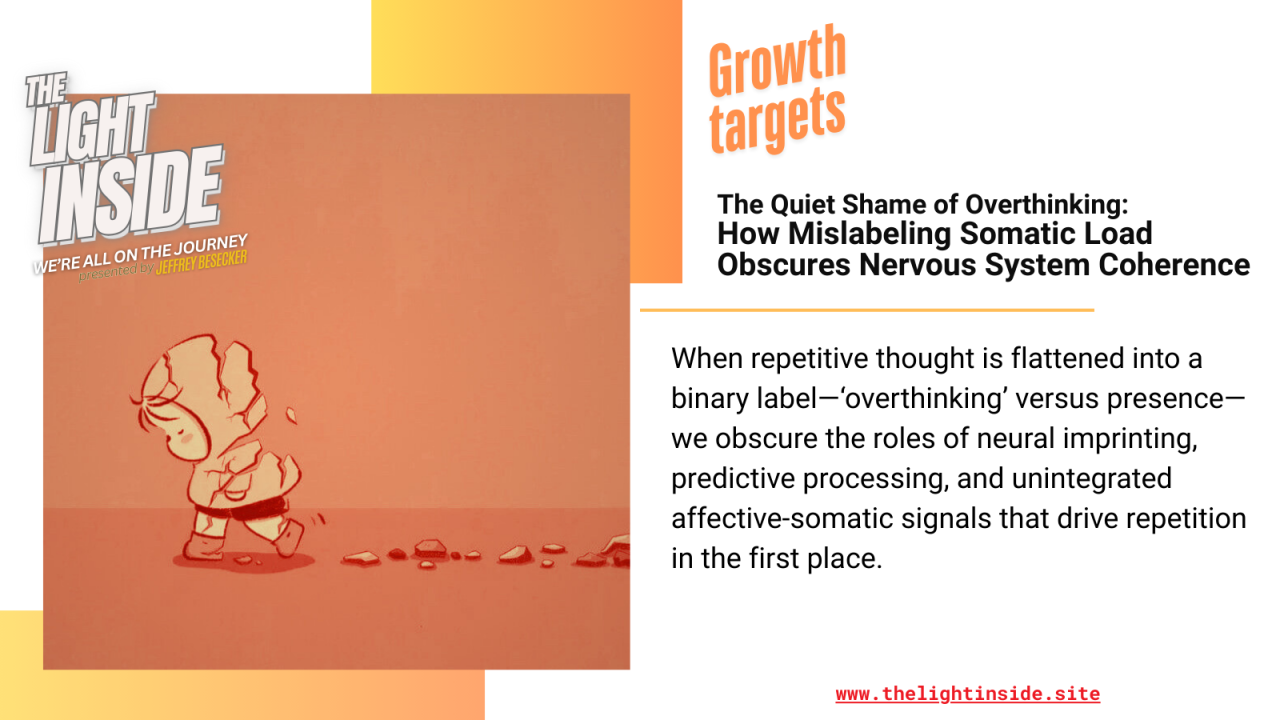
Framing complex, recursive cognitive–somatic activity as “overthinking” reflects a social attitude that moralizes mental load and prioritizes rapid quieting over integration, thereby privileging cognitive suppression in a culture that rewards performance-ready calm rather than capacity-building coherence.
What if the widespread urge to quiet the mind says less about mental health itself and more about our collective discomfort with unresolved sensation, uncertainty, and non-linear processing?
Epistemic Flattening, Ontological Certainty, and Dissonance
When repetitive thought is flattened into a binary label—‘overthinking’ versus presence—we obscure the roles of neural imprinting, predictive processing, and unintegrated affective-somatic signals that drive repetition in the first place.
In essence, such bypassing ensures we avoid the very thing we seek—attunement and connection.
This framing treats awareness as escape from thought rather than contact with the conditions that generate it, reinforcing avoidance, selective reinforcement, and narrative rigidity under the guise of relief.
Empirically: human systems do not stabilize through silence alone; coherence emerges when mind, body, and narrative are allowed to integrate, distributing load so no single system is forced to regulate in isolation.
Emotional Dissonance and Avoidant Sublimation
Below is a structured, empirically grounded analysis that addresses the core question being posed—“what if the goal isn’t to quiet the chatter, but to acknowledge and express the needs it is surfacing”—while illustrating how this pop cultural framing of “overthinking” epistemically flattens complex biological, narrative, and somatic processes.
1. How “Overthinking” Becomes an Epistemic Shortcut
Labeling rumination as overthinking often functions as a semantic compression—a way of collapsing multiple interacting systems into a single moralized behavior to be reduced or eliminated.
Empirically, what we call rumination frequently reflects:
Recursive neural loops shaped by early learning and reinforcement
Predictive processing errors, where the system repeatedly simulates outcomes to reduce uncertainty.
- Unintegrated affective-somatic signals that lack representational language
When we flatten this into “mental noise,” we implicitly treat cognition as separable from the body and biography.
This framing privileges cognitive suppression over meaningful integration, despite strong evidence that suppression increases rebound intensity, physiological load, and narrative rigidity.
2. Neural Imprinting, Narrative Authoring, and Recursive Thought
From a developmental and neurobiological perspective, repetitive thought is rarely random.
Neural Imprinting & Unresolved Bio-Psychological Data
Early attachment contexts, chronic uncertainty, or repeated relational mismatches shape implicit neural expectations.
These expectations are stored somatically and procedurally—not as explicit memories, but as prediction templates.
Rumination often represents the nervous system’s attempt to update a model that has never been fully reconciled—including the neural input from coordinating brain regions; e.g. cognitive thought.
Therefore, somatic coherence and regulatory function do not operate in absence or spite of thought—it occurs in addition to cognition.
Narrative as a Regulatory Strategy
Internal narratives are not merely stories we tell; they are regulatory scaffolds:
- They organize sensation
- They assign causality
- They forecast threat or relief
When somatic experience lacks acknowledgment or expression, narrative becomes over-recruited. What looks like “thinking too much” is often thinking in place of feeling, or thinking in place of relational completion.
3. The Cost of Quieting Without Integration
The passage shared frames relief as putting the glass down—quieting thought to “simply be.” While intuitively appealing, this metaphor carries several hidden assumptions.
Avoidant Detachment & Suppressive Sublimation
Practices that emphasize quieting without inquiry can:
Reward avoidant detachment under the guise of presence
Encourage sublimation—redirecting unresolved affect into calm, insight, or spiritualized distance
Reduce symptom visibility while leaving core drivers intact
Physiologically, this often looks like reduced cognitive noise alongside persistent autonomic load—the system appears calm but remains unresolved.
4. Fragmentation, Compartmentalization, and Internalization
When repetitive thought is treated as a problem to eliminate:
- Parts of experience become exiled
- Emotional data is internalized without metabolization
- Identity coherence fragments into “functional” and “unacceptable” states
Compartmentalization may restore short-term adaptability, but it increases long-term disintegration by preventing cross-system integration (cognitive, affective, somatic, relational).
5. Subconscious Scripts & Heuristic Forecasting
Rumination frequently follows heuristic shortcuts:
“If I can understand this fully, I can prevent pain.”
“If I replay it enough, I’ll find control.”
These scripts are not failures of insight—they are protective forecasts shaped by prior unpredictability. Selective reinforcement strengthens them:
- Relief comes from temporary certainty
- The system learns to loop again under future ambiguity
Thus, what’s labeled “overthinking” is often predictive labor performed by a system that never experienced reliable completion.
6. Presence vs. Dissociation
This raises your critical question:
Is active dissociation truly presence—or merely avoiding what we neglect connecting with?
From a psychophysiological standpoint:
Presence involves contact, not quiet
It includes sensation, affect, and meaning held simultaneously
Dissociation can feel peaceful precisely because it narrows bandwidth
- Practices that equate stillness with resolution risk reinforcing functional freeze—a state of apparent calm that bypasses unmet needs rather than integrating them.
7. Reframing the Goal: From Silence to Signal
Rather than asking How do I quiet my mind?, a more integrative inquiry is:
What is this repetition trying to complete, protect, or express?
When repetitive thought is approached as signal rather than noise:
- Core needs surface without escalation
- Somatic data finds language
Narrative loosens its grip because it no longer has to regulate alone
Freedom, in this model, does not come from putting the glass down prematurely—but from realizing why the arm has been holding it in the first place.
Closing Integration
The “quiet shame of just being” emerges when stillness is framed as virtue and mental activity as failure. Empirically and clinically, human systems do not seek silence—they seek coherence.
Quiet can be a byproduct of integration.
It is rarely the mechanism that creates it.
The work, then, is not to exit the mind—but to expand capacity across mind, body, and narrative so that no single system has to carry the load alone.
Summarized Overview:
Labeling rumination as overthinking often functions as a semantic compression—a way of collapsing multiple interacting systems into a single moralized behavior to be reduced or eliminated.
Empirically, what we call rumination frequently reflects:
Recursive neural loops shaped by early learning and reinforcement
Predictive processing errors, where the system repeatedly simulates outcomes to reduce uncertainty
Unintegrated affective-somatic signals that lack representational language
When we flatten this into “mental noise,” we implicitly treat cognition as separable from the body and biography.
This framing privileges cognitive suppression over meaningful integration, despite strong evidence that suppression increases rebound intensity, physiological load, and narrative rigidity.
The “quiet shame of just being” emerges when stillness is framed as virtue and mental activity as failure. Empirically and clinically, human systems do not seek silence—they seek coherence.
Quiet can be a byproduct of integration. It is rarely the mechanism that creates it.
The work, then, is not to exit the mind—but to expand capacity across mind, body, and narrative so that no single system has to carry the load alone.
Coachable inquiry:
When you notice repetitive thought arising, do you immediately try to quiet it—or do you pause long enough to ask what system in you is trying to be heard?
Labeling rumination as overthinking often functions as a semantic compression—collapsing multiple interacting systems into a single moralized behavior to be reduced or eliminated.
Empirically, what we call rumination frequently reflects recursive neural loops shaped by early learning, predictive processing efforts aimed at reducing uncertainty, and unintegrated affective-somatic signals that lack representational language.
When flattened into “mental noise,” cognition is treated as separable from body and biography, privileging suppression over integration—despite evidence that suppression amplifies rebound intensity, physiological load, and narrative rigidity.
The “quiet shame of just being” emerges when stillness is framed as virtue and mental activity as imperative. Yet human systems do not seek silence; they seek coherence. Quiet may emerge after integration, but it is rarely the mechanism that produces it.
What if this repetition isn’t excess—but effort? What need, boundary, or unresolved signal might the system be attempting to complete through thought?
Instead of trying to stop the chatter, experiment with widening capacity: name one sensation, one emotion, and one story present right now—simply holding and observing the core needs underlying them. Let integration, not suppression, do the regulating.

Behavior Counselor/Executive Producer/Host
Jeffrey Besecker is a dynamic and multifaceted content creator, podcast host, and behavioral therapist who is deeply dedicated to unraveling the complexities of human psychology, particularly focusing on subconscious and unconscious patterns that shape human behavior and influence decision-making.
His career path has traversed a variety of fields, including brand development, hospitality management, and the restaurant industry, each contributing to his holistic understanding of human dynamics and behavior.
Jeffrey specializes in addressing the unresolved psychological material that influences human responses and personal growth, with a mission to illuminate the unseen forces shaping behavior.
Jeffrey Besecker, as a Trauma-Informed Behavioral Practitioner, has a distinct approach to subconscious and unconscious patterns compared to the traditional approach and practices of his cognitive contemporaries when addressing these deeper-rooted patterns.
* His focus goes beyond addressing automatic behaviors or cognitive patterns by looking at the intricate psychological and emotional undercurrents that drive them.
This approach incorporates both primary subconscious patterns (root beliefs, emotional memories) and secondary behaviors (habitual responses and conditioned reactions) to examine how they impact behavior at a deeper level.
Holistic Integration: Unlike some methods that focus specifically on habit formation or self-talk, Jeffrey’s work combines aspects of neurobiology, psychology, somatic integration, and Jungian concept…Read More

Social Imperatives: How Cultural “Rules” Quietly Push Us into Distance or Mutuality