When Authority Becomes Risk: How Containment and Taxonomy Shape Embodied Agency
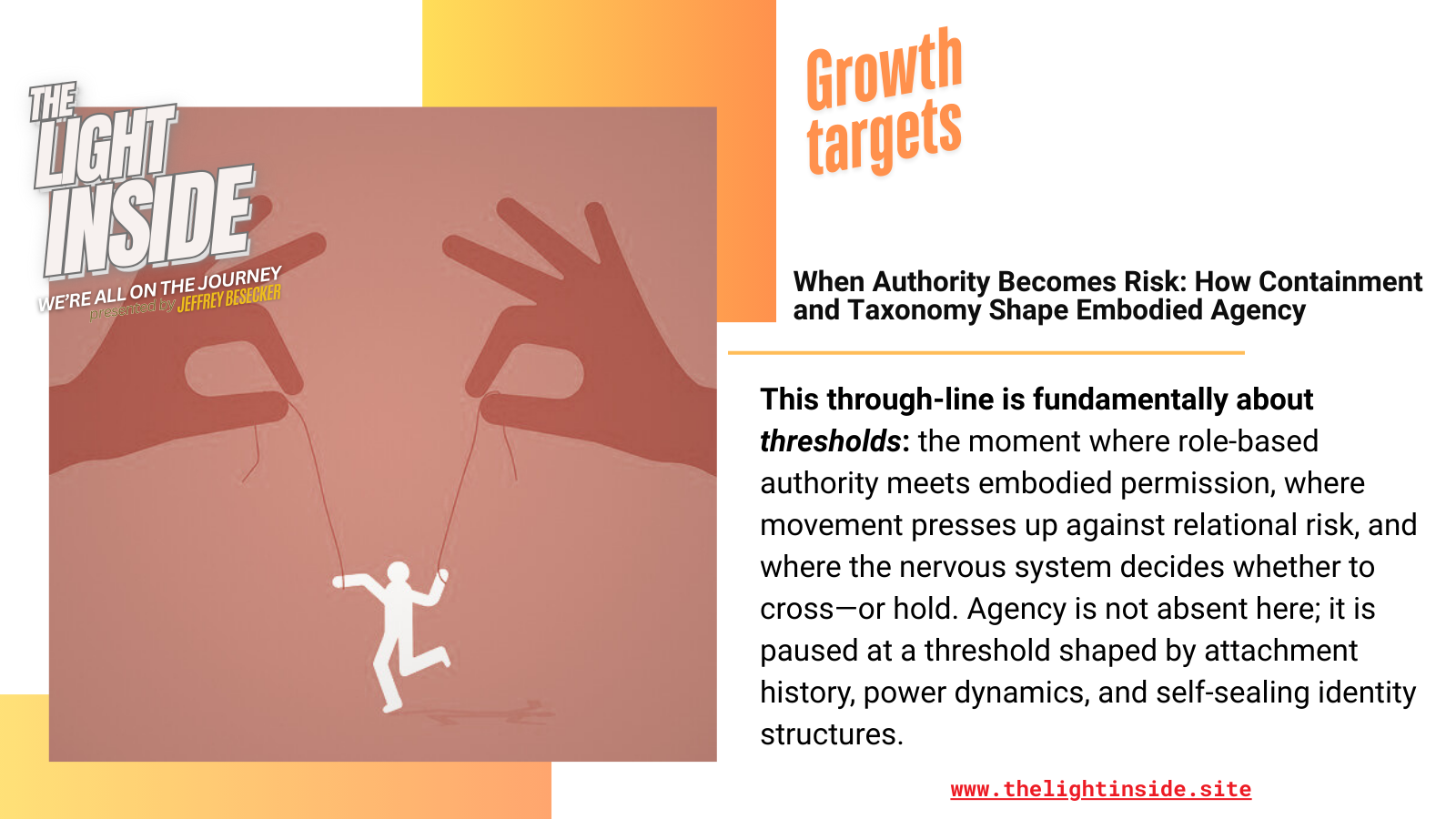
- Biased power dynamics reward dominance, punish dissent, and quietly teach capable individuals that visibility is a relational risk.
We’re often told that when leadership feels heavy or hesitant, it’s because we lack confidence—or haven’t “owned our power” yet.
But what if that tension isn’t a personal shortcoming at all? What if it’s the echo of a nervous system that learned, long ago, that visibility can cost connection?
The “inner authority gap” isn’t just about self-doubt—it’s about relational filters shaped by history, culture, and power dynamics, quietly asking, Do I have the capacity to move here? Will I still belong if I do?
Those filters can make pausing look like weakness, softening look like uncertainty, and caution look like incapacity—both to others and to ourselves. Yet beneath them is often a deeply intelligent system, sequencing connection before action. The work isn’t to override that wisdom, but to understand it—so agency can grow in ways that don’t require disappearance, dominance, or collapse.
From “Confidence Problem” to Relational Process: How Authority Becomes Embodied—or Contained
This clinical study explores why role-based authority so often fails to become embodied authority—revealing how early attachment economies, sub-cortical threat learning, and culturally reinforced power dynamics teach the nervous system that leadership equals relational risk.
We examine how containment strategies and identity-level taxonomies (“this is confidence,” “this is trauma,” “this is who I am”) stabilize coherence under load, yet quietly convert adaptive protection into self-sealing ego filters that restrict felt and held agency.
Rather than treating hesitation as a deficit to be “rewired,” we trace how over-control, appeasement, and collapse emerge as relationally intelligent responses to fields that punish visibility and dissent. By differentiating adaptive agency from compensatory control, this conversation reframes leadership not as a mindset problem, but as a developmental and relational process—one that requires pacing, field attunement, and sub-cortical updating so that action can occur without rupture.
When the Body Leads Before the Title: A Relational Snapshot of How Authority Becomes Filtered
Kate and Robert- A Relational Case Study
Kate walks into the meeting already aware of the room—not in a deliberate, strategic way, but in her body. Her breathing tightens just a little. Her shoulders subtly draw inward. She has done the work. Her thinking is clear.
Not consciously—somatically. Her breath narrows slightly. Her shoulders draw in just a fraction. She has prepared carefully; her analysis is sound, her recommendation clear. Yet before she speaks, her body runs an older calculation.
Will this land? Will this cost me something? Is it safer to check first?
Robert is already talking. He’s relaxed, unhedged, confident. He offers a version of the very idea Kate has been holding—close, but incomplete. The room turns toward him. Kate feels the familiar internal shift: not quite collapse, not quite anger, more like a gentle contraction. A narrowing.
She could step in and say, “That’s close, but here’s what I’m seeing.”
Instead, her voice softens.
She asks a clarifying question. She adds a qualifier.
She frames her contribution as an extension of his. From the outside, it looks collaborative. And it is. But it is also protective. Her nervous system is doing exactly what it learned to do long ago: preserve connection first, then move. The impulse to lead passes through a filter shaped by earlier fields—classrooms where she was interrupted, family dynamics where being “easy” maintained harmony, environments where visibility carried cost. Her body remembers that movement can risk belonging.
Robert does not perceive any of this. From his side of the field, Kate’s softening reads as uncertainty. He fills the space—not out of dominance, but out of habit. The room follows the clearer, louder signal.
The relational field answers her strategy.
Her hesitation is mirrored as reduced authority. That reduction is registered by her system as confirmation. The loop tightens.
Later, Kate tells herself, I should be more confident.
It feels like a personal flaw. It isn’t.
What is happening is relational and sub-cortical. Her system is not failing to lead—it is preserving coherence in a field that still carries asymmetry. The tension she feels is not incompetence. It is the friction between role-based authority and embodied permission.
Each time she waits for consensus before moving, her body is saying, connection first. Each time Robert moves without scanning, his body is saying, movement is safe.
Neither posture is a character flaw. They are histories meeting in real time. The work for Kate is not to override her caution or imitate Robert’s style. It is to become curious about what her system is protecting—and, in small, paced ways, to test a new sequence:
Move… and remain. Speak… and stay connected. Lead… without disappearing.
Agency does not arrive through assertion. It emerges when the body learns—through lived relational experience—that mutual trust and equanimity no longer requires losing belonging.
True authority does not arrive through dominance, bravado, or a cognitive reframe—it emerges through lived relational experiences that teach the nervous system it can move without losing connection. The popular narrative of an “inner authority gap” resonates because it externalizes shame, normalizes the experience, and offers a clean story with a clear fix. But in compressing a complex, relational phenomenon into a single cause (“it’s subconscious”) and a single solution (“rewire it”), it risks obscuring the deeper truth: leadership becomes embodied not by overriding caution, but by gathering repeated evidence—within real relational fields—that one can speak, differ, and act while remaining in relationship.
At the Threshold Where Authority Hesitates: When Moving Forward Risks Losing Connection
This through-line is fundamentally about thresholds: the moment where role-based authority meets embodied permission, where movement presses up against relational risk, and where the nervous system decides whether to cross—or hold.
Authority is not absent here; it is paused at a threshold shaped by attachment history, power dynamics, and self-sealing identity structures.
The work, clinically and developmentally, is not to force passage through maneuvering and power dynamics, but to widen the threshold so movement can occur without rupture.
When Authority Becomes Risk
A Mini Meta-Analysis of Field, Attachment, Sub-Cortical Prediction, and Identity Taxonomy
Leadership hesitation is routinely framed as a confidence deficit: if you “owned your power,” you’d act cleanly, speak directly, and stop over-consulting. But across the materials you assembled, a different convergence emerges: the “inner authority gap” is better explained as an interaction effect. Role-based authority (title, scope, formal power) can be fully present while embodied permission to act remains constrained because sub-cortical prediction, relational-field contingencies, and identity-level categorization co-produce leadership as relational risk rather than capability.
This reframing matters because it relocates the problem from personal inadequacy to developmental ecology. Authority does not fail to become embodied because the individual lacks belief in themselves. It fails when (a) threat learning encoded in the nervous system, (b) culturally patterned power dynamics, and (c) stabilizing identity categories converge to make visibility and dissent feel costly. What reads socially as hesitation is often the most coherent response available to a system tracking real or anticipated relational cost.
Convergent findings
1) Agency is developmental and relational, not merely cognitive
A central developmental claim runs through your synthesis: agency is not a trait installed by insight; it is a relational achievement. It forms through repeated experiences in which movement does not produce rupture. When early environments pair initiative with withdrawal, criticism, volatility, or social penalty, the system learns a sequencing rule—secure connection first, then act—stored less as narrative memory than as an action constraint.
In adulthood, when leadership roles demand unhedged action, the body does not consult credentials; it consults prediction. Sub-cortical systems bias breath, posture, voice, timing, and impulse before a coherent story arrives. The downstream behaviors—softening, delaying, over-consulting, deferring, scanning—often get moralized as weakness. In this model they are better read as relational intelligence under load: strategies to preserve connection, reduce exposure, and maintain coherence.
2) The relational field functions as an active regulator
Your through-line treats “context” as insufficient. The relational field is not the backdrop; it is the regulating matrix formed by interacting nervous systems, roles, status gradients, cultural scripts, and prior meaning. The field “answers” behavior—sometimes by granting attribution and space, sometimes by overriding, diminishing, or re-routing credit.
The loop you’ve named is the canonical field mechanism:
softened stance → diminished impact → increased override → heightened self-doubt
That sequence matters because it is not a private spiral; it is a bidirectional feedback system. What begins as an attachment-protective move is mirrored by the field as reduced authority. That response becomes data for the nervous system, tightening the prediction that movement is costly. In adjacent workplace research, identity-linked evaluative pressure (e.g., stereotype threat) shows reliable associations with depletion and coping-related outcomes—consistent with the idea that high-stakes visibility alters state and behavior through field-contingent cost. (PubMed)
3) Sub-cortical prediction precedes narrative
A second convergence is causal sequencing: state leads story. Sub-cortical systems generate readiness or contraction first; cortical systems then explain the state as “confidence,” “readiness,” or “permission.” In this frame, confabulation is not deceit—it is coherence maintenance.
This is why purely cognitive interventions (“trust yourself,” “reframe the narrative”) can miss the causal engine: they address explanation more than prediction. Sustainable change requires new relational evidence—repeated experiences of movement without disproportionate relational cost—paired with pacing that allows arousal to be metabolized rather than overridden.
4) Taxonomy stabilizes experience—and can become self-sealing
Across your material, taxonomy is treated as a regulatory act: categories compress complexity into coherence and reduce ambiguity. Initially, naming a pattern (“inner authority gap,” “people-pleasing,” “impostor”) can reduce shame and orient inquiry. The risk emerges when a category becomes identity—this is who I am—and the system stops updating.
Once identity-relevant, the label can become self-sealing: contradictory data is filtered out; confirming moments are amplified; the map replaces the territory. This is where helpful language becomes containment-by-definition: it organizes experience while quietly foreclosing new evidence.
Divergent emphases and productive tensions
Old danger vs present risk
Your most clinically important fork is differentiation, not diagnosis. Sometimes the system is replaying old danger; sometimes it is accurately tracking present contingencies; often it is both. The intervention differs by layer. If prediction is outdated, titrated agency experiments are indicated. If the field is objectively punitive, the work includes field strategy, boundary architecture, and threat realism—not exposure that increases cost.
Protective collaboration vs collapse management
“Softening” is alternately framed as relational intelligence and as collapse disguised as prosociality. The functional discriminator is not virtue; it’s choice-flexibility. Does the person retain options, timing, and internal contact—or is the system narrowing into appeasement because it cannot hold the load? Somatic markers (breath restriction, throat tension, freeze cues), aftereffects (rumination, depletion), and relational results (credit capture, override) help distinguish collaboration from submissive suppression.
The utility and risk of naming
Taxonomy helps and harms. The unresolved question is how to keep categories as hypotheses rather than identities in a culture 'saturated' with ready-made self-descriptions. The same label can expand inquiry or prematurely close it depending on how the clinician—and the field—handles it.
Where containment & narrative authoring become ego filters (and collapse)
The passage frames these behaviors as “old programming,” which is useful—unless it becomes a single-story container that blocks contact with real-time data.
Category, Taxonomy and Their Impact on Shaping Relational Field
Within identity organization and relational-field dynamics, a category is not merely a label—it is a regulatory scaffold.
Categories tell the nervous system what something is, what it means, and how it should be handled.
👉They compress complexity into coherence. In doing so, they reduce ambiguity, stabilize prediction, and preserve identity continuity under load.
This is why categories are adaptive. They allow the organism to move through uncertainty without collapsing. But when categories become rigid, they stop serving inquiry and begin serving containment.
Common containment moves here:
Each of the moves you outline illustrates a different way category shifts from map to cage:
- Narrative authoring as control “This is subconscious conditioning” becomes a totalizing category. What began as a useful hypothesis becomes an ontological claim. Ambiguity—Is this old danger or present risk?—is closed prematurely. The category answers before the system can feel. Learning halts because nothing new is allowed to be true.
- Reductive ego filter “I’m someone with an authority gap” transforms a state-dependent pattern into an identity class. The self is no longer having an experience; it is the experience. Curiosity gives way to membership. The category stabilizes selfhood, but at the cost of developmental movement.
- Submissive suppression as prosociality Here, the category of “collaboration” or “kindness” masks a protective submission strategy. The relational field receives compliance as virtue. The system’s avoidance of disapproval is morally reframed. Category becomes camouflage—what is protective is misrecognized as preference.
- Epistemic and ontological flattening Distinct layers—attachment history, stereotype threat, organizational politics, skill acquisition, autonomic load—are collapsed into a single class: “rewiring.” The category erases dimensionality. Different causal levers are treated as interchangeable. Intervention becomes blunt because the terrain has been flattened.
In all four cases, category functions as a self-sealing structure. It reduces cognitive and relational load by telling the system, You already know what this is. But it also governs perception: data that fits is absorbed; data that complicates is filtered out. The relational field then mirrors the category back, reinforcing it as truth.
Clinically, this means categories must be held as provisional maps, not fixed identities. Their task is to orient exploration, not terminate it. When a category remains flexible, it supports differentiation:
- Is this attachment protection or political realism?
- Is this collapse or strategic restraint?
- Is this old danger or present cost?
When a category becomes identity, it becomes fate.
👉The work is not to abolish categories, but to restore their developmental function:
- To organize experience without foreclosing possibility— to name patterns without turning them into selves— to guide attention without sealing the field against what might yet emerge.
Cultural imperatives & moral gating
A major subtext is the “double bind” many women report in leadership: be decisive but not “too much,” be warm but not “weak.” This is fertile ground for:
- Moral gating: “Good leaders don’t upset people / good women don’t take up too much space.” Morality becomes a leash on action.
- Confabulation: the mind explains discomfort as “I’m not ready / I’m not confident,” when the underlying driver may be anticipated relational cost (being disliked, punished, isolated).
- Doxastic closure: once the belief crystallizes (“my decisions are dangerous”), new evidence is filtered out; reassurance temporarily soothes, but keeps the belief system intact.
Evidence that the field matters (not just “confidence”):
- Workplace stereotype threat correlates with exhaustion, negative affect, coping behaviors, and lower job attitudes in a large meta-analysis. (ResearchGate)
- “Competence-questioning” behaviors (e.g., condescending explanations, voice nonrecognition) show measurable workplace patterns and attribution dynamics. (PMC)
- Gender differences in impostor phenomenon are mixed across studies, but meta-analytic work continues to examine systematic patterns rather than assuming it’s purely an individual deficit. (ScienceDirect)
Attachment strategies, childhood wounds, ACE-shaped templates
The passage gestures at early learning (“rewarded for being agreeable”). Clinically, you can widen that to attachment economy:
- If early belonging was contingent on being “easy,” “helpful,” “not too much,” leadership can register as threat to connection.
- Protest/appease strategies can show up as: over-explaining, over-collaborating, pre-emptive softening, perfectionism, and scanning for disapproval.
- ACE exposure is associated with later executive-function and cognitive outcomes in adulthood across review-level work (context-dependent, but directionally relevant to load, working memory, and decision strain). (PubMed)
Key point: what looks like “permission-seeking” can be attachment-protective sequencing: secure the bond → then move.
Interpretive intrusion (social + clinical domains)
In social discourse: the passage risks interpretive intrusion by declaring the cause (“it’s subconscious”) without differentiating:
- accurate appraisal of sexist/risky environments
- skill/experience gaps
- moral injury/belonging threats
- attachment-conditioned appeasement
- neurophysiological stress responses
In clinical work: interpretive intrusion shows up when the clinician over-assigns meaning (“this is father-wound / this is trauma”) before enough contact data exists (somatic cues, relational tracking, contextual threat realism). That can provoke reactance or compliance-without-integration.
A more precise clinical stance is: “What function does this strategy serve in this field, with this history, at this level of load/capacity?”
Ego development: pre-conventional → unitive
A useful developmental read:
- Pre-conventional / externally referenced self: “Authority lives outside me; I’m good when approved.” Leadership decisions require external permission because belonging is the regulator.
- Conventional / role-contained self: “I can perform leadership, but my body still defers to the room.” The title is integrated cognitively, not embodied relationally.
- Post-conventional / unitive trajectory: inner authority becomes relationally flexible: you can hold dissent, tolerate disapproval, and stay connected without collapsing. “Taking up space” becomes less identity-threat, more context-sensitive choice.
Parataxic distortions (old relational maps projected onto the present)
Common distortions that fit this pattern:
- Mind-reading: “They’ll think I’m arrogant.”
- Catastrophizing: “If I’m wrong, I’ll be exposed.”
- Authority transference: stakeholders/peers become parental stand-ins (“someone else knows better”).
- Selective abstraction: discounting evidence of competence while amplifying micro-signals of disapproval.
These aren’t “errors” so much as relationship-preserving predictions that once worked.
Pattern map listicle (primary → secondary → ancillary → recursive)
1) Primary pattern: Permission-seeking as capacity regulation
- Primary behavior: over-consulting, reassurance-seeking, consensus dependence
- Function: reduce relational risk + distribute responsibility
- Cost: delayed action, diluted stance, chronic tension
2) Primary pattern: Dissociation-by-abstraction (decision cognition over contact)
- Primary behavior: thinking about leadership instead of sensing through it (over-analysis, over-prep)
- Function: stabilize arousal by moving up into narrative control
- Cost: diminished embodied confidence; “clean decisions” stay inaccessible without external cues
3) Secondary pattern: Appeasement-coded communication
- Secondary behavior: softening opinions, hedging, excessive qualifiers
- Function: preserve belonging; prevent backlash
- Cost: authority signals weaken; others unconsciously “fill the vacuum”
4) Secondary pattern: Moral gating of agency
- Secondary behavior: “I shouldn’t upset people / I should be agreeable”
- Function: maintain identity as “good/safe-to-like” (capacity-protective)
- Cost: resentment, self-erasure, leadership fatigue
5) Ancillary pattern: Hypervigilant field-scanning
- Ancillary behavior: reading micro-reactions, pre-emptive justification, vigilance after speaking
- Function: threat detection + rupture prevention
- Cost: cognitive load, impaired working memory in the moment, reduced spontaneity
6) Ancillary pattern: Confabulated deficit story
- Ancillary behavior: “It’s just confidence” (or “I’m broken”)
- Function: creates an explainable narrative container
- Cost: mis-targeted solutions; structural realities get ignored
7) Recursive loop: Doxastic closure → reinforcement
- Recursive sequence: doubt → seek reassurance → temporary relief → belief remains (“I need permission”) → doubt returns
- Outcome: the strategy becomes evidence for the belief
8) Recursive loop: Field reinforcement
- Recursive sequence: softened stance → others interrupt/override more → internal doubt intensifies → more softening
- Outcome: culture and nervous system co-train the pattern
“Sometimes it’s ‘old programming.’ Sometimes it’s accurate appraisal of a punitive field. Often it’s both — and the intervention differs depending on which layer is driving the load.”
A unifying lens: the Field–Prediction–Taxonomy loop
This synthesis coheres most tightly when expressed as a single mechanism:
- Field contingencies define the cost of visibility, dissent, and error.
- Sub-cortical prediction estimates those costs before conscious thought.
- Protective strategies (softening, over-consulting, delaying) deploy to preserve connection and coherence.
- Field response mirrors the strategy (override, diminished attribution), which becomes data for the nervous system.
- Taxonomy narrates the experience (“confidence issue,” “authority gap,” “people-pleaser”), stabilizing identity and guiding perception.
- Self-sealing occurs when taxonomy hardens; disconfirming data is filtered out; the loop becomes self-validating.
This explains why “confidence training” often fails: it targets step (5) (story) while leaving steps (1–4) (field and prediction) intact. It also explains why structural reforms can fail: policy changes that don’t alter micro-dynamics may not shift the felt cost of movement.
Case illustration: Kate and Robert as field dynamics, not personality defects
Kate arrives with prepared analysis and legitimate role authority. Yet her body runs an older calculation: Will this land? Will this cost me something? Is it better to check first? Her voice softens. She asks a clarifying question. She frames her idea as an extension of Robert’s. From the outside, it can look like collaboration; internally, it is also protection.
Robert speaks unhedged. The room orients toward the clearer, louder signal. From his side of the field, Kate’s softening can read as uncertainty; he fills space out of habit. The field then completes the loop: Kate’s protective move is mirrored as reduced authority attribution. Her system reads the response as confirmation, and the pattern tightens.
What matters clinically is the reframe: this is not a character deficit (hers) or moral failure (his). It is histories meeting a field—status dynamics, turn-taking norms, credit capture, and gendered expectations shaping what is rewarded and what is ignored. The field becomes evidence, and evidence becomes identity.
Empirical adjacency: what this model is consistent with
Our core argument is mechanism-forward, not reducible to a single construct like impostor phenomenon. That’s methodologically careful. It also fits adjacent literatures:
- Workplace identity threat research shows consistent associations with depletion and coping-like outcomes, aligning with your claim that high-stakes visibility changes state and behavior in ways that look like “hesitation.” (PubMed)
- Impostor phenomenon research highlights conceptual/measurement heterogeneity and mixed patterns, supporting your caution against collapsing ecology into an intrapsychic label. (PubMed)
- Adversity exposure is associated with altered adult brain reactivity across domains (including inhibitory control/executive functioning tasks), lending plausibility to your load/capacity framing without turning it deterministic. (JAMA Network)
Practical implications
For clinicians and supervisors
- Formulate hesitation as information, not deficiency: What is this protecting—connection, identity continuity, or threat realism?
- Differentiate layers before intervening: old danger vs present risk vs skill edge.
- Use micro-experiments in agency: smallest action that preserves relational coherence while expanding capacity.
- Hold categories lightly: name the pattern without turning it into a self.
- Track the in-session field: reassurance, over-structuring, or explanatory certainty can externalize authority and accidentally reinforce permission-seeking.
For leadership development and organizations
- Treat “executive presence” as a field-and-body phenomenon, not a branding skill.
- Audit micro-dynamics: interruption norms, turn-taking, credit assignment, decision-right clarity.
- Build conditions where dissent is survivable in practice, not merely “allowed” in policy.
- Pair skills training with field change; otherwise training increases exposure while leaving cost structure intact.
Closing synthesis
Taken together, your materials argue that the “inner authority gap” is not primarily about confidence. It is about how authority is priced in relational fields and encoded through sub-cortical prediction and identity organization. Containment strategies and taxonomies can stabilize coherence under load, but they can also become self-sealing structures that restrict agency and recruit reinforcing feedback from the environment.
Leadership, then, is not a mindset problem. It is a developmental and relational process. Embodied authority emerges when the system accumulates repeated evidence that it can move and remain, differ and belong, and act without disappearance. Insight may open the door—relationship is what teaches the body to walk through it.
Coachable Inquiry:
When agency stalls in moments of leadership or conflict, what if the question isn’t “Why am I not confident enough?” but “What is my system protecting in this relational field right now?”
Containment often looks like prudence, collaboration, or self-restraint—but when it becomes self-sealing, it can quietly reinforce conflicted power dynamics by prioritizing coherence over contact, and stability over truth. In those moments, the field mirrors caution as weakness, and the loop tightens: agency contracts, authority is outsourced, and relational patterns harden rather than heal.
The coachable edge is this: where might agency return—not by pushing harder or reframing faster—but by attuning more precisely to what the relationship can metabolize now?
When containment is held as protection rather than identity, it becomes a bridge instead of a barrier—allowing movement that preserves connection, and leadership that emerges through relationship rather than dominance.
Below is a peer-reviewed, empirically grounded bibliography listicle that supports the core claims of this piece—organized by mechanism, not popularity—so readers can trace how relational fields, sub-cortical prediction, attachment, taxonomy, and power dynamics converge to shape embodied agency.
Empirical & Theoretical Foundations Supporting This Analysis
1. Relational Field Effects & Identity Threat
These studies establish that context and power dynamics materially shape behavior, performance, and withdrawal—supporting the claim that hesitation is often field-conditioned, not intrapsychic deficit.
- von Hippel, C., et al. (2015). Stereotype threat and workplace outcomes: A meta-analysis. Demonstrates robust associations between identity threat and exhaustion, coping behaviors, disengagement, and performance strain in real organizational settings.
- Briggs, S. R., et al. (2012). Gender differences in competence questioning and conversational dominance. Documents patterned interruptions, voice nonrecognition, and attribution bias—showing how the relational field “answers” authority signals differently.
- Kang, S. K., et al. (2016). Whitened résumés: Race and self-presentation in the labor market. Illustrates how power norms and identity pricing shape self-suppression strategies that are often misread as confidence issues.
2. Sub-Cortical Prediction, State-Dependent Behavior, and Confabulation
These works support the claim that state precedes story—that nervous-system prediction drives behavior before cognition assigns meaning.
- Barrett, L. F. (2017). How Emotions Are Made. Establishes predictive processing as foundational to emotion and action, undermining purely cognitive models of agency.
- LeDoux, J. E. (2015). Anxious: Using the Brain to Understand and Treat Fear and Anxiety. Details how sub-cortical circuits shape action constraints prior to conscious awareness.
- Nisbett, R. E., & Wilson, T. D. (1977). Telling more than we can know. Classic evidence that post-hoc explanations often rationalize states generated outside awareness—supporting the role of confabulation as coherence maintenance.
3. Attachment Economies & Developmental Sequencing
These sources ground the argument that agency is learned in relationship, not installed through insight.
- Bowlby, J. (1988). A Secure Base. Establishes the developmental link between secure attachment and exploratory behavior.
- Mikulincer, M., & Shaver, P. R. (2016). Attachment in Adulthood. Shows how attachment strategies shape decision-making, autonomy, and relational risk tolerance under stress.
- Schore, A. N. (2012). The Science of the Art of Psychotherapy. Links early relational attunement to right-hemisphere regulation, capacity, and later agency.
4. Containment, Collapse, and Over-Functioning
These studies validate the framing of appeasement, over-control, and shutdown as adaptive regulatory strategies, not pathology.
- Ogden, P., Minton, K., & Pain, C. (2006). Trauma and the Body. Provides empirical grounding for somatic sequencing, collapse responses, and titrated agency restoration.
- Porges, S. W. (2011). The Polyvagal Theory. Explains how social engagement, dorsal shutdown, and appeasement are autonomic strategies shaped by perceived relational safety.
- Van der Kolk, B. (2014). The Body Keeps the Score. Synthesizes evidence that unresolved action and suppressed agency persist as embodied states, not beliefs.
5. Taxonomy, Identity, and Epistemic Closure
These works support the claim that naming regulates perception and can either expand or foreclose development.
- Hacking, I. (1999). The Social Construction of What? Explores how categories loop back to shape behavior and identity (“making up people”).
- Dweck, C. S. (2006). Mindset. Often cited reductively—yet the research itself warns against fixed identity categories that arrest learning.
- Berger, P. L., & Luckmann, T. (1966). The Social Construction of Reality. Foundational for understanding how meaning systems stabilize experience while limiting alternative interpretations.
6. Adverse Childhood Experiences, Load, and Executive Capacity
These studies support the load-capacity argument without collapsing it into determinism.
- Anda, R. F., et al. (2006). The enduring effects of abuse and related adverse experiences. Shows long-term associations between early adversity, stress reactivity, and functional outcomes.
- Pechtel, P., & Pizzagalli, D. A. (2011). Effects of early life stress on cognitive and affective function. Reviews how early stress shapes executive function and decision strain into adulthood.
7. Ego Development & Relational Authority
These sources ground the developmental arc from externally referenced authority to relationally flexible agency.
- Kegan, R. (1982). The Evolving Self. Establishes stages of meaning-making relevant to authority, identity, and autonomy.
- Cook-Greuter, S. (2005). Ego development: Nine levels of increasing embrace. Details the transition from role-bound authority to post-conventional, integrative agency.
Why This Matters
Taken together, this literature supports a central conclusion of your piece:
Agency is not restored by insight alone, nor lost by personal weakness. It is shaped—supported or constrained—by relational fields, developmental history, sub-cortical prediction, and the categories we use to make sense of ourselves.
This bibliography anchors the work not in metaphor or motivation, but in empirically supported mechanisms—giving clinicians, leaders, and scholars a shared evidence base for moving beyond confidence narratives toward relationally grounded change.

Behavior Counselor/Executive Producer/Host
Jeffrey Besecker is a dynamic and multifaceted content creator, podcast host, and behavioral therapist who is deeply dedicated to unraveling the complexities of human psychology, particularly focusing on subconscious and unconscious patterns that shape human behavior and influence decision-making.
His career path has traversed a variety of fields, including brand development, hospitality management, and the restaurant industry, each contributing to his holistic understanding of human dynamics and behavior.
Jeffrey specializes in addressing the unresolved psychological material that influences human responses and personal growth, with a mission to illuminate the unseen forces shaping behavior.
Jeffrey Besecker, as a Trauma-Informed Behavioral Practitioner, has a distinct approach to subconscious and unconscious patterns compared to the traditional approach and practices of his cognitive contemporaries when addressing these deeper-rooted patterns.
* His focus goes beyond addressing automatic behaviors or cognitive patterns by looking at the intricate psychological and emotional undercurrents that drive them.
This approach incorporates both primary subconscious patterns (root beliefs, emotional memories) and secondary behaviors (habitual responses and conditioned reactions) to examine how they impact behavior at a deeper level.
Holistic Integration: Unlike some methods that focus specifically on habit formation or self-talk, Jeffrey’s work combines aspects of neurobiology, psychology, somatic integration, and Jungian concept…Read More
Insight Without Capacity Becomes Explanation: Why Lasting Change Depends on Linkage Across the Full Cue Stack