When Calm Is Over-Performance: Adaptive Dissociation, Over-Resourcing, and the Misidentification of Regulation
When a client’s “I’m fine” sounds like a closing statement, what markers of coherence—oscillation, recovery time, interoceptive access, and relational availability—suggest this composure is adaptive dissociation rather than integrated regulation, and how might we pace containment to restore adaptability without forcing intensity?
High-functioning clients often reinforce this inference with language that sounds reassuring but functions as a closing statement—“I’m fine, just tired,” “I don’t fall apart,” “I handle things.” Yet this outward profile can coexist with flattened sensation, narrowed emotional range, chronic bracing, disrupted sleep, and delayed collapse. The result is a common clinical error: treating composure as evidence of coherence.
When emotional bypassing, flattening, and avoidance are mistaken for regulation, we lose access to the very signals that make integration possible—containment restores adaptive capacity by meeting experience at the pace the nervous system can actually sustain.
Modern clinical and organizational cultures quietly equate composure with regulation. If someone speaks clearly, performs reliably, and appears emotionally steady, they are presumed to be “doing well.” High-functioning clients often reinforce this inference themselves: “I’m fine—just tired,” “I handle things,” “I don’t fall apart.” Yet this presentation can coexist with flattened sensation, chronic bracing, disrupted sleep, delayed emotional awareness, and sudden collapse.
The problem is not calm itself. The problem is mistaking calm for coherence. In many high-responsibility populations, calm is the surface expression of adaptive dissociation—a functional freeze state that preserves performance by dampening interoceptive and emotional signal. Under these conditions, composure functions less as integration and more as a masking technology that stabilizes output and belonging at the cost of flexibility, felt access, and long-term capacity.
If regulation is defined as coherence rather than appearance, then clinical practice must move beyond tone and narrative polish toward deeper markers: oscillation, recovery time, interoceptive access, and relational availability.
Regulation redefined: from emotional control to coherence
Integrated regulation is not the absence of arousal or the permanent achievement of serenity. It is the system’s ability to move—to mobilize and settle, to feel and reorient, to enter contact and return without losing access to self. Regulation, in this sense, is defined by flexibility and recovery rather than by how calm someone looks.
“False calm,” by contrast, describes outward stability maintained through inhibition and signal dampening, often supported by cognitive override and role-based identity fusion. This is not a moral failure or a character flaw; it is a functional solution to constraint. The mistake occurs when this solution is rewarded as evidence of health rather than assessed for cost.
Coherence becomes the relevant diagnostic lens: are bodily cues, cognitive meaning, and relational engagement aligned—or merely controlled?
False calm as a selection problem under constraint
False calm is not simply shutdown. It is policy selection. Across learning-based and predictive frameworks, organisms select strategies that minimize uncertainty and relational cost. When emotional expression or interoceptive awareness historically predicted threat—rejection, overload, role failure—the system learned that feeling was expensive.
Over time, this learning reweights signal priority. Early bodily indicators of fatigue, grief, or anger are down-weighted. Signals of competence, composure, and role compliance are up-weighted. The result is a configuration that feels stable because it reduces ambiguity, even as it narrows the bandwidth required for long-term coherence.
This explains the paradox clinicians often encounter: individuals who appear highly regulated but have little access to limits until their system forces a reset through illness, burnout, panic, or collapse. False calm is best understood as an intelligent short-horizon strategy with predictable long-horizon costs.
Adaptive dissociation: economical regulation with hidden trade-offs
Adaptive dissociation preserves function by lowering signal intensity. Emotional inhibition is not emotional absence; it is emotion held outside awareness so performance can continue. In environments that reward composure—caregiving, leadership, professional service—this strategy is often praised as emotional maturity, intelligence, or resilience.
Clinically, however, inhibition leaves neural imprints Clients narrate fluently but struggle to sense. Their language is cognitively rich and somatically thin. Needs are recognized late, often only after the body escalates through headaches, insomnia, gastrointestinal symptoms, panic spikes, or profound fatigue. What looks like stability is frequently a narrowed sensory field—a life organized around function rather than contact.
As interoceptive trust erodes, self-guidance shifts outward: routines, checklists, monitoring, and external validation replace felt orientation. Over-Performance becomes the primary interface with reality.
Cognitive override as a regulator-of-last-resort
When bodily signals are muted or mistrusted, cognition often assumes regulatory dominance. Planning, rumination, and narration provide certainty when sensing feels over-resourced or incoherent. This works—immediately. It reduces uncertainty, protects identity, and preserves relational standing.
The cost is cumulative.
Attentional rigidity increases, sympathetic effort is sustained beneath a calm exterior, and spontaneous emotional processing is constrained. Cognition shifts from flexible tool to control ritual. The person remains externally functional while becoming internally fragmented—capable until collapse makes limits unavoidable.
The distinction here is not anti-cognitive. It is functional.
👉Cognition expands capacity when it integrates signal and meaning; it contracts capacity when it replaces sensing altogether.
Identity consolidation: when coping becomes selfhood
False calm does not persist solely because it works physiologically; it persists because it becomes who the person is. Over time, over-functioning consolidates into identity: the competent one, the reliable one, the calm one.
Belonging becomes contingent on over-performance, and vulnerability is exiled to preserve continuity.
Over-resourcing—perfectionism, redundancy, constant anticipation—functions less as anxiety management and more as a relational strategy. The system organizes around predictability because predictability historically secured attachment. Fragmentation follows not from weakness, but from necessity.
Change, then, threatens more than symptoms. It threatens the identity economy that kept the person attached and viable. Without acknowledging this, interventions risk becoming coercive—pushing expression before capacity exists to tolerate it.
What happens in your body and your story when you’re trying to set a boundary—and one of them seems to move faster than the other?
It’s tempting to frame boundaries as either physiological or a mindset issue, yet that split can quietly limit what’s actually available to you under load. Bodily signals often lead—tight jaw, shallow breath, bracing—but the meanings you assign in real time (“this isn’t safe,” “I shouldn’t say no,” “I’ll deal with it later”) actively shape how intense, narrow, or flexible those signals become. In that sense, beliefs and values aren’t just words layered on top of sensation; they’re part of the same loop that modulates arousal, threat appraisal, and choice.
Rather than asking whether your body or your mind is “in charge,” it may be more useful to get curious about how they’re talking to each other. When a signal shows up, what story does it recruit—and how does that story either expand or constrict your options in the moment?
Over time, these pairings can harden into identity (“this is just how I am”) or soften into capacity (“I can stay present and choose”).
If boundaries feel stuck, the work may be less about forcing words or overriding sensations—and more about gently updating the loop between signal and meaning so your system has more room to respond, not just protect.
Systems that train false calm
False calm is not only embodied; it is selected. High-demand systems routinely reward speed over integration, composure over truth, and output over recovery. In such environments, dissociative competence is adaptive. It protects employment, reputation, and relational standing.
This has direct clinical implications. Individual capacity-building must be paired with environment-facing interventions: boundary renegotiation, workload realism, protected recovery, and relational cultures that reward coherence rather than mere performance. Without systemic change, therapeutic tools risk becoming methods for tolerating unsustainable conditions.
Breathwork as conditional integration: precision, not release
Breath practices belong in this framework as conditional scaffolds, not universal remedies. Evidence most strongly supports slow, paced breathing as a means of modestly improving autonomic flexibility and emotional regulation correlates. The key contribution here is conceptual: breath is best understood as oscillation training, not cathartic release.
When used to gradually restore interoceptive clarity, breath can reduce reliance on cognitive override, widen experiential bandwidth, and support relational presence. When used as an intensity-driven achievement or “breakthrough” ritual, it can reinforce bypass and destabilize dissociative or trauma-exposed systems.
Ethical application requires guardrails: titration over intensity, consent checkpoints, orienting exits, and explicit integration of sensation with meaning. Capacity—not peak experience—is the target.
Primary hypothesis (restated cleanly)
In high-functioning populations, outward calm can reflect functional freeze (adaptive dissociation) rather than integrated regulation; breath-based practices improve interoceptive access and autonomic flexibility when they build capacity and oscillatory tolerance, but can destabilize dissociative/trauma-exposed profiles when used as high-intensity activation or cathartic release.
Methodological posture
- Design type: integrative translational synthesis across psychophysiology, interoception science, network neuroscience, dissociation/trauma literature, and breath intervention studies.
- Strength: convergence of patterns across domains (not causal proof).
- Limit: heterogeneity of populations, protocols, and mechanisms; risk of over-inference if claims exceed what cross-literature alignment can support.
Core “findings” (translated as convergent insights)
- False calm can be adaptive: emotional inhibition + interoceptive dampening preserve function when intensity historically exceeded capacity (Schäflein et al., 2018; Tschacher et al., 2022).
- Cognitive override can stabilize at a cost: planning/rumination/self-monitoring can substitute for bodily guidance, narrowing experiential bandwidth and increasing load (fits with control-as-negative-reinforcement logic and network switching constraints).
- Network dynamics are heterogeneous: salience-network involvement is best described as biased prioritization and switching, not a single-pathway shutoff (Seeley et al., 2007).
- Slow breathing has reliable but modest effects: paced breathing is linked to autonomic shifts and emotion-regulation correlates (Zaccaro et al., 2018; Streeter et al., 2012).
- Risk is real and phenotype-dependent: dissociative profiles often show impaired interoceptive accuracy and altered vagal markers, implying that interoceptive exposure requires titration (Schäflein et al., 2018; Krygier et al., 2020; Sutcliffe et al., 2022).
Broader implications beyond the text
- “Calm” should be assessed as a classification problem (coherence vs. control) rather than treated as an outcome.
- Institutions inadvertently train false calm by rewarding composure and punishing need—so individual interventions must be paired with systemic levers (workload realism, recovery norms, relational repair practices).
- Breath-based methods should be described as precision training for oscillation and interoceptive literacy, not as “release technology.”
Limitations and unresolved questions
- Phenotype matching: who benefits from breath-first vs. cognition-first vs. relational-first sequencing?
- Dose/timing: what pacing supports reconsolidation-like updating rather than overwhelm?
- Mechanistic specificity: relative contributions of chemoreflex/baroreflex vs. central network switching in different protocols.
- Longitudinal durability: how long do changes persist without environment change?
- Measurement validity: how to combine HRV proxies with behavioral/relational markers without over-claiming.
Conclusion: the diagnostic question that reorganizes practice
False calm is not failure. It is competence shaped by constraint. It preserves function and belonging when sensing, feeling, or needing would have been too costly. The therapeutic task is not to dismantle it prematurely, but to expand capacity so sensation, ambiguity, and relational contact can be tolerated without collapse or control.
The organizing question is therefore clinical, not rhetorical:
Is this calm coherence—or protection?
When regulation is assessed through oscillation, recovery, signal access, and relational availability, calm stops being something performed and becomes something inhabited—through restored adaptability rather than force.
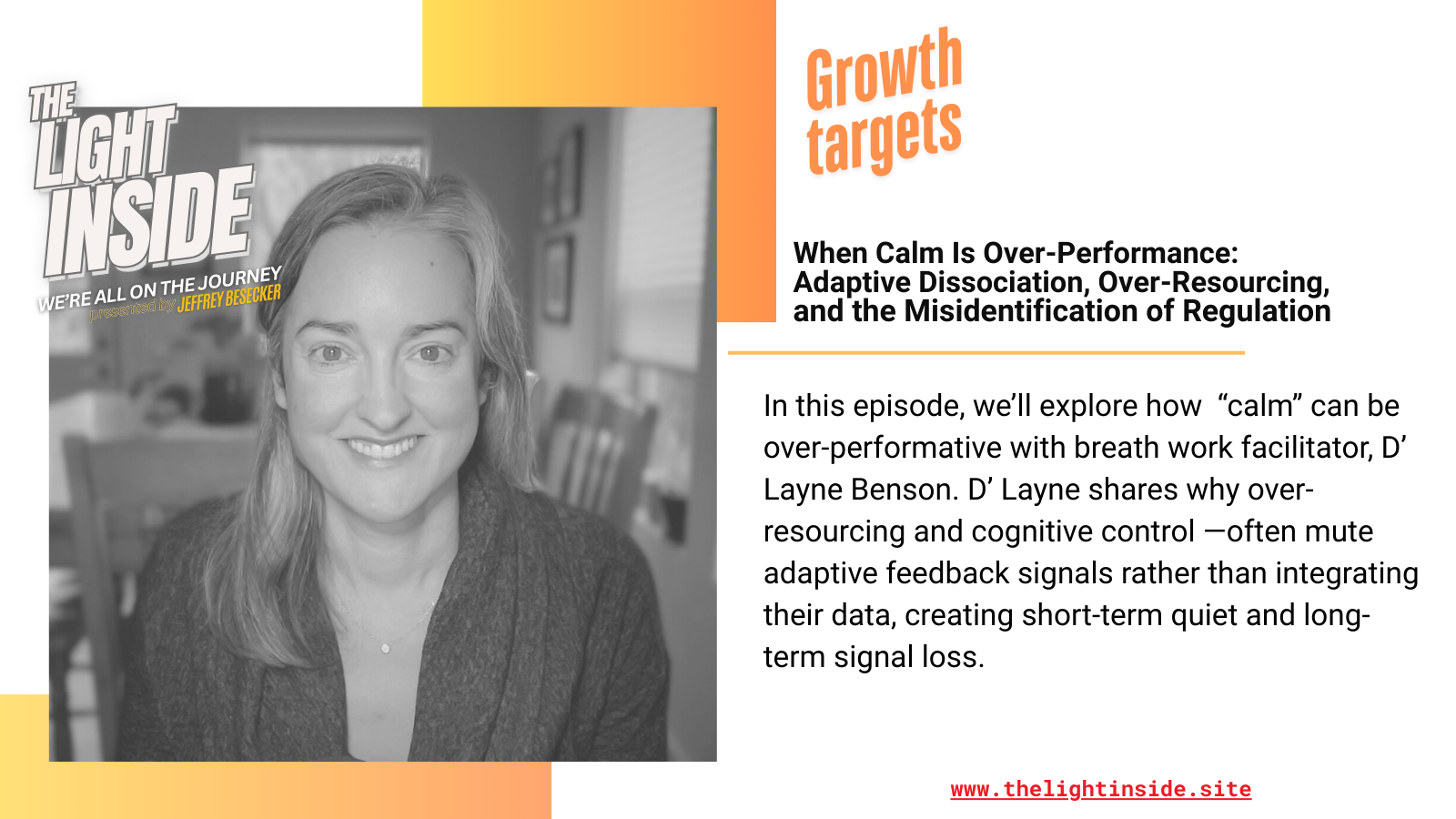
In this episode of The Light Inside, host Jeffrey Besecker delves into the concept of containment and its role in emotional regulation with breathwork facilitator D'Layne Benson RN, NC-BC. Together, they explore how emotional bypassing and avoidance can hinder our ability to process and integrate experiences, leading to a disconnection from vital signals.
Tune In!
Clinician Sidebar
False Calm Differential: When Composure ≠ Coherence
Physiological Markers
- Shallow or held breath; jaw/SCM/pelvic bracing
- Narrow interoceptive awareness (“I don’t notice until I crash”)
- Delayed fatigue or emotional signals
Cognitive–Narrative Markers
- High narrative clarity with low sensation specificity
- Rapid meaning-making that bypasses felt experience
- Identity statements under load (“I’m just not that kind of person”)
Relational Markers
- Polished affect, reduced spontaneity
- Difficulty tolerating micro-rupture or ambiguity
- Boundary difficulty paired with appeasement or over-explanation
Key Clinical Questions
- Can the client oscillate and recover without collapse?
- Does clarity increase flexibility—or narrow options?
- Is “safety” language masking a capacity limitation?
Clinical Caution
- Somatic signals are data, not directives
- Avoid reinforcing “somatic certainty” as a new control ritual
- Pair body-based work with narrative updating to expand capacity
Core Empirical Bibliography
Supporting Adaptive Dissociation, False Calm, Capacity, and Coherence
Below is a content-relevant, clinician-facing bibliography listicle that directly supports the core empirical claims in your blog summary. The emphasis is on convergent evidence rather than over-claiming causality, and on sources commonly cited across affective neuroscience, trauma studies, interoception research, and autonomic regulation.
1. Regulation vs. Suppression & Emotional Inhibition
Foundational evidence that outward calm can coexist with internal load and physiological cost.
- Gross, J. J. (1998). The emerging field of emotion regulation: An integrative review. Review of General Psychology.
- Gross, J. J., & John, O. P. (2003). Individual differences in two emotion regulation processes: Implications for affect, relationships, and well-being. Journal of Personality and Social Psychology.
- Butler, E. A., et al. (2003). The social consequences of expressive suppression. Journal of Personality and Social Psychology.
- English, T., & John, O. P. (2013). Understanding the social effects of emotion regulation. Emotion Review.
Relevance: Demonstrates that suppression can maintain outward composure while increasing physiological strain and relational cost—key to the “false calm” argument.
2. Adaptive Dissociation, Functional Freeze & Trauma Phenotypes
Evidence that dissociation and emotional dampening function as protective load-management strategies.
- Schäflein, E., et al. (2018). Disrupted interoceptive accuracy in dissociative disorders. European Journal of Psychotraumatology.
- Lanius, R. A., et al. (2010). Emotion modulation in PTSD: Clinical and neurobiological evidence for dissociative subtypes. American Journal of Psychiatry.
- van der Kolk, B. A., et al. (1996). Dissociation, somatization, and affect dysregulation. American Journal of Psychiatry.
- Tschacher, W., et al. (2022). Embodiment, affect, and the therapeutic process. Frontiers in Psychology.
Relevance: Supports the claim that calm presentations can reflect adaptive dissociation rather than integrated regulation.
3. Interoception, Signal Loss & Bodily Awareness
Empirical grounding for interoceptive dampening and delayed awareness of limits.
- Craig, A. D. (2002). How do you feel? Interoception and the sense of the physiological condition of the body.Nature Reviews Neuroscience.
- Khalsa, S. S., et al. (2018). Interoception and mental health. Biological Psychiatry.
- Krygier, J. R., et al. (2020). Mindfulness meditation, well-being, and cardiac vagal tone. Psychosomatic Medicine.
- Mehling, W. E., et al. (2012). The Multidimensional Assessment of Interoceptive Awareness (MAIA). PLoS ONE.
Relevance: Establishes that impaired interoceptive access is measurable, state-dependent, and clinically meaningful.
4. Network Neuroscience & Contextual Switching (Non-Reductionist Models)
Evidence that regulation involves dynamic network coordination rather than single “calm centers.”
- Seeley, W. W., et al. (2007). Dissociable intrinsic connectivity networks for salience processing and executive control. Journal of Neuroscience.
- Menon, V. (2011). Large-scale brain networks and psychopathology. Trends in Cognitive Sciences.
- Barrett, L. F. (2017). How emotions are made. Houghton Mifflin Harcourt.
Relevance: Supports framing false calm as biased prioritization and switching rather than neural deficit.
5. Predictive Processing, Uncertainty & Control Strategies
Theoretical spine for “false calm as policy selection.”
- Friston, K. (2010). The free-energy principle: A unified brain theory? Nature Reviews Neuroscience.
- Carhart-Harris, R. L., & Friston, K. J. (2019). REBUS and the anarchic brain. Pharmacological Reviews.
- Hirsh, J. B., et al. (2012). Psychological entropy. Psychological Review.
- Grupe, D. W., & Nitschke, J. B. (2013). Uncertainty and anticipation in anxiety. Nature Reviews Neuroscience.
Relevance: Explains why over-control and composure reduce uncertainty while narrowing adaptability.
6. Allostatic Load & Long-Horizon Cost
Physiological cost-accounting for sustained over-regulation.
- McEwen, B. S., & Stellar, E. (1993). Stress and the individual: Mechanisms leading to disease. Archives of Internal Medicine.
- McEwen, B. S. (2007). Physiology and neurobiology of stress and adaptation. Physiological Reviews.
- Juster, R.-P., et al. (2010). Allostatic load biomarkers of chronic stress. Neuroscience & Biobehavioral Reviews.
Relevance: Grounds the delayed-collapse pattern seen in high-functioning clients.
7. Identity, Role Fusion & Self-Verification
Evidence that coping strategies consolidate into identity structures.
- Swann, W. B. (1983). Self-verification: Bringing social reality into harmony with the self. Psychological Perspectives.
- Mikulincer, M., & Shaver, P. R. (2016). Attachment in adulthood. Guilford Press.
- Siegel, D. J. (2012). The developing mind. Guilford Press.
Relevance: Supports the claim that over-functioning becomes selfhood, not just behavior.
8. Emotional Labor, Caregiving & Systemic Reinforcement
Evidence that institutions select for composure and suppress signal.
- Hochschild, A. R. (1983). The managed heart. University of California Press.
- Figley, C. R. (1995). Compassion fatigue. Brunner/Mazel.
- Dean, W., Talbot, S., & Dean, A. (2019). Reframing clinician distress: Moral injury. Journal of General Internal Medicine.
Relevance: Links false calm to cultural and occupational contingencies.
9. Breathwork, Autonomic Modulation & Ethical Constraints
Evidence supporting breath as conditional regulation support.
- Zaccaro, A., et al. (2018). How breath control can change your life. Frontiers in Human Neuroscience.
- Streeter, C. C., et al. (2012). Effects of yoga on autonomic regulation. Medical Hypotheses.
- Sutcliffe, K., et al. (2022). Breathwork interventions: A systematic review. Frontiers in Psychology.
- Hopper, S. I., et al. (2023). Breathing practices and autonomic recovery. Neuroscience & Biobehavioral Reviews.
Relevance: Supports slow breathing for capacity building while documenting risk and variability in high-arousal methods.
10. Clinical Integration & Capacity-Based Sequencing
Evidence for pacing, containment, and integration over catharsis.
- Ogden, P., Minton, K., & Pain, C. (2006). Trauma and the body. Norton.
- Fisher, J. (2017). Healing the fragmented selves of trauma survivors. Routledge.
- Siegel, D. J. (2020). The developing mind (2nd ed.). Guilford Press.
Relevance: Reinforces containment, sequencing, and capacity as ethical imperatives.
Summary for Readers
Together, this literature converges on a clear conclusion: composure is not a sufficient indicator of regulation. Adaptive dissociation, cognitive override, and over-resourcing can preserve function while signaling reduced coherence. Integration emerges not from forcing calm, but from restoring oscillation, interoceptive access, and relational flexibility at a pace the system can sustain.
Behavior Counselor/Executive Producer/Host
Jeffrey Besecker is a dynamic and multifaceted content creator, podcast host, and behavioral therapist who is deeply dedicated to unraveling the complexities of human psychology, particularly focusing on subconscious and unconscious patterns that shape human behavior and influence decision-making.
His career path has traversed a variety of fields, including brand development, hospitality management, and the restaurant industry, each contributing to his holistic understanding of human dynamics and behavior.
Jeffrey specializes in addressing the unresolved psychological material that influences human responses and personal growth, with a mission to illuminate the unseen forces shaping behavior.
Jeffrey Besecker, as a Trauma-Informed Behavioral Practitioner, has a distinct approach to subconscious and unconscious patterns compared to the traditional approach and practices of his cognitive contemporaries when addressing these deeper-rooted patterns.
* His focus goes beyond addressing automatic behaviors or cognitive patterns by looking at the intricate psychological and emotional undercurrents that drive them.
This approach incorporates both primary subconscious patterns (root beliefs, emotional memories) and secondary behaviors (habitual responses and conditioned reactions) to examine how they impact behavior at a deeper level.
Holistic Integration: Unlike some methods that focus specifically on habit formation or self-talk, Jeffrey’s work combines aspects of neurobiology, psychology, somatic integration, and Jungian concept…Read More

Not Irrational, but Organized: How Protective Cue Stacks Preserve Coherence Under Load