Beyond Arousal: Recovering the Context That Organizes Human Behavior
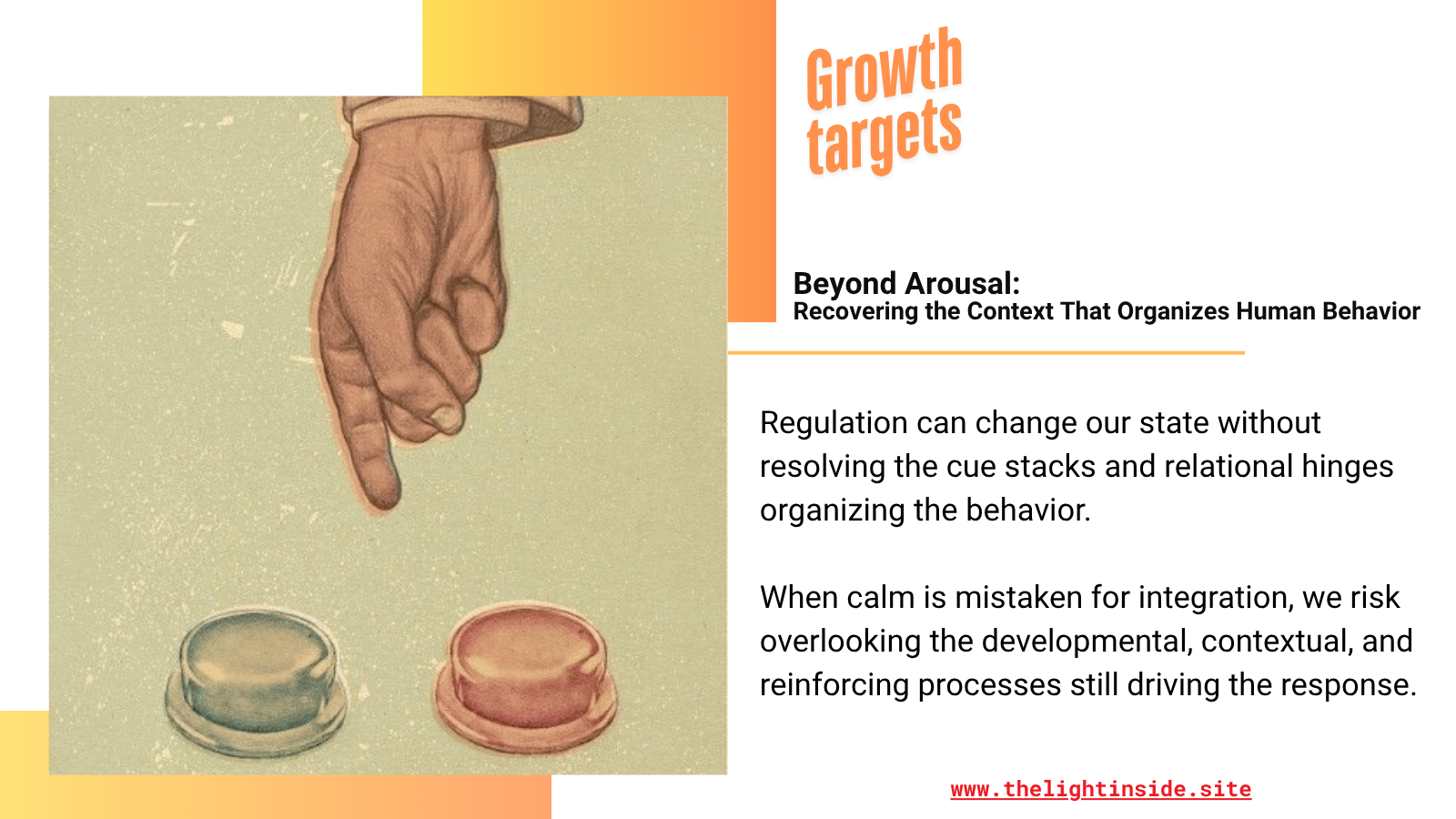
Regulation may change the state, but context reveals what is driving the behavior.
What might change if, rather than treating physiological regulation as the primary explanation for behavior, we began by identifying the developmental, relational, environmental, and reinforcing cues that give the response its context, meaning, and adaptive function?
Culturally, we often overweigh nervous-system regulation as the primary mechanism of human change, mistaking visible shifts in arousal for evidence that the underlying pattern has been resolved; this misattribution compresses the broader causal cue stack—developmental learning, relational prediction, contextual meaning, reinforcement, memory, and adaptive function—and causes us to misidentify the true hinges organizing behavior.
Nervous-system regulation is clinically important, but it is often overpromoted from an enabling condition into a primary causal explanation. Regulation may reduce acute arousal, increase attentional flexibility, widen behavioral choice, and make difficult material more approachable. It does not, by itself, identify what organized the response, revise the learned prediction, transform the relational contingency, update procedural memory, or demonstrate that change will generalize beyond the regulating environment.
Arousal Misattribution: When Regulation Obscures the Causal Context
This article examines how culturally over-prioritizing nervous-system regulation can lead us to mistake reduced arousal for deeper psychological reintegration. While regulation can expand attention, flexibility, and behavioral choice, it does not independently identify or revise the developmental, relational, environmental, and reinforcing cue stacks organizing a response.
When calm is treated as proof of resolution, clinicians and individuals risk misattributing causality, collapsing activation into dysregulation, and overlooking the broader biological supersystem through which behavior emerges. A more accurate formulation tracks the contextual cues, predictions, adaptive functions, relational hinges, and reinforcement loops that continue to shape behavior across time and settings.
The central formulation error is:
A change in physiological state is treated as proof that the causal organization producing the behavior has been identified and reintegrated.
This turns regulation from one component of intervention into a totalizing explanatory model.
What the empirical literature supports
Slow breathing and related practices can alter autonomic indices, including heart-rate variability, and may improve aspects of emotional and cognitive flexibility. Emotion regulation also shows meaningful associations with psychotherapy outcomes, particularly in anxiety treatment. These findings support regulation as a legitimate clinical process—not as a complete causal theory of behavior. (PubMed)
Contemporary neurovisceral, predictive-processing, and allostatic models describe behavior as emerging from interaction among autonomic activity, central neural processes, interoceptive predictions, metabolic demands, attention, past learning, action selection, and changing environmental conditions. The autonomic nervous system is therefore one participating layer within a distributed biological supersystem, not an independent command center that singularly “calls the shots.” (PubMed)
This distinction matters because the body does not merely react to an objectively detected condition. Interoceptive experience is partly constructed through predictions about bodily needs, constrained by sensory input and situated within an external context. Arousal is consequently data requiring formulation, not a transparent readout of a single underlying cause. (PubMed Central (PMC))
Where regulation becomes over-prioritized
1. State is confused with causal origin
A client settles after paced breathing, orienting, co-regulation, movement, or grounding. The improvement is then interpreted as evidence that autonomic dysregulation was the primary driver.
But the same state shift may arise through several routes:
- reduced uncertainty;
- temporary attentional redirection;
- expectancy or perceived therapist responsiveness;
- removal of a relational demand;
- interruption of rumination;
- increased sense of agency;
- suppression or strategic compliance;
- contextual learning that applies only in the session;
- simple passage of time.
The outcome—reduced arousal—does not discriminate among these causal pathways. Psychotherapy-process research repeatedly cautions that an observed process must temporally precede and explain outcome before it can be treated as a mechanism; many studies do not establish that sequence. (PubMed)
Formulation gap: Because regulation changed the response, regulation is assumed to have located the source.
That inference is not warranted.
2. Physiological quiet is confused with integration
Reduced heart rate, easier breathing, stillness, warmth, or a subjective sense of calm may indicate that activation has decreased. They do not establish that:
- the original cue has been differentiated;
- the prediction attached to it has changed;
- competing meanings have become available;
- avoidance has decreased;
- procedural action tendencies have reorganized;
- the new response survives relational conflict;
- the learning transfers across settings;
- the client has regained agency rather than complied.
Fear-extinction research is particularly instructive. A fear response can decline while the original learning remains available; changes in context can produce renewal, reinstatement, spontaneous recovery, or rapid reacquisition. Extinction commonly involves new, context-sensitive learning rather than simple deletion of the earlier association. (PubMed)
Thus:
Regulation may reduce the expression of an adaptive response without reorganizing the learning that makes the response probable.
A client who can remain regulated while discussing rejection with a trusted therapist may still become controlling, avoidant, appeasing, or dissociative when rejection is enacted by a partner, supervisor, or family member.
3. Autonomic markers are treated as etiologically specific
Measures such as HRV can be useful correlates of regulatory flexibility, but they are not reliable stand-alone explanations of a particular client’s behavior. Reduced HRV appears across multiple forms of psychopathology, which makes it potentially informative at a transdiagnostic level but weak as a specific marker of cause, meaning, diagnosis, or intervention target. Recent large-scale synthesis has reinforced this broad nonspecificity. (PubMed)
Autonomic patterns also vary according to the emotion, person, task, measurement method, and situation. Reviews have found both partial differentiation and substantial contextual or individual-response specificity, undermining the idea that one bodily pattern maps neatly onto one psychological state. (PubMed)
Tachycardia, shallow breathing, freezing, lowered HRV, agitation, or numbness may therefore reflect very different configurations:
- threat prediction;
- effort mobilization;
- shame exposure;
- grief;
- pain;
- anger inhibition;
- social evaluation;
- excitement;
- metabolic strain;
- medication effects;
- fatigue;
- conditioned situational expectancy.
Physiology narrows possibilities only when it converges with behavioral, relational, developmental, cognitive, and contextual evidence.
4. Regulation is assigned a universal positive teleology
The implicit assumption often becomes:
-More calm, more vagal influence, less activation, and greater physiological control equal greater health.
Yet adaptive functioning does not require continuous downregulation. Mobilization, sympathetic activation, anger, vigilance, withdrawal, and temporary narrowing can serve contextually appropriate functions. Healthy regulation involves flexible recruitment and recovery, not maintaining one preferred state.
Regulation Is Not Resolution: Rethinking the Causal Drivers of Behavior
The neurovisceral literature itself frames adaptability as integration among autonomic, attentional, affective, and executive processes—not maximal parasympathetic dominance. (PubMed)
Over-prioritization can therefore pathologize appropriate activation and reinforce premature emotional compliance:
- the quiet client is judged more integrated;
- the emotionally expressive client is judged less regulated;
- stillness is privileged over protest;
- tolerability for the clinician is mistaken for improvement in the client;
- discomfort is coded as evidence that the intervention exceeded capacity;
- the therapeutic aim drifts from adaptive choice toward managed presentation.
This can turn regulation into a behavioral performance standard rather than a resource for differentiated action.
The false-positive problem
Here, false positive is best understood as a formulation analogy rather than a formal diagnostic statistic.
A false positive occurs when a marker of temporary regulatory success is misclassified as evidence of deeper organizational change.
Example
A client discussing parental criticism begins to shake, becomes cognitively disorganized, and reports pressure in the chest. The clinician guides breathing, orienting, and grounding. The shaking stops; speech becomes coherent; the client says, “I’m okay now.”
The false-positive conclusion would be:
“The underlying problem was autonomic dysregulation, and regulation resolved it.”
Several competing explanations remain:
- The client’s attention moved away from the evoking relational material.
- The client learned that visible activation disrupts the session and should be contained.
- The client complied with an implicit demand to become easier to manage.
- The clinician’s presence temporarily supplied an external regulatory scaffold.
- The original criticism prediction remained unchanged.
- The client became less physiologically activated but more emotionally detached.
- The intervention reduced response intensity without altering avoidance.
- The client’s declaration of being “okay” functioned as a relational exit cue.
Without follow-up across context, behavior, meaning, memory, agency, and relationship, observable calm cannot tell us which process occurred.
The dyadic collapse
The over-prioritization of regulation produces at least two dyadic collapses.
Collapse 1: Activation ↔ dysregulation
The formulation is reduced to two poles:
- activated = dysregulated;
- calm = regulated.
This erases distinctions among:
- adaptive mobilization and defensive escalation;
- grief and panic;
- anger and terror;
- engaged emotional contact and flooding;
- strategic stillness and integrated repose;
- fatigue-based shutdown and protective dissociation;
- relational protest and physiological instability.
Activation is not inherently evidence of failed organization. It can be the organism’s proportionate response to current demand.
Collapse 2: Regulation ↔ resolution
The second collapse pairs:
- state reduction = therapeutic progress;
- recurrence = failure to regulate.
This removes the middle layers where actual formulation occurs:
cue → appraisal/prediction → interoceptive weighting → affective state → action tendency → behavior → relational response → reinforcement → memory updating or non-updating.
When these layers disappear, the clinician sees only the beginning and the end: arousal was present; arousal was reduced. The unexamined organizational system between them is treated as a nervous-system event.
A broader dyadic collapse can also occur within the therapeutic relationship:
The clinician becomes the regulator; the client becomes the regulated.
The relationship then organizes around state management rather than collaborative inquiry. The clinician’s preferred arousal range may become the implicit target, and the client may learn that continued connection depends upon becoming physiologically and affectively manageable.
How selective reinforcement maintains the error
Selective reinforcement develops through a clinically convincing loop:
- Activation is observed.
- A regulating intervention is applied.
- Activation decreases.
- The immediate change rewards the clinician’s intervention.
- The clinician attributes the improvement to the nervous-system explanation.
- Competing causal data are investigated less thoroughly.
- Future activation is interpreted through the same model.
- Regulation is repeatedly selected, strengthening confidence in the original formulation.
This is a self-sealing intervention loop. Regulation reliably produces visible proximal changes, while deeper processes—prediction revision, behavioral generalization, relational differentiation, memory updating, and agency restoration—are slower and harder to observe. The immediacy of physiological change therefore gives it disproportionate epistemic weight.
The therapist may then gather the very data the intervention is designed to produce: slower breathing, reduced movement, lower subjective distress, increased verbal coherence. Because alternative hypotheses are not tested, the intervention appears to confirm its own causal theory.
Four-domain compression
Epistemic compression
What do we know?
Arousal is treated as direct evidence of unresolved threat or dysregulation, and calm is treated as evidence of resolution. Yet autonomic data are probabilistic, multicausal, and context-sensitive. A state marker cannot independently establish the meaning or cause of that state.
Etiological compression
What produced it?
Developmental learning, attachment expectations, pain, endocrine and metabolic variables, relational contingencies, attentional habits, avoidance, social position, current threat, and reinforcement history are compressed into a single nervous-system cause.
Ontological compression
What is the response?
The behavior is reified as a physiological state rather than understood as an emergent organism-environment transaction. The person’s action becomes something the nervous system “does to them,” reducing the role of meaning, intention, learning history, social context, and adaptive function.
Teleological compression
What should change accomplish?
The goal becomes calm, regulation, or return to a preferred window rather than increased differentiation, context-sensitive action, agency, learning transfer, relational flexibility, and reduced dependence on the therapeutic scaffold.
A supersystem formulation
A more empirically defensible model treats human behavior as an emergent output of interacting systems:
Biological regulation
Autonomic, endocrine, immune, metabolic, sleep, pain, sensory, and motor processes.
Predictive organization
Interoceptive and exteroceptive predictions, expectancy, salience weighting, uncertainty estimation, and anticipated energetic demand.
Learning and memory
Classical and instrumental conditioning, procedural memory, reinforcement, avoidance, habit, extinction, reconsolidation, and context-dependent retrieval.
Cognitive-affective organization
Attention, appraisal, language, self-models, emotion concepts, beliefs, imagery, working memory, and metacognition.
Relational organization
Attachment predictions, trust, authority, power, rupture, repair, responsiveness, interpersonal reinforcement, and the client’s reading of the clinician.
Social and environmental conditions
Material resources, discrimination, role expectations, family systems, occupational demands, cultural meaning, actual danger, and access to support.
Developmental organization
Early markers, repeated contingencies, relational hinges, learning on-ramps, near neighbors, and periods of heightened plasticity.
Behavior is not located in any single layer. It is a context-dependent solution produced by coordination among them.
Clinically stronger causal model
Rather than asking only, “How do we regulate this response?”, formulation should ask:
- What precisely cued the response? Not merely the topic, but the tone, timing, gaze, silence, uncertainty, role demand, perceived judgment, bodily sensation, or relational shift.
- What prediction did the cue activate? For example: “I will be controlled,” “I will become burdensome,” “Disagreement ends connection,” or “Visible need produces humiliation.”
- What biological state supported the predicted action? Mobilization, collapse, analgesia, vigilance, nausea, narrowing, fatigue, or altered interoceptive attention.
- What behavior became more probable? Appeasement, withdrawal, intellectualization, anger, overexplaining, compliance, checking, dissociation, or control.
- What consequence reinforced it? Reduced conflict, therapist reassurance, escape from exposure, restoration of predictability, or avoidance of shame.
- What changed after regulation? Only arousal—or also prediction, action choice, self-other differentiation, relational participation, and behavior across settings?
Reintegrative markers beyond calm
A stronger inference of reintegration requires convergence across several domains:
- the client can identify earlier cue markers before full activation;
- bodily sensations become more differentiated rather than merely quieter;
- multiple meanings can be held without premature certainty;
- the client can remain agentic while activated;
- new behavior occurs in the original triggering context;
- reliance on therapist-led regulation decreases;
- conflict, uncertainty, or emotional intensity no longer automatically selects the old response;
- the client can approach rather than only suppress or escape the cue;
- the new learning persists across time, relationships, and physiological states;
- recurrence is used as new formulation data rather than labeled regulatory failure.
The therapeutic alliance is especially relevant. Across hundreds of psychotherapy studies, alliance quality has a consistent association with outcome, and therapist effects contribute meaningfully to that relationship. This means that what appears to be internal autonomic change may partly reflect relational collaboration, responsiveness, expectancy, or dyadic organization. (PubMed)
Bottom line
The nervous system is neither irrelevant nor sovereign. Regulation is often the on-ramp to reintegration, but it should not be mistaken for the vehicle, destination, or proof of arrival.
The core supervisory guardrail is:
Regulation may make new learning biologically and relationally available; only convergent changes in prediction, memory, behavior, agency, and contextual transfer suggest that unresolved organization is being reintegrated.
When physiological settling is treated as causal resolution, we risk generating a false positive: observable calm with preserved underlying prediction. When activation and dysregulation—or regulation and resolution—are collapsed into dyads, the full supersystem disappears from formulation. What remains is a legible state change, but not necessarily an accurate account of the person, the adaptive function, or the contextual organization continuing to drive the behavior.
Peer-Supported Evidence: Why Regulation Is Not the Full Causal Formulation
1. Regulation can support change without identifying its mechanism
Psychotherapy research distinguishes an intervention-associated improvement from a demonstrated causal mechanism. Establishing mechanism requires evidence of temporal precedence, specificity, consistency, experimental influence, and a credible pathway from the proposed mediator to the eventual outcome; an immediate reduction in arousal does not independently satisfy those conditions. (PubMed)
Why this matters relationally: A client becoming calmer after a clinician intervenes may show that the interaction altered their present state, but it does not tell us whether reassurance, attentional redirection, compliance, relational trust, expectancy, or physiological settling produced the change. Treating the visible response as causal proof can close inquiry before the client’s own meanings and organizing predictions have been differentiated.
2. Extinction often inhibits earlier learning rather than erasing it
Fear-extinction research indicates that reduced responding frequently reflects new, context-dependent learning that competes with—not necessarily removes—the earlier association. Renewal, reinstatement, spontaneous recovery, and reacquisition demonstrate that an apparently resolved response can return when time, setting, stress, or cue conditions change. (PubMed)
Why this matters relationally: A client may discuss a cue without marked activation inside a predictable therapeutic relationship while the original response remains available in family, occupational, or intimate contexts. In-session regulation should therefore be assessed as potential access to new learning, not automatic evidence that the earlier relational prediction has been reintegrated.
3. Autonomic measures are informative but etiologically nonspecific
Heart-rate variability is associated with regulatory processes and differs across several forms of psychopathology, yet its transdiagnostic distribution limits its ability to identify one disorder, cause, meaning, or behavioral function. A 2025 umbrella review also found substantial variability across pooled analyses, reinforcing that HRV is not a stand-alone index of psychological organization or treatment resolution. (PubMed)
Why this matters relationally: Similar physiological readings can accompany shame, effort, vigilance, grief, pain, inhibition, excitement, medication effects, or perceived social evaluation. Assigning one relational meaning to a nonspecific bodily marker risks interpretive intrusion and may replace collaborative formulation with physiological certainty.
4. Arousal patterns do not map cleanly onto singular emotional meanings
Reviews of autonomic activity show a mixture of partial emotion differentiation, individual-response specificity, situational effects, and methodological variation. Even where recognizable physiological patterns emerge, the eliciting context and induction method substantially influence the autonomic response. (PubMed)
Why this matters relationally: Activation cannot be assumed to mean dysregulation, threat, or diminished capacity without examining what happened between the participants and how the client interpreted it. The same physiological mobilization might signal fear, anger, engagement, protest, anticipatory effort, or an adaptive attempt to preserve relational agency.
5. Regulatory adaptability depends on context—not continuous calm
Regulatory-flexibility models emphasize sensitivity to context, access to a varied strategy repertoire, and responsiveness to feedback rather than reliance on one supposedly optimal strategy or state. Research increasingly challenges universal classifications of regulation strategies as inherently adaptive or maladaptive apart from their fit with situational demands. (PubMed)
Why this matters relationally: A client’s anger, withdrawal, vigilance, or increased activation may be proportionate to an interaction rather than evidence of failed regulation. Privileging calm can inadvertently reward emotional manageability while obscuring whether the person can flexibly mobilize, protest, connect, disengage, and recover according to present relational conditions.
6. Interoception is shaped by prediction and learned context
Predictive-interoception models propose that bodily experience emerges through interaction between sensory signals and prior expectations about the body, environment, and anticipated demands. Physiological sensations are therefore not raw, self-interpreting evidence; they are weighted and experienced within an active predictive model informed by previous learning. (PubMed)
Why this matters relationally: A tightening chest may be experienced as danger, shame, excitement, exposure, effort, or loss of control depending on the cue stack and relational prediction already in place. Regulation may soften the sensation, but formulation must still identify which prediction gave that sensation meaning and selected the subsequent behavior.
7. Human regulation operates through an integrated biological supersystem
Allostatic models describe the brain as predictively coordinating autonomic, endocrine, immune, metabolic, sensory, and behavioral processes in anticipation of changing demands. This evidence opposes the reduction of behavior to a single autonomic pathway and instead situates state regulation within a distributed, hierarchical organism–environment system. (PubMed)
Why this matters relationally: The client’s behavior cannot be adequately explained by whether their nervous system is “regulated” in isolation from sleep, pain, energy demand, medication, social power, environmental uncertainty, developmental history, and relational consequence. A supersystem formulation asks how these processes coordinate around a specific adaptive demand rather than assigning unilateral command to one bodily system.
8. Social and cultural contexts help construct regulatory patterns
Research on cultural emotion regulation suggests that communities shape which situations are selected, which appraisals are encouraged, and which emotional expressions are reinforced or discouraged. Allostatic-load research similarly shows that changing social and environmental conditions become biologically embedded, influencing physiological functioning and health over time. (PubMed)
Why this matters relationally: A response may organize around cultural expectations concerning authority, emotional restraint, independence, obedience, gender, belonging, or relational obligation—not merely around internal physiological instability. Removing context can pathologize an adaptive response while overlooking the social conditions that repeatedly cue and reinforce it.
9. The therapeutic relationship is itself an active causal context
A large meta-analysis of adult psychotherapy found a consistent association between therapeutic alliance and treatment outcome, while further analyses indicate that alliance contributes beyond several intake characteristics and treatment processes. Therapist effects also influence the alliance–outcome relationship, meaning that state changes occurring in therapy cannot automatically be attributed solely to processes within the client. (PubMed)
Why this matters relationally: A client may settle because they feel understood, because uncertainty has decreased, because the clinician has withdrawn a demand, or because they predict connection will be preserved if they become composed. The dyad must therefore be included in the formulation rather than treating the clinician as a neutral regulator acting upon an isolated nervous system.
10. Emotion-regulation improvement is meaningful, but it remains one change process among several
Meta-analytic evidence indicates that emotional changes and regulation capacities are associated with psychotherapy outcomes, supporting their legitimate place in treatment. However, this literature also examines multiple emotional processes and does not establish regulation as the singular or universally primary mechanism through which psychological change occurs. (PubMed)
Why this matters relationally: Regulation may increase attentional access, tolerance for ambiguity, and the ability to remain engaged with difficult interpersonal data. Its value is diminished—not strengthened—when it is overextended into an explanation that eclipses meaning, memory, reinforcement, relationship, and the client’s adaptive purpose.
Support Summary
Across psychophysiology, learning science, affective neuroscience, allostatic theory, and psychotherapy-process research, the evidence supports regulation as an important source of access and flexibility but not as independent proof of causal resolution. Generative behavioral change is more credibly inferred when physiological shifts converge with revised predictions, differentiated cue recognition, expanded agency, relational adaptability, new behavioral choices, and transfer across the contexts in which the original pattern was learned and reinforced.

Executive Program Director | Guest Relations | Clinical Education Coordination
Anna Getz serves as Executive Program Director at The Light Inside, where she helps guide the relational, editorial, and community pathways that support the platform’s clinician-facing educational mission. With a warm, thoughtful presence and a strong eye for language, Anna helps create the connective tissue between guests, contributors, practitioners, and the larger community.
Her work centers on making each interaction feel clear, welcoming, and well-held—from early guest outreach and pre-call coordination to research support, editorial alignment, and community engagement. Anna brings a relationally attuned approach to helping conversations take shape with care, curiosity, and purpose, ensuring that each episode and educational resource reflects the platform’s commitment to clinical relevance, shared trust, and meaningful human connection.
At The Light Inside, Anna’s role is both practical and deeply relational. She helps translate ideas into organized pathways, supports guests in understanding the heart of the program, and nurtures the kind of contact that allows thoughtful clinical education to emerge with clarity, humility, and care.
When Psychological Safety Becomes Constraint: The Role of Risk in Human Adaptation and Generative Growth
