The Child Is the Cue, Not the Cause: How Arousal Misattribution Fuels Reactive Parenting
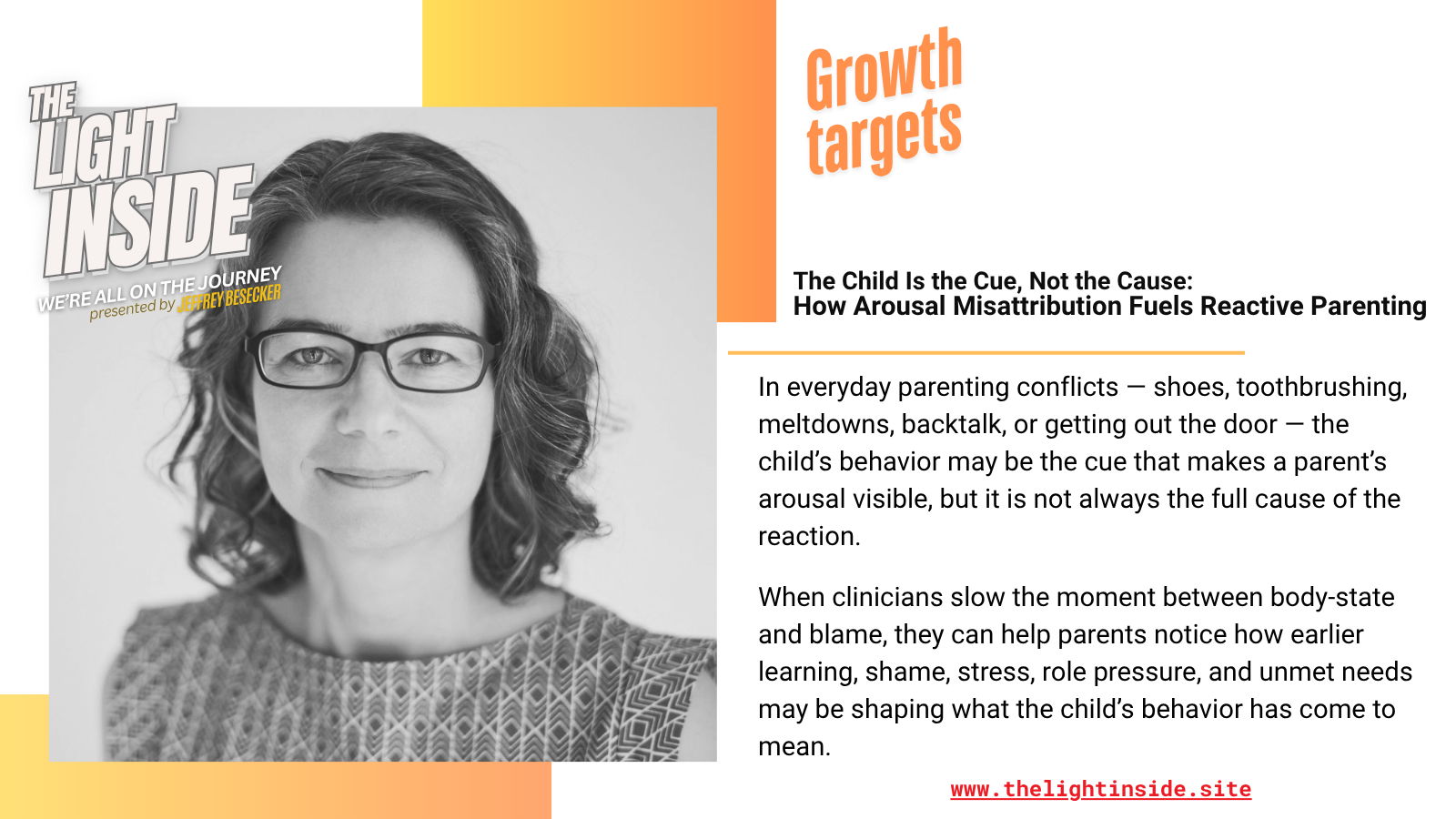
In tense moments of parent-child conflict, what becomes possible when we shift from blaming the child’s behavior to noticing our own arousal attribution — and asking what that activation may be pointing toward beneath the surface?
We’ve all had those moments…
When a child’s behavior seems to push a button we didn’t know was still there. The shoes are not on, a toothbrush untouched, the clock ticking.
And suddenly the parent’s body is already telling a story:
One of urgency, tightening, shame, frustration—or the need to regain a false sense of dominance and control.
But what if the child’s behavior is not the whole story?
What if the more important clinical moment begins just before the reaction — When the parent’s body activates.
The mind assigns meaning, and an older developmental pattern starts shaping what the present moment seems to require?
Why it matters: That is the hinge we are exploring today through our clinical lens:
- How arousal becomes attribution
- How the child can become the container for a parent’s unresolved data
- And how clinicians can help slow that sequence with enough care
That both parent and child remain visible inside the relational field.
Sharpening Clinical Formulation Before Intervention Begins
Reactive parenting is often described through the behavior we can most easily see: yelling, controlling, withdrawing, over-explaining, appeasing, rescuing, or escalating. Yet these visible responses rarely explain themselves. Beneath the reaction, a parent’s nervous system may be attempting to regulate threat, shame, helplessness, uncertainty, role pressure, sensory overload, or unresolved developmental learning that becomes active before reflective choice is fully available.
This is where Jen Lumanlan s parenting-development frame offers a meaningful bridge to the clinical and supervisory mission of The Light Inside. Her work helps parents notice how their children’s behavior may activate stored emotional, relational, and body-based data from earlier life. The clinical task, however, is not to reduce the parent to “reactive,” the child to “the problem,” or culture to a single master explanation. The task is to formulate what the parent’s system is detecting, what meaning it assigns, what state shift follows, and what behavior temporarily restores coherence.
A clinically clean formulation begins here:
The child’s behavior is often the activating cue, but not the total cause.
The child may refuse shoes, melt down, talk back, resist toothbrushing, struggle in school, demand autonomy, or express need in ways that contact the parent’s unresolved developmental and relational data. The parent’s body then shifts before the parent can fully understand why: throat constriction, tight chest, sweaty hands, faster heartbeat, jaw tension, heat, collapse, urgency, or shame. That arousal may then be assigned to the child: “They are causing this,” “They are disrespecting me,” “If they would stop, I would be okay,” or “I have to fix this right now.”
This is the pivotal hinge of the episode: arousal misattribution.
The parent’s body activates. The mind assigns cause. The child becomes the container for a state shaped by earlier learning, current stress, sociocultural conditioning, and relational prediction.
From Parent Reactivity to Protective Function
The stronger episode direction is not simply, “Why do parents react?”
The cleaner question is:
What is parent reactivity trying to solve?
This moves the conversation below the symptom layer. Yelling may be trying to restore control. Appeasement may be trying to preserve attachment. Withdrawal may be trying to prevent escalation. Over-explaining may be trying to regain coherence. Rescuing may be trying to prevent shame, helplessness, or relational rupture. These responses are not automatically adaptive in the present, but they often make sense inside the nervous system that learned them.
A clinically useful cue stack might look like this:
Child behavior meltdown, talking back, mess, refusal, school struggle, disorganization, autonomy, emotional intensity
→ Default cue “This behavior once threatened belonging, safety, worth, acceptance, or role stability.”
→ Appraisal “If I do not fix this now, something bad will happen.”
→ State shift arousal, tightening, urgency, collapse, narrowed attention, shame, heat, panic, helplessness
→ Role-state controller, rescuer, peacekeeper, over-functioner, ashamed parent, abandoned child, responsible one
→ Behavior yelling, lecturing, fixing, appeasing, withdrawing, over-explaining, over-functioning, demanding repair
→ Short-term payoff temporary compliance, reduced uncertainty, restored role coherence, reduced shame, attachment preservation
→ Reinforcement the parent concludes the child’s behavior caused the activation, rather than recognizing the default cue beneath the response.
This keeps the episode aligned with the core educational mission of The Light Inside: helping clinicians move beneath surface symptom management into organizational formulation. What cue does the system detect? What meaning does it assign? What body-state shift occurs? What role-state comes online? What behavior follows? What reinforcement keeps the loop active?
Why “The Child Isn’t the Trigger” Needs Clinical Refinement
Jen’s submitted thesis included the direction: “The Child Isn’t the Trigger: How Arousal Misattribution Fuels Intergenerational Reactive Parenting.” The spirit of this frame is clinically valuable because it challenges the common parental belief that the child’s behavior is the full cause of the parent’s distress. However, the phrase may overcorrect.
A cleaner formulation is:
The Child Is the Cue, Not the Cause: How Arousal Misattribution Fuels Intergenerational Reactive Parenting.
This distinction matters. The child’s behavior may absolutely be the proximal cue. A child refusing shoes, melting down, or talking back may be the live relational contact point where arousal becomes noticeable. But the parent’s response may be organized by a wider cue stack: bodily arousal, early punishment history, shame conditioning, belonging-threat learning, role pressure, neurodivergence, sensory load, sleep deprivation, current stress, sociocultural expectations, and implicit relational memory.
If we say the child is not the trigger, we may unintentionally erase the present interaction. If we say the child is the total cause, we collapse the formulation into blame. The clinically useful middle position is that the child’s behavior activates the cue stack, while the parent’s developmental and sociocultural learning organizes the appraisal.
The Clinical Value of Arousal Misattribution
Arousal misattribution matters because physiological activation is not self-interpreting. The body sends intensity before the mind has fully determined meaning. Under stress, the parent may look to the most available contextual cue—the child’s behavior—and assign the arousal there.
This is especially important in parent-child interactions because children often express needs through immature strategies. A child may resist, stall, cry, argue, withdraw, or act impulsively because they are tired, overwhelmed, seeking connection, needing autonomy, experiencing sensory discomfort, or lacking developmental capacity.
But if the parent’s body-state has already organized the child as the cause of distress, the parent may respond to the child as a threat rather than as a child communicating through limited developmental tools.
The central clinical gap is that many parents do not recognize the sequence between arousal and attribution. They experience the child’s behavior and their own body-state as one fused event. The clinician’s role is to create enough space to differentiate:
- What did the child actually do?
- What did the parent’s body detect?
- What did the parent’s system predict?
- What meaning was assigned?
- What action began to feel necessary?
- What short-term relief reinforced the response?
This is the intervention before the intervention. It sharpens clinical formulation before advice, skills, scripts, or corrective parenting strategies are introduced.
Sociocultural Context as Cue-Stack Data, Not Master Explanation
One of Jen’s strongest contributions is her insistence that parenting does not occur in a neutral individual vacuum. Parents are shaped by what they were rewarded for, punished for, shamed for, praised for, silenced around, and trained to fear. Many of these lessons are organized by larger sociocultural systems, including racialized expectations, gendered caregiving roles, productivity demands, achievement pressure, authority norms, and belonging rules.
This is clinically meaningful. Culture is not merely a backdrop; it can become part of the nervous system’s predictive map. A parent may learn:
- “A good child complies.”
- “A good parent controls.”
- “Needs are inconvenient.”
- “Rest is selfish.”
- “Talking back is dangerous.”
- “Mess means failure.”
- “Achievement protects belonging.”
- “Emotional expression invites punishment.”
- “If my child is judged, I am judged.”
- “If I lose control, I lose safety.”
These are clinically usable formulation variables. They translate broad sociocultural systems into observable default cues: belonging threat, shame conditioning, role expectation, compliance learning, punishment history, productivity demand, authority sensitivity, and threat-to-worth appraisal.
Clinical risk: The risk appears when large systems such as white supremacy, patriarchy, or capitalism are named as the explanation before the client’s lived cue has been observed. A clinician cannot intervene directly on “capitalism” in the room, but the clinician can help a parent examine the embodied belief: “If my child does not perform, I have failed,” or “If I rest, I am selfish,” or “If my child resists authority, they will be unsafe.”
This preserves the systemic layer without allowing it to become interpretive intrusion.
The Risk of Interpretive Intrusion
Interpretive intrusion occurs when the clinician’s explanation becomes more organized than the client’s lived experience. It can happen through a trauma frame, a behavioral frame, or a sociopolitical frame. The content of the interpretation may even be plausible, but the process becomes intrusive when the clinician assigns meaning before the client has enough capacity, consent, and shared language to test it.
A clinician might say:
“This is patriarchy showing up in your parenting.”
That may be meaningful at one layer of analysis, but it can bypass the parent’s immediate lived moment:
“When my child talks back, my chest tightens because I learned that disrespect leads to punishment, rejection, or public shame.”
The second statement is more clinically contactful. It keeps the work in the client’s system. It allows the clinician to ask, “Where did your system learn that this behavior threatens belonging, worth, or safety?” From there, family, culture, race, gender, class, authority, and economic pressure can be explored as possible layers of the cue stack rather than imposed as the whole explanation.
A clean supervisory stance would be:
“Let’s track what your system learned this behavior means, then we can ask whether family, cultural, racialized, gendered, or economic norms helped train that meaning.”
When Systemic Insight Can Become Moral Pressure
Systemic analysis can deepen clinical formulation, but it can also become morally overloading when introduced too quickly. A parent already carrying shame may hear, “You are reproducing harm,” even when the clinician’s intention is compassionate. That can intensify collapse, defensiveness, over-controlled repair, appeasement, or premature emotional compliance.
This is especially important in parent-child work because many parents arrive already fearing they are failing. If the clinical frame adds another layer of moral indictment, the parent may agree outwardly while losing inner access to the very data needed for change.
The guardrail is sequencing:
- Start with the body-state. “What happened first in your system?”
- Identify the default cue. “What did your system detect?”
- Name the protective function. “What was this response trying to prevent, preserve, regulate, or restore?”
- Then widen to culture. “Where did you learn that this behavior threatens belonging, worth, safety, or acceptance?”
This pacing reduces the chance that structural analysis becomes moral overload. It also preserves the parent’s agency while keeping the child’s needs visible.
The Role of Self-Compassion
Jen’s emphasis on self-compassion is not a soft supplement to the model; it is part of the mechanism of change. Many parents have internalized the formula: knowledge plus willpower equals results. When they know what they “should” do and still react, they conclude they lack discipline, care, or moral strength. That shame narrows capacity and keeps the pattern locked.
Self-compassion changes the field because it helps the parent understand the protective function of the response without over-identifying with it. The parent can say, “This reaction made sense in the system where it was learned,” without concluding, “Therefore I cannot change.” That distinction protects agency.
A parent may begin to recognize:
- “My body is activated.”
- “This arousal is real.”
- “My child may not be the full cause.”
- “My response is trying to protect something.”
- “I can ask what need is present.”
- “I can test a different response before the loop reaches its apex.”
This is not permissiveness. It is formulation. It creates enough contact for intervention to become possible.
Interoception and the Early-Warning Window
A major clinical strength in Jen’s framing is the emphasis on early somatic markers. Parents often ask, “How do I stop yelling at my child?” But by the time the parent is yelling, the interaction may already be at the apex of activation. The more useful clinical window appears earlier: throat constriction, shoulder tension, sweaty hands, faster heartbeat, tight chest, heat, urgency, breath change, or collapse.
Each parent may have a specific somatic signature. One parent who was not heard in childhood may feel throat constriction when they believe they are not being heard now. Another may feel chest tightness when a child resists authority. Another may feel stomach activation when time pressure, public judgment, or failure cues enter the field.
The clinician’s task is to help the parent map that early-warning system before the response becomes automatic. This is where body-based awareness becomes clinically useful: not as a generic regulation technique, but as a precise formulation tool.
The question becomes:
What shifts first, and what does that shift make easier or harder in the moment?
Need Versus Strategy
One of the most clinically useful distinctions in Jen’s model is the difference between a need and a strategy. A parent may say, “I need my child to put on their shoes.” But that is not the need; it is the strategy. The underlying need might be ease, cooperation, safety, punctuality, support, relief from judgment, or reduced fear that the child’s behavior reflects the parent’s worth.
The same is true for the child. Refusing shoes may not be “defiance.” It may be an immature strategy for meeting a need: autonomy, sensory comfort, connection, play, transition support, or being seen.
This distinction protects the clinician from collapsing the field into behavior management. Instead of asking, “How do we get the child to comply?” the clinician can ask:
- What need is the parent trying to meet?
- What need is the child trying to meet?
- What strategy is each person using?
- Is there a new strategy that could meet both needs with less rupture?
This shifts the work from control to contact.
Behavioral Models as an Important Counterweight
A clinically clean episode should not reject behavioral parenting research entirely. Coercive family process models show that parent and child behavior can become mutually reinforcing through present-time contingencies. A parent escalates, the child complies or escalates, the parent experiences short-term relief, and both systems learn from the interaction. Behavioral parent training models also have evidence supporting improvements in parent, child, and family outcomes.
This evidence does not erase trauma, culture, interoception, or developmental learning. It prevents the formulation from becoming too intrapsychic or too structural.
The most integrated model holds all levels:
- present contingency,
- child developmental capacity,
- parent arousal,
- parent history,
- sociocultural conditioning,
- reinforcement,
- relational repair.
For some families, behavioral strategies and contingency changes may be necessary. For others, those strategies fail because they do not address the parent’s true activation source. The clinical challenge is determining which level is organizing the response in vivo.
Where This Episode Fits The Light Inside
This conversation is a strong fit for The Light Inside when it remains anchored in clinical formulation rather than broad parenting advice. The core objective is not to teach parents a better script. It is to help therapeutic professionals observe how unresolved data enters the relational field through arousal, attribution, protective behavior, and reinforcement.
The best episode anchor is:
When a child’s behavior activates a parent’s body-state, what did the parent’s system learn this behavior means?
That question preserves complexity without losing clinical contact. It allows the clinician to hold the child’s developmental signal, the parent’s embodied state, the family history, the cultural context, and the live alliance at the same time.
Three Clinically Clean Guardrails
1. Do not replace one compressed explanation with another
The problem is not only the belief, “My child caused this.” The problem is any formulation that closes too early. “This is trauma,” “this is patriarchy,” “this is a coercive cycle,” or “this is sensory overload” may each be partly true. None should become the whole explanation before the cue stack has been observed.
2. Translate broad systems into observable variables
Instead of stopping at “societal stigma,” ask what the nervous system is actually detecting: judgment, punishment, rejection, loss of belonging, failure, exposure, disrespect, danger, incompetence, or loss of control.
3. Preserve agency for both parent and child
The parent is not the villain. The child is not the problem. The clinician is not the moral interpreter. The work is to restore enough differentiation for everyone in the field to become more visible.
Clinician Cue Questions
When consent and capacity are present, clinicians might ask:
- “What happened first in your body as your child did that?”
- “What did your system seem to believe this behavior meant?”
- “Where did you learn that this kind of behavior threatens safety, belonging, respect, or worth?”
- “What was your response trying to prevent, protect, restore, or regulate?”
- “What else could be shaping the arousal besides the child’s behavior?”
- “What need were you trying to meet, and what need might your child have been trying to meet?”
- “What would change if we treated the arousal as data rather than proof?”
These questions delay early closure and keep the formulation collaborative.
Concluding Peer-Reviewed Evidence Summary
The episode direction is supported by several converging bodies of evidence named in the submitted materials. Schachter and Singer’s two-factor theory of emotion provides foundational support for the idea that physiological arousal is interpreted through contextual and cognitive labeling rather than arriving as a complete explanation. Dutton and Aron’s misattribution-of-arousal study further illustrates how physiological intensity can be assigned to an available but incomplete explanation. Together, these support the clinical relevance of arousal misattribution in parent-child conflict.
Interoception research also supports the episode’s emphasis on early body cues. Schaan and colleagues’ work links childhood trauma with stress-related interoceptive accuracy, while Price and Hooven describe interoceptive awareness as a pathway for emotion regulation. Schulz and Vögele further connect interoception, stress systems, and mental health, reinforcing the idea that bodily signaling, appraisal, and regulation interact dynamically rather than linearly.
Arousal reappraisal research provides additional support for the intervention pathway. Brooks’ work on reframing anxiety as excitement and Jamieson, Nock, and Mendes’ research on stress reappraisal both suggest that the meaning assigned to physiological activation can change downstream behavior. This aligns with the episode’s central claim: when parents can notice arousal early and reattribute it more accurately, they may regain access to agency before the pattern reaches full activation.
The submitted materials also highlight the need to include sociocultural and family-process context. Research on cultural parenting models, family stress, racial discrimination, racial socialization, gendered caregiving expectations, and intensive mothering supports the claim that parenting behavior is shaped by broader relational and structural contexts, not simply individual choice. At the same time, behavioral parenting and coercive family process research remain important counterweights because they show how present-time parent-child contingencies can reinforce escalation, withdrawal, and compliance cycles.
The most clinically responsible synthesis is therefore neither purely behavioral nor purely trauma-based nor purely sociopolitical. Reactive parenting often emerges where present child behavior, parent arousal, early developmental learning, sociocultural conditioning, and reinforcement converge. The work is to slow the sequence early enough to differentiate the child’s developmental signal from the parent’s stored data, while holding culture as an important layer of formulation—not the whole formulation.
In Summary
Reactive parenting is not best understood as a failure of insight, care, or willpower. It is often a state-dependent protective response organized by arousal misattribution: the parent’s body detects a familiar cue, assigns meaning before the present field is fully sampled, and moves into control, appeasement, withdrawal, or over-functioning to restore coherence. Clinically, the task is to help parents and practitioners pause at the hinge where arousal becomes attribution, so the child remains visible as a developing person, the parent remains visible as an agentic caregiver, and intervention begins from context rather than blame.
Supervisory Resources
The clinical hinge is attribution:
when parents can ask, “What is this pointing toward?” they regain space to separate their own needs, history, and body-state from the child’s present signal.
The work is not building better scripts, but deeper contact:
clinicians can help parents preserve agency, test meaning, and move toward small lived experiments that support both parent and child.
Tip of the day:
Use this quick cue card inside the client container to slow early closure, preserve consent, and track what a client’s arousal may be pointing toward before moving into formulation.
“As we touch this moment, what do you notice first in your body, your thoughts, or your impulse to act?”
“Would it feel useful to slow this down together, or would stepping back help you stay more connected right now?”
“Before we decide what this means, can we gently ask what this arousal may be pointing toward?”
One final insight we can take from this conversation:
Arousal misattribution often begins when the body detects a familiar relational pattern before the mind has fully sampled the present moment — which gives clinicians a meaningful place to pause, track the parent’s earliest body cues, and ask what prior learning, unmet need, role pressure, or developmental prediction may be shaping the response—before the child becomes organized as the cause.
Find out more in this week’s episode of The Light Inside, where Jeffrey Besecker and Jen Lumanlan explore how parent reactivity forms when arousal gets assigned to the child before the deeper cue has been understood.
“Arousal Misattribution in Parenting: How Clinicians Track Reactivity Before Intervention”

Executive Program Director | Guest Relations | Clinical Education Coordination
Anna Getz serves as Executive Program Director at The Light Inside, where she helps guide the relational, editorial, and community pathways that support the platform’s clinician-facing educational mission. With a warm, thoughtful presence and a strong eye for language, Anna helps create the connective tissue between guests, contributors, practitioners, and the larger community.
Her work centers on making each interaction feel clear, welcoming, and well-held—from early guest outreach and pre-call coordination to research support, editorial alignment, and community engagement. Anna brings a relationally attuned approach to helping conversations take shape with care, curiosity, and purpose, ensuring that each episode and educational resource reflects the platform’s commitment to clinical relevance, shared trust, and meaningful human connection.
At The Light Inside, Anna’s role is both practical and deeply relational. She helps translate ideas into organized pathways, supports guests in understanding the heart of the program, and nurtures the kind of contact that allows thoughtful clinical education to emerge with clarity, humility, and care.
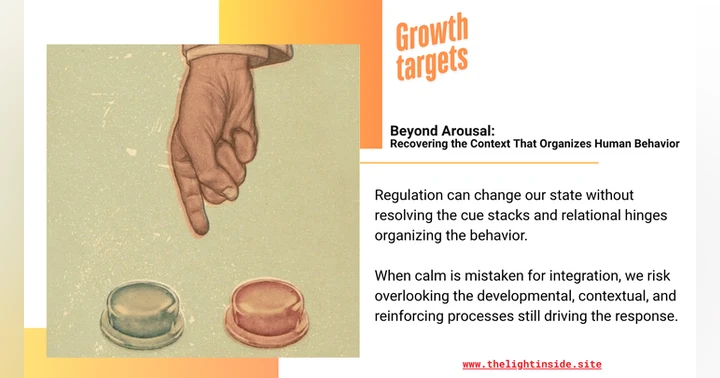
Beyond Arousal: Recovering the Context That Organizes Human Behavior