Mirror Neurons Fallacy: Why Observational Forecasting Is Often Over-Inferred
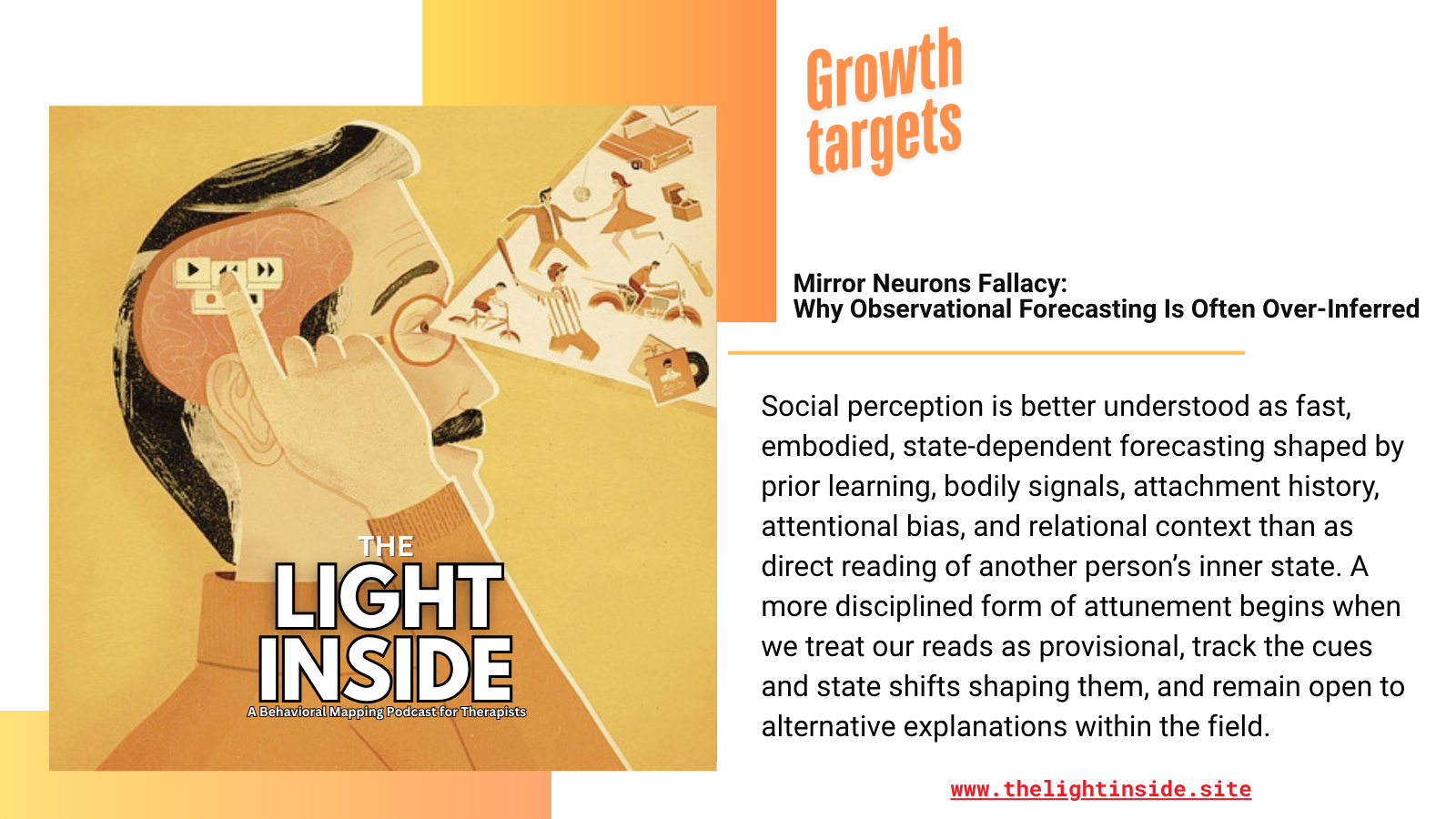
How accurately do we really read another person’s inner state when both social perception and self-perception are shaped by attentional bias, predictive inference, and the introspective limits we bring to our own unresolved patterns?
Mirror systems may help the brain map observed behavior onto our own action-affect templates, but understanding another person’s state is better modeled as rapid, context-shaped predictive inference than as literal emotional “reading”—better understood as embodied, predictive, state-dependent inference shaped by load, priors, and relational contex.
How Predictive Learning Shapes What We Think We See
A more defensible clinical answer is: less directly than we often assume. Human beings do not literally “read” one another’s minds or emotions. We infer them.
Mirror-type systems may contribute to action resonance, partial embodied simulation, and low-level action matching, but understanding another person’s internal state is better modeled as a rapid, context-shaped act of predictive inference than as transparent emotional access. What often feels like immediate interpersonal knowing is usually a fast, embodied, state-dependent estimate assembled from prior learning, interoceptive signals, attachment expectations, attentional weighting, and current relational cues.
This distinction matters because it changes the clinical task. If social perception is not a neutral readout of reality, then attunement cannot be reduced to accuracy of observation alone. It must also include disciplined awareness of how the observer’s own bodily state, history, expectations, and need for coherence are shaping what is noticed, what is inferred, and what is prematurely treated as truth. In this sense, perception is not passive detection but active organization: a best-guess model built under conditions of uncertainty.
Beyond Mind-Reading: From Resonance to Inference
The popular mirror-neuron story became compelling because it offered a simple explanation for a complex human experience. If seeing another person act or emote activates corresponding systems in the observer, then social understanding can appear immediate, embodied, and self-evident. Yet the narrower empirical claim is more sustainable than the stronger cultural one. Mirror-related processes may support sensorimotor resonance and contribute to recognizing visible action patterns, but they do not, by themselves, establish direct access to another person’s felt experience, motive, or meaning. The stronger versions of the mirror-neuron argument were likely overstated. (PubMed)
This is where predictive accounts offer a more coherent framework. Social perception is better understood as a distributed inferential process in which the brain continuously generates and updates best guesses about what another person is feeling, intending, or about to do. These guesses are shaped not only by incoming cues such as facial expression, posture, tone, pace, and timing, but also by top-down expectations, autobiographical memory, attachment-linked forecasting, and the observer’s interoceptive state. Put simply: we do not just see people; we predict them.
A major point in the later literature is that the strongest versions of the claim were probably overstated. Critical reviews and reassessments argue that mirror-related areas seem better supported for low-level processing of observed actions, action matching, and motor prediction than for high-level mindreading or inferring complex intentions. One influential 2021 review summarizes the current state this way: mirror-neuron brain areas likely contribute to distinguishing observed actions, but not, by themselves, to inferring the actor’s broader intention. (PubMed)
What We Notice, What We Infer, and What We Miss
Viewed together, the relevant factors are best understood as components of a predictive, state-dependent learning system rather than as isolated “problems.” Prior experience, bodily activation, attachment history, and current relational context shape what a person expects, notices, feels, infers, and does next. This has major implications for how we think about intuition, attunement, and “reading the room.”
What feels like intuition is often not random and not mystical. It is a rapid synthesis of cue weighting, arousal labeling, relational forecasting, and prior habit. That helps explain both its power and its fallibility. Fast interpersonal knowing can be directionally accurate, but it can also be distorted by attentional bias, misattributed arousal, selective inference, personalization, and previously reinforced expectations. The problem is not that human beings infer; it is that they often forget they are inferring. Once inference is mistaken for direct observation, confidence can outrun evidence.
This is also where introspective limits become clinically relevant. If our own unresolved bio-physiological material, learned identity organizations, or state-dependent distortions are only partially visible to us, then certainty about another person’s internal state should be held with corresponding humility. What we call “reading” the other may partly reflect what we are failing to read in ourselves.
A Causal Cue-Stack Model of Social Perception
A more clinically useful way to organize the material is through a causal cue-stack sequence. In this model, perception unfolds through interacting stages or strata rather than through direct emotional detection.
A cue is first registered as salient: a pause, a facial tension shift, a delayed reply, a change in tone, distance, authority, praise, conflict, or ambiguity. That cue is not encountered as raw fact. It is filtered through conditional priors built from repeated experience, especially attachment-relevant learning, autobiographical memory, neural imprinting from repeated states, and current autonomic load. The system then weights salience: under anxiety, shame, uncertainty, or prior relational threat, some cues become overprivileged while others recede. A narrowed part of the field begins to stand in for the whole field.
That cue is filtered through attachment expectations, autobiographical memory, neural imprinting from repeated states, and current autonomic load. The system then generates an appraisal, labels bodily arousal, selects an interpretation, and moves toward a habitual response that has previously reduced uncertainty, preserved attachment, or maintained coherence. If the response appears to “work” by lowering distress, preventing shame, or restoring role stability, it is reinforced and becomes easier to reuse. Over time, this is how habitual response patterns become fast, convincing, and self-confirming. (PMC)
At the same time, the body contributes evidence. Interoceptive changes in breath, heart rate, muscle tone, gut sensation, urgency, or constriction shape how the moment feels and what it appears to mean. This is where unresolved bio-physiological material becomes central: internal activation is not merely downstream from interpretation, but part of the evidence used to construct interpretation in the first place. A person may accurately detect activation while inaccurately inferring its cause, reading it as rejection, danger, attraction, certainty, or intuition when the signal itself is more ambiguous.
The system then moves into appraisal and relational forecasting. What is happening? What does this mean? What does it mean about me, the other person, or the relationship? What is likely to happen next if I speak, retreat, appease, confront, reveal need, or stay silent? At this stage, previously held beliefs, old relational templates, attentional bias, and arousal misattribution can exert strong influence. What follows is not merely interpretation but embodied preparation.
The appraisal becomes a state shift—mobilization, collapse, shame constriction, freeze, defensive certainty, appeasement, or withdrawal—and this state then organizes protective behavior.
Over time, repeated cue → appraisal → state → response sequences become reinforced, especially when they reduce uncertainty, prevent shame, preserve belonging, or restore role stability. That is the clinically useful meaning of habitual response and neural imprinting here: the system learns not only content, but procedure. Familiar sequences become easier to run, more convincing to inhabit, and harder to revise.
From Heuristics to Relational Templates
Within this frame, constructs such as doxastic reasoning, parataxic distortion, selective inference, biased heuristics, attentional bias, transference, and faulty intuition become more coherent. They are not arbitrary errors so much as patterned ways the system economizes under uncertainty.
Doxastic reasoning describes inference being guided by already-held beliefs; parataxic distortion describes old relational templates being imposed onto present interactions; selective inference and attentional bias narrow what is noticed and how disconfirming evidence is handled; affective heuristics make rapid feeling-tones stand in for fuller analysis.
In anxious or socially threat-sensitive states, the literature consistently shows increased selective attention to threat-relevant cues and biased updating of self-referential information, which helps explain why some interpersonal predictions feel immediately true even when they are only partially grounded. (PMC)
Belief-guided inference gives already-held expectations disproportionate weight. Older relational templates become active in present relationships. Threat-relevant cues are noticed faster and disengaged from more slowly. Ambiguous events are personalized. Fast embodied appraisals come to feel authoritative even when they are partially shaped by prior load rather than present-moment accuracy.
Early social-emotional mirroring further scaffolds these patterns by teaching the person which states are legible, which are dangerous, and how tone, distance, authority, and responsiveness are to be interpreted. These are not merely cognitive habits. They become embodied expectancy structures that guide anticipation, vigilance, and timing within the relational field.
Attunement, Bias, and the Predictive Nature of Human Perception
Transference, personalization, and learned social-emotional mirroring fit neatly into the same system. Transference is best understood clinically as the reactivation of prior relational expectations in present relationships, including therapy, especially when current cues resemble old attachment-relevant patterns.
Personalization is one common inference outcome of such templates: ambiguous events are experienced as being centrally about the self. Learned social-emotional mirroring contributes because early repeated interactions teach the person which states are legible, which are dangerous, and how to read faces, tone, distance, and authority. These are not merely “cognitive” habits; they become embodied expectancy structures that guide anticipation, vigilance, and interpersonal timing. Empirical reviews support transference as a normal social-information process, not something limited to pathology, and attachment research supports the view that internal working models shape regulation, social perception, and later vulnerability. (SAGE Journals)
Protective Organization Under Load
Differentiation, sublimation, self-sealing containment, fragmentation, and compartmentalization can be understood as regulatory organizations of the self under load. Differentiation refers to the capacity to remain in reflective contact with one’s own state while staying in relationship with another without fusing, collapsing, or cutting off. Sublimation redirects activation into workable action. Compartmentalization and fragmentation preserve functioning when conflict, threat, or state-dependence make fuller integration difficult. Self-sealing containment refers to the use of certainty, explanation, role stability, or moral compression to keep destabilizing information from being metabolized. (PMC)
These patterns are not best treated as inherently pathological. Many begin as adaptive strategies for preserving coherence, attachment, or function under overwhelming or ambiguous conditions. The clinical problem emerges when they become rigid, recursive, and resistant to revision. In those cases, the pattern that once protected coherence begins to prevent integration.
This is also where a crucial guardrail is needed. Terms such as self-sealing containment, faulty intuition, and parts of doxastic reasoning are strongest as integrative formulation language, not as single experimentally isolated variables. They remain useful, but only if they are treated as provisional descriptions of clustered processes rather than as literal mechanisms or motive-reading labels. The gap is not between “real science” and “mere clinical language.” The gap is between lower-level evidence on specific mechanisms and higher-order formulations that summarize how those mechanisms cluster in lived practice.
Why Reading the Room Is Never Neutral
On the interpersonal side, co-regulation is best understood as dynamic, emergent, and state-dependent. It is not a one-way transfer of calm from one person to another. It is a bidirectional process shaped by timing, physiology, expectation, cue detection, relationship history, and current strategy. One person’s tone, pacing, silence, or sequencing becomes input to the other’s predictive model. That input may widen capacity and reduce uncertainty, or it may intensify vigilance and confirm prior threat expectations. The effect depends on state, timing, history, and meaning—not on behavior alone. (PNAS)
This is why “reading the room” is never neutral. Observational forecasting in the relational field can become over-inferred when surface behavior is treated as if it directly reveals a fixed internal truth. A pause may reflect shame, thoughtfulness, overload, restraint, rupture risk, effortful inhibition, or simple fatigue. Silence may be regulating in one state and dysregulating in another. Quick certainty may reflect conviction, collapse of ambiguity tolerance, moral compression, or a field-level response to dissonance. Once clinicians or observers move too quickly from cue to explanation, reliability drops.
A more disciplined formulation therefore requires a middle layer between observation and theory: What exactly changed? What lower-inference markers support the reading? What else could explain the same pattern? What in the field may be shaping it? What would disconfirm the hypothesis? This is the difference between elegant formulation and reliable formulation.
The Problem of Operational Clarity
One of the strongest concerns in the broader overview is that higher-order clinical language can outrun operational clarity. Terms like moral gating, interpretive intrusion, self-sealing containment, and dramatic compression can be rich and clinically illuminating, but unless they are translated into lower-inference markers, different clinicians may use them differently. That is exactly where case-formulation reliability weakens. Less-inferential elements such as problems, triggers, and maintaining factors tend to show stronger agreement across clinicians than high-inference explanatory hypotheses.
The corrective is not to abandon higher-order formulation. It is to discipline it. A term like self-sealing containmentshould not function as the observation itself. It should come after the observation has been specified. Instead of saying, “This is self-sealing containment,” the formulation might first state:
“Disconfirming information repeatedly failed to change the person’s interpretation, and certainty increased when ambiguity rose.” Likewise, interpretive intrusion should not mean “the clinician imposed meaning,” but “the clinician moved from cue to inferred motive without enough intermediate data.” This kind of translation preserves insight while improving inter-rater clarity.
Formal Disconfirmation as a Clinical Guardrail
A second important refinement is the need for more explicit disconfirmation. If The Light Inside already excels at mapping cue stacks and relational dynamics, its next methodological edge is to make humility procedural rather than aspirational.
For every higher-order formulation, the framework should require a lead hypothesis, at least two plausible alternatives, observable support, disconfirming evidence, and attention to field contribution. For example, if a client pauses, looks away, and answers briefly after a charged question, the lead hypothesis may be shame-linked narrowing under attachment threat. But plausible alternatives could include cognitive overload, fatigue, strategic restraint, therapist pacing that felt too fast, or simple careful thinking. Only after these alternatives are considered, and observable support or disconfirming evidence is specified, should the higher-order formulation be strengthened.
This matters because observational forecasting is unavoidable. The clinical task is not to stop forecasting, but to prevent forecasting from masquerading as fact.
Load, Capacity, Coherence, and Premature Closure
A further refinement emerging across the overview is that many of these gaps are better understood as load-, capacity-, and coherence-dependent patterns than as isolated conceptual deficits. Under conditions of dissonance, uncertainty, identity threat, or emotional persistence, attentional resources narrow, threat-salient cues are over-weighted, alternative interpretations lose ground, and explanatory closure begins to function as a protective strategy rather than a truth-tracking one. What looks like a purely conceptual rigidity may therefore be better understood as a relationally organized attempt to restore coherence under strain.
This also explains why cultural paradigms matter. Cultures can scaffold the higher-order priors that shape which interpretations feel available under pressure—what counts as strength, weakness, rationality, loyalty, threat, or moral legitimacy. When a culture rewards certainty, speed, dominance, or explanatory compression, it may train people to experience ambiguity as incapacity and humility as threat. Under those conditions, reductive certainty can become self-sealing: the explanation that stabilizes distress also narrows sampling, limits updating, and increases the need for the same explanation.
Still, proportion matters. Not every rapid inference or strong conviction is defensive. Sometimes certainty reflects expertise or proportionate evidence. The clinically useful question is not whether certainty is present, but what happens to sampling, updating, and relational contact when certainty rises. If certainty preserves revision, it may be functional. If it absorbs counterevidence and becomes immune to modification, it is more likely serving containment than understanding.
Clinically clean causal cue-stack map
Core cue stacks do not merely trigger reactions; they recruit prior embodied models of meaning. What we call intuition, affective reading, or interpersonal knowing is often a rapid, state-dependent synthesis of interoception, attachment priors, attentional selection, relational forecasting, and reinforced habit—accurate at times, distorted at others, and always shaped by capacity, context, and history.
Below is a clinically clean synthesis of the prompt, organized as a causal cue-stack map rather than as a list of disconnected constructs.
At the broadest level, current evidence supports this formulation: social and emotional perception is predictive, embodied, and state-dependent. The brain does not passively “detect” another person’s state in a neutral way. It continuously generates best-guess models from prior learning, interoceptive input, context, attachment expectations, and incoming cues, then updates those models as interaction unfolds. Interoception and affect are now widely understood as integral to this predictive process, not as
Clinically clean causal cue-stack map
1) Cue registration
A person encounters a cue: tone of voice, facial tension, delayed reply, conflict, distance, authority, praise, ambiguity, novelty, or even internal sensations such as chest tightness or rising activation.
That cue is not encountered as “raw data.” It is filtered immediately through conditional priors built from prior experience, especially repeated attachment-relevant learning. Internal working models formed in early caregiving contexts help shape expectations about availability, threat, rejection, repair, and closeness. Those models do not determine the future in a fixed way, but they bias what the system is prepared to notice and predict. (PMC)
2) Salience weighting
Once the cue appears, the system decides what matters most. This is where attentional bias, biased heuristics, and selective inference begin doing their work.
Under anxiety, shame, uncertainty, or prior relational threat, attention is more likely to orient toward threat-relevant information and to have difficulty disengaging from it. That means a narrowed part of the field can start standing in for the whole field. In practice, one look, one pause, or one shift in prosody can become disproportionately weighted relative to all other available evidence. (PMC)
3) Interoceptive loading
At the same time, the body contributes ongoing evidence. Heart rate, breathing changes, muscular tension, gut sensation, inflammation-related shifts, and autonomic activation alter the felt sense of urgency, certainty, danger, or pull.
This is where unresolved bio-physiological data matters. Unintegrated or repeatedly reactivated states increase the probability that present cues will be processed through older alarm-weighted templates. Interoceptive difficulty also appears to make social judgments more vulnerable to contextual bias, meaning the person may not only feel activated, but may also become less precise in how that activation is interpreted. (PMC)
4) Appraisal and labeling
The system then asks, often outside awareness: What is happening? What does this mean? What does this mean about me, them, or us?
Here we see the influence of:
- Arousal attribution / misattribution
- Doxastic reasoning (belief-guided inference)
- Parataxic distortion (old relational templates imposed on present interaction)
- Personalization
- Faulty intuition
Empirically, arousal tends to amplify judgments and increase reliance on dominant response styles. When the source of activation is unclear, the mind often assigns a plausible explanation quickly. That is one reason “intuition” can feel compelling while still being partially organized by prior expectation, state load, or misattributed activation rather than present-moment accuracy. (PMC)
5) Relational forecasting
After appraisal comes prediction: What is likely to happen next if I stay open, speak, retreat, comply, confront, or reveal need?
This is the zone where attachment dynamics, transference, and learned social-emotional mirroring become especially important. Prior relational experience shapes not only what is noticed, but what outcomes are anticipated. The person is not merely reacting to the present; they are forecasting probable relational consequences using old templates. In psychotherapy and other close relationships, transference can be understood as affective-cognitive expectations from earlier relationships becoming active in the present relational field. (PMC)
6) State shift
Prediction alters physiology. The appraisal becomes embodied as a state shift: sympathetic mobilization, collapse, shame constriction, freeze, defensive certainty, appeasement, anger, withdrawal, or over-functioning.
This is why co-regulation and misattunement are so dynamic. The same external cue may evoke entirely different states depending on load, history, context, and whether the person’s capacity is already stretched. Emotion regulation research increasingly treats these shifts as involving both intra- and interpersonal processes rather than a purely internal skill set. (PMC)
7) Protective organization
Once the state shifts, the system organizes a protective response. This is where many of the terms in your prompt cluster together:
- Sublimation: difficult activation redirected into acceptable action, productivity, caretaking, intellect, performance
- Compartmentalization / fragmentation: keeping conflicting states or identities separate to preserve functioning
- Self-sealing containment: using certainty, explanation, role stability, or moral compression to prevent destabilizing information from entering awareness
- Personalization: locating ambiguous strain as proof of personal defect or personal causation
- Differentiation failure: losing reflective contact with one’s own state while fused with, overrun by, or cut off from the other
Clinically, these are not random distortions. They often begin as adaptive ways to preserve coherence, attachment, or function under load. The problem is not that they exist, but that they can become rigid, recursive, and less revisable when they are chronically reinforced. Trauma-related integration research supports the broader pattern that overwhelming or conflicting experience is more likely to be managed through compartmentalized or poorly integrated forms of organization. (PMC)
8) Behavioral output
The protective organization then becomes visible as behavior:
- appeasing
- over-explaining
- over-reading
- withdrawing
- monitoring for threat
- testing the relationship
- controlling the frame
- intellectualizing
- rescuing
- shutting down
- performing certainty
- seeking reassurance
- idealizing or devaluing
By this point, the person often experiences the behavior as simply “what made sense,” because the entire chain leading up to it has already constrained what feels plausible.
9) Reinforcement and neural imprinting
If the behavior reduces uncertainty, avoids shame, preserves belonging, restores role stability, or prevents feared exposure, it gets reinforced.
This is the heart of habitual response and neural imprinting in clinically usable terms: repeated cue → appraisal → state → response sequences become easier to run again. The system learns not only content, but procedural expectation. Over time, these loops can produce strong subjective certainty because what is familiar becomes easier to predict, and what is easier to predict often feels more true.
Predictive-processing accounts and affective neuroscience both support this view of learning as iterative model-updating shaped by prior expectations and recurrent bodily-contextual evidence. (ScienceDirect)
How the named factors fit inside one sequence
A concise way to map the specific terms we've listed:
Unresolved bio-physiological data Raises baseline salience and bias in how cues are felt and interpreted. (PMC)
Arousal attribution / misattribution Shapes what the person believes the activation means. (PMC)
Doxastic reasoning Previously held beliefs guide interpretation before fuller evidence is integrated. Supported indirectly by predictive-processing and interpretation-bias models. (ScienceDirect)
Parataxic distortion / transference Older relational templates become active in present interactions. (PMC)
Selective inference / attentional bias / biased heuristics Certain cues are privileged, disconfirming cues minimized, ambiguity compressed. (PMC)
Faulty intuition Fast embodied appraisal feels authoritative, but may reflect prior weighting more than present accuracy. (PMC)
Personalization Ambiguous events are pulled into self-referential meaning-making.
Fragmentation / compartmentalization / self-sealing containment Preserve coherence by keeping destabilizing material separated, renamed, moralized, or excluded from revision. This is a clinical synthesis consistent with trauma and integration models, though those exact labels are more formulation language than discrete lab variables. (PMC)
Differentiation Determines whether the person can remain in contact with self and other without fusion, collapse, or cutoff. This is more a systems/clinical construct than a single experimental variable, but it tracks closely with attachment security, reflective function, and emotion-regulation capacity. (PMC)
Learned social-emotional mirroring Early repeated interactions teach the person how affect is recognized, named, amplified, ignored, or regulated in relationship. Parent-child and attachment research strongly supports the role of caregiving interactions in scaffolding later emotional meaning-making. (PMC)
Co-regulation as dynamic, emergent, and state-dependent
Co-regulation is not a static transfer of calm from one person to another. It is a bidirectional, time-sensitive coordination process shaped by each person’s state, expectations, history, physiology, and moment-to-moment signaling. Research on interpersonal emotion regulation and synchrony shows that regulatory outcomes vary with context and with who is regulating whom; synchrony can support alliance and emotional organization, but it is not automatic and it is not uniformly beneficial in every state or relational setup. (PMC)
That means co-regulation is best understood like this:
- one person’s face, tone, pacing, posture, silence, or sequencing becomes input to the other person’s predictive model
- that input may reduce uncertainty and widen capacity, or intensify vigilance and confirm prior threat expectations
- the effect depends on state, timing, history, and meaning, not just on the behavior itself
So co-regulation is emergent because it arises from the interaction, dynamic because it changes moment to moment, and state-dependent because the same intervention can land as organizing in one state and intrusive in another. (PMC)
Full clinical cue-stack example
Cue: A therapist, partner, colleague, or authority figure pauses, looks away, and speaks more briefly than usual.
Conditional priors activated: “Distance means disapproval.” “Reduced contact means I am about to lose connection.” “Authority shifts signal risk.” (PMC)
Attentional narrowing: The mind privileges the pause and reduced warmth, while ignoring neutral or stabilizing cues. (PMC)
Interoceptive loading: Heart rate rises, chest tightens, stomach drops; unresolved prior activation increases signal intensity. (PMC)
Appraisal: “Something is wrong.” “I caused it.” “They are pulling away.” This may include personalization, parataxic distortion, and belief-driven inference. (PMC)
Arousal attribution: Activation is read as proof that the interpretation is correct rather than as one source of data among many. (PMC)
State shift: Shame, alarm, appeasement urgency, defensive certainty, or collapse.
Protective organization: Over-explain, apologize, rescue, withdraw, intellectualize, or become highly controlled.
Behavioral output: The person speaks rapidly, seeks reassurance, defends preemptively, or shuts down.
Relational consequence: The other person may feel pressured, confused, distant, or compelled to regulate the interaction.
Reinforcement: If the response reduces uncertainty quickly, even at relational cost, the loop is strengthened and becomes easier to repeat. (ScienceDirect)
Bottom-line formulation
A clinically clean synthesis is this:
Predictive learning and affective analysis are organized through cue-weighting, interoceptive loading, attachment-based forecasting, and reinforced procedural habit. What often feels like immediate intuition about self or other is frequently a rapid, state-shaped inference assembled from conditional priors, embodied arousal, attentional selection, and learned relational templates. Co-regulation enters this system not as a fixed calming technique, but as an emergent relational process that can widen or narrow capacity depending on timing, attunement, history, and state.
Conclusion
The strongest clinically clean conclusion is this: social perception is not a neutral readout of another person’s interior. It is a predictive, embodied, relationally organized inference process shaped by cue weighting, interoceptive loading, attachment-based forecasting, attentional bias, reinforcement history, and current contextual demands. Mirror-type systems may contribute to resonance, but what we often call reading another person is better understood as observational forecasting under uncertainty—sometimes accurate, often useful, but always provisional.
The broader implication is both humbling and practical. The problem is not that human beings infer too much. The problem is that we often forget inference is what we are doing. When inference is mistaken for direct observation, humility drops, alternatives narrow, and the relational field becomes easier to overread. When inference is recognized as embodied, state-dependent, and revisable, attunement becomes less magical but more disciplined. That shift does not diminish relational intelligence. It makes it more accountable, more coherent, and more clinically useful.
Coachable inquiry
When a client, partner, or colleague seems immediately “readable,” how often are we tracking direct observation—and how often are we organizing around a fast, embodied forecast shaped by our own attention, arousal, prior learning, and relational expectation?
Three cue-based clinical interventions for therapeutic professionals
1. Separate cue from conclusion
When a client’s tone shifts, pace drops, eye contact changes, or certainty rises, pause and name only what is observable before assigning meaning. This helps reduce overreading and keeps the formulation anchored in lower-inference data rather than fast interpretive closure.
2. Track the state shift before the story
Invite the client to notice what changed in their body, timing, or internal load just before the behavioral shift. This keeps the work tied to interoceptive and contextual sequencing instead of prematurely collapsing the moment into character, motive, or fixed meaning.
3. Widen the field with alternatives
After identifying the first likely explanation, ask for two other plausible readings of the same cue. This strengthens reflective capacity, reduces doxastic closure, and helps preserve humility in moments where certainty may be serving regulation more than accuracy.
Call to action
In your next live clinical interaction, choose one moment that feels especially clear or emotionally charged and slow it down: identify the cue, track the state shift, test at least two possible meanings, and notice how that changes the quality of attunement in the room.
Peer Supported Bibliography
1. Feldman, M. J., et al. (2024). The Neurobiology of Interoception and Affect. This review matters because it supports the claim that bodily signals are part of how affective meaning is constructed, not merely a downstream consequence of it; in predictive forecasting terms, interoceptive loading changes which relational cues feel urgent, salient, or trustworthy enough to dominate interpretation. (PMC)
2. Gao, Q., et al. (2019). Body Influences on Social Cognition Through Interoception. This review matters because it links interoception directly to social cognition, showing that internal bodily awareness shapes how we process other people and social situations; that makes selective inference easier to understand as a field-weighting process in which bodily state biases what is noticed and what is ignored. (PMC)
3. Arnold, A. J., et al. (2019). Interoception and Social Connection. This paper matters because it shows that interoception is closely tied to social connection and social understanding, reinforcing the idea that “reading” another person is partly constrained by how accurately or inaccurately we are processing our own internal state while in relationship. (PMC)
4. Soma, C. S., et al. (2019). Coregulation of Therapist and Client Emotion During Psychotherapy. This study matters because it demonstrates that therapist and client arousal change in relation to one another over the course of session, supporting the claim that co-regulation is dynamic and reciprocal rather than a one-way transfer; in field terms, each person’s state becomes part of the other’s forecasting environment. (PMC)
5. Ameli, F., et al. (2025). A Systematic Review of Patient-Therapist Synchrony as an Interpersonal Process in Psychotherapy. This review matters because it supports the argument that synchrony and co-regulation are meaningful but complex interpersonal phenomena, not transparent indicators of “what the other person is feeling”; selective inference can therefore misread synchrony cues unless context, timing, and bidirectionality are tracked carefully. (PMC)
6. Dwyer, K. M., et al. (2010). Attachment, Social Information Processing, and Friendship Quality. This article matters because it shows how internal working models shape later social information processing, offering support for the claim that attachment-linked priors help determine what a person expects, notices, and infers in relationship; in predictive terms, attachment history alters the weighting of cues before conscious interpretation is complete. (PMC)
7. Wang, Y., et al. (2024). Attentional Bias of Individuals with Social Anxiety Towards Threatening Information. This study matters because it supports the role of attentional bias in threat-weighted cue selection, showing how certain forms of activation increase the pull of threat-relevant material; this is a concrete example of selective inference operating as a field-weighting mechanism. (PMC)
8. Claus, N., et al. (2023). The Interplay Between Cognitive Biases, Attention Control, and Anxiety. This paper matters because it shows a strong relationship between interpretation bias and anxiety symptoms, while also highlighting the role of attention control; together, these findings support the claim that predictive forecasts become less flexible when attention narrows and disconfirming information is less likely to be integrated. (PMC)
9. Costa, C., et al. (2024). Comprehensive Investigation of Predictive Processing: A Cross-Domain Meta-Analysis. This meta-analysis matters because it supports predictive processing as a broad organizing framework rather than a narrow metaphor, strengthening the blog’s core claim that perception involves ongoing model-based estimation rather than passive detection. (PMC)
10. Merchant, J. S., et al. (2025). Brain Bases of Real-Time Social Interaction: A Meta-Analytic Review. This review matters because it suggests real-time social interaction places strong demands on predictive processing networks, helping substantiate the claim that relational attunement depends on fast, adaptive forecasting rather than direct emotional readout. (PMC)
11. Heyes, C., et al. / mirror-neuron reassessment literature summarized in current reviews. This body of work matters because it narrows what mirror systems can plausibly explain: action resonance and lower-level action processing are better supported than full-blown mindreading or direct access to another person’s intention; this directly supports the blog’s critique of overextended mirror-neuron claims. (Europe PMC)
12. Lin, Z., et al. (2025). Interpreting Anxiety Disorders From the Perspective of Predictive Processing and Interoception. This review matters because it shows how rigid threat beliefs and interoceptive prediction problems can sustain cognitive bias and maladaptive behavior; it supports the broader argument that under load, predictive systems can over-weight threat and close too quickly around a particular interpretation. (PMC)
Support Summary: Across this literature, the throughline is consistent: social perception is not a neutral readout of another person’s interior, but a probabilistic, embodied inference shaped by priors, bodily signals, attachment-linked expectations, attentional weighting, and reciprocal field effects. Taken together, these studies show that what often feels like direct “reading” is better modeled as predictive forecasting under uncertainty, and that selective inference functions as a field-weighting mechanism by privileging some cues while suppressing or underweighting others. (PMC)

Behavior Counselor/Executive Producer/Host
Jeffrey Besecker is a dynamic and multifaceted content creator, podcast host, and behavioral therapist who is deeply dedicated to unraveling the complexities of human psychology, particularly focusing on subconscious and unconscious patterns that shape human behavior and influence decision-making.
His career path has traversed a variety of fields, including brand development, hospitality management, and the restaurant industry, each contributing to his holistic understanding of human dynamics and behavior.
Jeffrey specializes in addressing the unresolved psychological material that influences human responses and personal growth, with a mission to illuminate the unseen forces shaping behavior.
Jeffrey Besecker, as a Trauma-Informed Behavioral Practitioner, has a distinct approach to subconscious and unconscious patterns compared to the traditional approach and practices of his cognitive contemporaries when addressing these deeper-rooted patterns.
* His focus goes beyond addressing automatic behaviors or cognitive patterns by looking at the intricate psychological and emotional undercurrents that drive them.
This approach incorporates both primary subconscious patterns (root beliefs, emotional memories) and secondary behaviors (habitual responses and conditioned reactions) to examine how they impact behavior at a deeper level.
Holistic Integration: Unlike some methods that focus specifically on habit formation or self-talk, Jeffrey’s work combines aspects of neurobiology, psychology, somatic integration, and Jungian concept…Read More
Insight Without Capacity Becomes Explanation: Why Lasting Change Depends on Linkage Across the Full Cue Stack