The Introspection Illusion: Cue-Driven Appraisal and the Early Loss of Contact
-Common Cue-Based Communication Gaps or Gates
When communication strain begins to build, the problem is often not simply poor wording or failed intent, but the speed at which cue-driven appraisal, embodied state, and prior relational learning begin organizing interpretation faster than the interaction can sustain reflective contact.
When Interpretation Begins Moving Faster Than Contact
In moments of conflict or relational strain, can we pause long enough to ask whether we are responding to what is actually happening between us, or to a state-shaped meaning that has formed before the fuller context, intention, and relational field have been adequately tracked?
Many communication gaps emerge not because people lack care or skill, but because state-dependent interpretations begin solidifying before the relational field can hold enough context,
Cue-Driven Appraisal and the Early Loss of Contact
When the interaction starts to narrow, are we still in contact with each other’s actual meaning, or have we begun organizing around a cue-shaped conclusion that feels true before it has been sufficiently tested in the relationship?
Testing the Meaning We Are Making in Real Time
Below is a clinically clean synthesis that treats communication breakdown as a cue-organized, state-dependent process, not simply a failure of “skills” or “intent.” Across social, cognitive, and affective research, behavior is better explained by the interaction of cue structure, appraisal, prior learning, embodied state, and interpersonal context than by transparent access to motives alone.
Research on self-knowledge, implicit motives, affective forecasting, emotional prosody, social regulation, motivated reasoning, and interpersonal distortion all points in the same direction: people often act from processes they can only partly observe, then generate explanations after the fact that feel immediate and true. (Simine)
Cue-Driven Appraisal and the Early Loss of Relational Contact
Many communication gaps do not begin with bad intent or inadequate skill, but with the speed at which cue-driven appraisal, embodied state, and prior relational learning begin organizing meaning faster than the interaction can sustain reflective contact. Once interpretation hardens before context, pacing, and mutual tracking have been sufficiently established, communication narrows from collaborative meaning-making into defensive certainty, protective adaptation, or relational rupture.
Why this matters
This matters because when state-dependent inference outruns relational contact, people often stop responding to what is actually unfolding between them and begin responding to what the exchange has come to mean under strain. That shift increases the likelihood of misattunement, premature motive assignment, pseudo-mutuality, moralized certainty, and false repair, particularly in interactions shaped by attachment stress, adversity-linked cue sensitivity, or asymmetrical power.
Introduction
Communication breakdown is often framed as a problem of wording, failed intention, or insufficient interpersonal skill. That formulation is sometimes useful, but it is too narrow to explain how quickly thoughtful, well-meaning interactions can destabilize. A more psychologically rigorous account begins with the recognition that communication is not merely the exchange of semantic content. It is an emergent interpersonal process shaped by cue detection, appraisal, autonomic shifts, prior relational learning, attentional narrowing, tone, pacing, and the reciprocal pressures of the relational field.
From this perspective, many communication gaps arise because interpretation begins to organize faster than contact. A socially meaningful cue is registered, filtered through past experience and current state, and then woven into a conclusion before the broader context has been sufficiently tested. The interaction then becomes less about staying in mutual contact and more about managing internal tension, preserving coherence, or securing certainty. This is where introspection illusion and interpretive intrusion become especially costly. People often feel confident not only that they know why they themselves are reacting, but that they also know what the other person means, intends, or represents.
The central thesis of this essay is that communication tends to break down when cue-shaped inference outruns held relational contact. It tends to recover when cue, context, state, and uncertainty can be sequenced long enough for interpretation to remain accountable to contact rather than hardening into fact.
Central thesis
Human communication is best understood not as a direct transfer of intention into language, but as a cue-shaped, state-dependent, relationally regulated process of meaning-making. Because much of the appraisal and response-selection process is only partly available to introspection, both self-understanding and other-understanding remain vulnerable to distortion. Communication gaps therefore often emerge when rapid inference, affective forecasting, and defensive organization begin replacing mutual contact, contextual tracking, and revisable interpretation.
A cue-based model of communication collapse
A clinically useful sequence can be stated this way:
cue → appraisal → state shift → attentional narrowing → inferred meaning → protective response → reciprocal cueing → rupture or repair
This sequence should be treated as an organizing model, not a rigid law. Its usefulness lies in clarifying that communication failure is not usually caused by one variable alone. The same phrase, silence, delay, or prosodic shift may lead to very different outcomes depending on prior learning, current arousal, relational expectations, perceived power, and what the interaction is already beginning to mean to each person.
The key shift occurs when inference stops functioning as a provisional interpretation and begins functioning as a regulatory conclusion. At that point, the person is no longer primarily tracking what remains unknown. They are tracking what feels increasingly certain.
When interpretation begins moving faster than contact
In moments of strain, a useful question is not only, “What was said?” but also, “What meaning did the system begin assigning before the field had enough time to test it?” Many communication failures begin here. Not in the absence of care, but in the premature stabilization of meaning.
When interpretation begins moving faster than contact, a person may still feel reflective, fair, or morally grounded while already organizing around a cue-shaped conclusion. A delayed response becomes rejection. A strained tone becomes attack. A clarification becomes defensiveness. These interpretations may sometimes prove accurate, but their felt immediacy does not establish their correctness. What feels self-evident under load may still be an early-stage construction shaped by state, history, and expectancy.
This is why the early loss of contact matters so much. Once the field narrows, both people become less available as partially opaque subjects and more available as inferred objects inside each other’s explanatory systems.
Communication as cue-driven, state-dependent meaning-making
A psychologically cleaner account of communication begins with the recognition that people respond not only to explicit content, but also to prosody, ambiguity, silence, pacing, bodily activation, role expectations, and relational memory. In many strained exchanges, what appears to be a reaction to what was said is more accurately a reaction to what the interaction has come to signify under current cue conditions.
Meaning is therefore co-constructed through appraisal. A cue is detected, evaluated in relation to prior learning and present state, and incorporated into a working model of what is happening, what may happen next, and what response feels necessary. When the interaction remains stable enough, this model can stay flexible. When strain increases, however, appraisal may begin organizing perception and response faster than reflective tracking can keep up.
The problem is not that people infer. Inference is unavoidable in social life. The problem is that under strain, inference can begin substituting for contact. Once that happens, mutuality gives way to certainty, and interpretation starts functioning less as inquiry and more as protection.
Held relational contact and the narrowing of the field
Once a cue is registered as significant, the organism often shifts not only cognitively but physiologically. Changes in arousal, vigilance, action readiness, and perceived threat alter what becomes salient and how incoming information is weighted. Under these conditions, ambiguity becomes harder to tolerate, attention narrows, and rapid explanatory closure becomes more compelling.
This is where the concept of held relational contact becomes especially useful. As a clinical organizing model, held contact refers to the maintenance of enough mutual orientation, pacing, and interpretive openness that the interaction does not immediately collapse into defensive certainty. It is not mere politeness, and it is not surface-level agreement. It is the degree to which the field remains wide enough for both people to remain revisable, partially knowable, and still in dialogue.
When held relational contact weakens, the field becomes more vulnerable to one-up/one-down filtering, accusatory attribution, acquiescent compliance, pseudo-mutuality, and coercive clarity. The narrowing is therefore not only cognitive but relational. Each person becomes less engaged with the other’s actual meaning and more captured by what the other has come to represent.
Introspection illusion and the limits of self-knowledge
A major implication of this framework is that people often overestimate how transparently they can access the reasons for their own reactions. Research on self-knowledge repeatedly suggests that much of the processing involved in appraisal, motive formation, judgment, and response selection is only partially available to conscious report. People often know the explanation they can tell more readily than the full set of processes that generated the behavior.
This is where introspection illusion matters. It describes the tendency to experience one’s own motives, interpretations, or reactions as more directly knowable than they are. A person may sincerely report, “I know exactly why I reacted that way,” while lacking direct access to the implicit appraisals, bodily signals, expectancy structures, or shame-regulatory processes that shaped the response.
A helpful distinction here is between access recall and implicit access. Access recall refers to the retrieval of consciously available reasons or narratives. Implicit access refers to the underlying processes that influenced behavior outside full awareness. These are not interchangeable. Remembering one’s explanation is not the same as accessing the generative system that produced it.
This distinction helps prevent two common errors. The first is assuming that people are fully transparent to themselves. The second is assuming that incomplete self-access implies deceit. In many cases, divergence between stated intention and enacted behavior reflects complexity in self-organization rather than bad faith.
Prosody, arousal, and false intuition
Communication frequently destabilizes before semantic meaning has been fully processed. Vocal intensity, rhythm, sharpness, hesitation, flattening, and pacing all carry affective and interpersonal information rapidly. A speaker may believe they are being clear or direct, while the listener experiences the delivery as harsh, distancing, unstable, or controlling. The mismatch may emerge before either person has consciously organized what is happening.
Prosody therefore deserves more weight than common communication models usually grant it. It is not secondary decoration around content. It is often an early carrier of relational meaning, especially in strained interactions where prior threat learning and heightened arousal amplify small shifts in delivery.
Arousal further complicates interpretation through misattribution. Under ambiguity, people may experience a strong embodied signal and interpret that intensity as evidence of accuracy. Urgency can be mistaken for truth, discomfort for danger, and conviction for reliable intuition. This is one route into what your framework names false intuition. The signal itself may be real; the explanation attached to it may still be provisional.
Clinically, the task is not to dismiss activation. It is to separate the fact of activation from the certainty of explanation. Feeling strongly does not by itself clarify why the feeling is present.
Affective forecasting and state-preserving predictions
Another important layer of communication distortion involves how people predict future emotional outcomes. People often forecast that a conversation will go badly, that disclosure will overwhelm the other person, or that tolerating uncertainty will produce an intolerable loss of coherence, status, or moral footing. These anticipations can begin organizing the interaction before it has fully unfolded.
This is where affective forecasting becomes useful. Individuals often misjudge how intense future distress will feel, how long it will last, and how much adaptive capacity will be available once the moment actually arrives. In communication, such prediction errors can bias the system toward avoidance, overcontrol, defensive explanation, appeasement, or moral rigidity.
These are rarely neutral predictions. Often they function as state-preserving expectations. They stabilize a protective orientation by treating anticipated feeling states as if they were already established facts about the interaction. In that sense, the person is not only predicting a future event. They are organizing around a current state that has made certain outcomes feel more plausible and more necessary to defend against.
Motivated reasoning, identity protection, and self-sealing containment
Interpretation is shaped not only by what evidence appears to show, but also by what a conclusion needs to do for the person. Motivated reasoning helps explain why people may select, weight, and organize evidence in ways that preserve valued identities, protective narratives, or morally stabilizing explanations. Under strain, the question is often not only, “Is this true?” but also, “What does this conclusion preserve?”
This is where your concept of self-sealing containment becomes especially important. As a novel organizing model, it describes the moment when an explanation stops functioning as a hypothesis and begins functioning as a regulatory enclosure. Clarification becomes proof of evasion. Disconfirming information is absorbed into the original certainty. Alternative interpretations feel threatening rather than informative.
Self-sealing containment should not be treated as a diagnostic category. Its usefulness lies in describing a recognizable mode of explanatory closure under strain. Once the explanation becomes self-sealing, the interaction is no longer organized around collaborative meaning-making. It is organized around maintaining a certainty structure that protects coherence, identity, or moral position.
This does not mean all certainty is pathological or unwarranted. Some interactions involve clear harm, repeated patterns, or boundary violations that justify firm conclusions. The psychologically relevant issue is narrower: certainty becomes suspect when it expands faster than the available data, resists revision, and increasingly recruits all counterevidence into itself.
Interpersonal distortion: projection, transference, and interpretive intrusion
Communication is rarely shaped by the present moment alone. Current interactions are often filtered through older relational templates, carried-forward expectations, and unresolved interpersonal themes. This is why concepts such as transference, countertransference, and projection remain useful well beyond formal psychotherapy settings. They describe the broader reality that present perception is often mediated by past relational learning.
Projection refers to the process by which difficult-to-hold inner material is attributed outward and then reacted to as though it clearly originated in the other person. Transference and countertransference refer more broadly to the ways present interactions are colored by prior relational expectations and by the receiver’s own unresolved assumptions, sensitivities, and adaptations. These processes can be informative when treated as data. They become distorting when enacted as fact.
This leads directly to interpretive intrusion, one of the most consequential patterns in your framework. Interpretive intrusion occurs when private inference is inserted into the relational field as if it were already established shared reality. Statements such as “You’re trying to control me,” “You do not care,” or “You’re ashamed” may sometimes function as accurate hypotheses. They become intrusive when delivered without sufficient testing, sequencing, consent, or openness to disconfirmation.
The core problem is not inference itself. It is the collapse of observation and inference into a single move. Once that collapse occurs, mutuality deteriorates because the other person is no longer engaged as partially knowable and still revisable. They are engaged through a preorganized explanatory lens.
Attachment, adversity, and social-emotional learning
Communication styles do not emerge in a vacuum. Early attachment experiences, adversity exposure, family communication patterns, and broader social-emotional learning histories shape what cues become salient, what responses become available, and what kinds of relational ambiguity feel tolerable.
This should not be treated deterministically. Adversity does not rigidly fix later behavior. But it can bias the system toward certain cue-response organizations. Some individuals may become especially vigilant for criticism, withdrawal, inconsistency, or rejection. Others may become more prone to appeasement, concealment, overfunctioning, or preemptive inference. These are often best understood not as static traits, but as adaptations to earlier relational conditions.
This developmental lens deepens the central thesis by clarifying why communication breakdown cannot be understood only at the level of surface behavior. The meaning of a pause, tone shift, delayed response, or ambiguity depends partly on the kinds of experiences that have trained the individual to treat similar cues as significant. Social-emotional learning therefore includes not only skill acquisition, but also expectancy acquisition: what relationships are assumed to require, threaten, permit, or foreclose.
Power, context, and the relational field
Communication is also shaped by context, hierarchy, and power. Lower-power individuals often have to forecast interpersonal consequences more carefully, monitor others more closely, and inhibit direct expression more strategically. Higher-power individuals may mistake reduced challenge, fluency, or compliance for clarity, trust, or shared understanding. These asymmetries influence not only what is said, but what becomes visible and what remains hidden in the field.
For this reason, mutuality cannot be reduced to equal speaking time or cordial tone. It requires conditions in which both people remain sufficiently interpretable to one another without coercive pressure, role foreclosure, or defensive distortion. Apparent harmony may conceal acquiescence. Surface calm may conceal withdrawal. Responsiveness may conceal appeasement.
The concepts of enmeshment, acquiescence, and inference are useful here. Enmeshment weakens differentiation. Acquiescence trades full contact for compliance or relational preservation. Inference supplies certainty when open negotiation feels unavailable or too costly. These processes may stabilize an interaction temporarily while quietly undermining mutuality over time.
Why “actions speak louder than words” is too flat
The phrase “actions speak louder than words” captures one partial truth: behavior often provides important evidence that should not be ignored in favor of self-description alone. But as a general psychological theory, the phrase is too compressed. Actions do not interpret themselves. Their meaning depends on state, sequence, role context, prior learning, available alternatives, and the observer’s interpretive frame.
A withdrawal may indicate contempt, overload, shame, dissociative distancing, fear of escalation, protective pausing, or strategic avoidance. The action itself is real. Its meaning is not self-announcing.
The revised phrase, “actions only speak louder than words when intentions are clear,” remains too simple. Intentions themselves are often mixed, only partly conscious, and state-dependent. People may sincerely endorse one intention while enacting another behavioral organization under load. This need not imply hypocrisy. It may instead reflect the fact that declared intention and enacted protection are not always aligned.
A clinically cleaner formulation would be:
- Actions may carry greater evidentiary weight than declarations, but neither actions nor words are self-interpreting outside cue structure, state, sequence, and relational context.
Rupture, repair, and re-traumatization
The consequences of premature explanatory closure become especially visible in rupture and repair processes. Rupture tends to occur when one or both people lose the ability to hold ambiguity, track state, or preserve the other as a separate mind. Once inference hardens into fact, the interaction becomes harder to reopen because clarification itself may be assimilated into the original conclusion.
Repair requires more than apology or reassurance. It requires restoring enough relational contact that interpretation can slow down, context can widen, and each person can again become partially knowable rather than already decided.
Repair is therefore not just cognitive correction. It is the re-establishment of conditions under which inquiry becomes possible again.
In trauma-linked contexts, this matters even more. Rapid interpretive intrusion, poorly timed moral framing, coercive certainty, or forced disclosure can reproduce shame, helplessness, misattunement, or relational collapse. Pacing and sequencing matter not because they avoid all discomfort, but because they help prevent adaptation from turning into reenactment.
Pattern listicle
Primary patterns
- Premature motive assignment Converting incomplete cues into confident explanations of the other person’s intent, character, or moral position.
- State-as-truth processing Mistaking present arousal, urgency, or emotional intensity for accurate evidence about what is happening.
- Context collapse Compressing a multi-determined interaction into a single motive claim, trait claim, or moral judgment.
- One-up/on-down filtering Reading the interaction through status, role entitlement, superiority, inferiority, or compliance rather than mutual contact.
- Protective overfunctioning or acquiescence Managing the field through rescue, appeasement, preemptive agreement, or over-explanation instead of differentiated contact.
Secondary patterns
- Introspection illusion Overestimating access to one’s own motives and treating post hoc explanation as full access to the generative process.
- Faulty affective forecasting Predicting future emotional outcomes in ways that bias the person toward avoidance, rigidity, or preemptive protection.
- Prosodic overread or misread Assigning fixed interpersonal meaning to arousal, bodily signal, tone, pacing, or vocal intensity without adequate contextual testing.
- Motivated reasoning Selecting and weighting evidence in ways that preserve identity, coherence, or moral position.
- Moral gating Using moral concern as a sorting device that prematurely decides who is valid, accountable, or beyond curiosity.
- Egosyntonic and egodystonic filtering Selectively recognizing reactions that fit self-image while disowning those that do not.
Ancillary patterns
- Projection Attributing difficult-to-hold internal material to the other person and reacting as though it originated there.
- Transference and countertransference enactment Organizing present responses through older relational templates and unresolved assumptions.
- Emotional parroting Mirroring the appearance of attunement without sufficiently tracking lived context, pacing, or actual meaning.
- Diffusion Becoming so vague that the interaction cannot be evaluated, tested, or revised.
- Flattening complexity Overcompressing complex behavior into slogans such as “that’s just who they are” or “actions speak louder than words.”
- Karpman-style role shifts Oscillating among rescuer, persecutor, and victim positions instead of sustaining differentiated accountability.
Recursive patterns
- Cue-confirmation loops Expecting rejection, reacting protectively, evoking distance, and then taking that distance as confirmation.
- Certainty-reinforcement loops Becoming more certain as uncertainty rises, then using that certainty to exclude new data.
- Rupture-misrepair loops Attempting repair through explanation alone without restoring state, contact, or mutual recognition.
- Shame-appeasement loops Sensing disapproval, submitting or over-accommodating, then later withdrawing or resenting the interaction.
- Moral-certainty loops Using moral conviction to make one’s inference feel exempt from revision even as the field deteriorates.
RAD-F framework
R — Relational contact
Is there enough mutual orientation to remain in dialogue rather than collapse into unilateral interpretation?
A — Autonomic patterning
What state shift is occurring, and how is it shaping attention, urgency, tone, or certainty?
D — Dissonance
What contradiction, ambiguity, identity strain, or relational tension is being managed?
F — Field feedback loop
How is each person’s adaptation cueing the next response and reinforcing the pattern?
RAD-F is useful because it preserves sequencing. It resists the move from surface behavior directly into motive certainty.
7 D’s of social dissonance
As a heuristic model, the sequence can be stated as:
- Detection — a cue is noticed.
- Designation — the cue is labeled.
- Distortion — the label is filtered through prior learning or current state.
- Dissonance — tension rises between experience, identity, expectation, and role demand.
- Defense — certainty, appeasement, accusation, withdrawal, rescue, or moralizing organizes behavior.
- Diffusion or flattening — complexity becomes either vague or overcompressed.
- Disconnection — mutuality drops and rupture risk increases.
Five strata of humility
- Perceptual humility — What I noticed may be incomplete.
- Interpretive humility — My explanation may be wrong.
- State humility — What feels obvious may be shaped by arousal.
- Relational humility — The other person has meanings I do not yet grasp.
- Moral humility — My concern may be valid while my reading of cause or intent remains partial.
This model is useful because it protects revision capacity without requiring passivity or indifference.
Conceptual limits and counterpoints
A rigorous account should state its own limits. Not all rapid appraisal is distortion. Quick social judgments can be adaptive and necessary. Not all inference is intrusive. Some inferences are well supported, especially when grounded in repeated pattern observation across time. Introspection is limited, but it is not useless. People often do have meaningful insight into their motives, values, and conflicts.
Likewise, ambiguity should not be romanticized. Some contexts warrant strong conclusions and clear boundaries, particularly when harm is patterned, coercion is present, or evidence is cumulative. The argument here is not against certainty as such. It is against certainty that expands faster than the relational and contextual data can justify, becomes increasingly resistant to revision, and begins functioning more as protection than as discernment.
The deeper shaping variables
Here is a list of influential factors can be organized into several clusters.
1. State and relational field variables
These include autonomic patterning, held contact, contextual load, rupture history, and the degree to which the interaction still feels metabolizable.
2. Interpretive variables
These include introspection illusion, affective forecasting, arousal misattribution, motivated reasoning, egosyntonic and egodystonic filtering, and false intuition.
3. Relational carryover variables
These include transference, countertransference, projection, bonding patterns, attachment expectations, social-emotional learning histories, and adversity-linked cue sensitization.
4. Social and structural variables
These include culture, hierarchy, power dynamics, one-up/one-down positioning, role expectation, and moral sorting processes.
5. Complexity-management failures
These include diffusion, flattening, emotional parroting, compartmentalization, identity fragmentation, and self-sealing containment.
Taken together, these factors support the central premise that communication failure is rarely reducible to content alone. It is organized across multiple levels at once.
Concluding peer-reviewed evidence summary
Across several adjacent research areas, the broad logic of this framework is well supported.
Work on self-knowledge and introspection suggests that people often lack full conscious access to the processes generating their judgments and actions, making post hoc explanation feel more complete than it is.
Research on implicit motives and nonconscious processing reinforces the idea that behavior can be shaped by systems only partly available to awareness. Findings on affective forecasting show that people regularly misjudge future emotional intensity and duration, which helps explain why anticipated distress may organize present behavior. Studies of emotional prosody and social signal processing support the claim that interpersonal meaning is often extracted rapidly from vocal features before full reflective evaluation or metacognition occurs.
The evidence is lining up around one core point: people often construct behavioral organization from appraised significance before they can accurately narrate why, but that still does not mean cognition is missing. I’m tightening the distinction between pre-reflective appraisal, later explanation, and actual integration so the formulation stays clinically precise.
Why This Matters: The assertion matters because “meaning before state” does not mean “emotion without cognition.” It means that organisms often register the significance of a cue before they can reflectively explain it. Research on implicit motives suggests behavior can be energized by motivational systems that operate partly outside awareness, and work on emotional prosody shows that socially relevant vocal cues can be evaluated very quickly, including through pathways linked to rapid emotional appraisal. In parallel, affective-forecasting research shows that people often overestimate the intensity and duration of future distress, so an anticipated meaning can begin organizing present avoidance, control, reassurance-seeking, or withdrawal before a person has articulated a coherent narrative about what is happening. (Frontiers)
Clinically, that means the sequence is often closer to this: cue → appraised significance → state shift → protective cognition/behavior → later explanation.
👉The cue is not merely “felt”; it is interpreted, even if that interpretation is fast, partial, embodied, and not yet available to introspection.
A shift in tone of voice, facial tension, pacing, or interpersonal distance may be registered as disapproval, threat, abandonment, dominance, or exclusion before explicit metacognition comes online. So when someone bypasses, suppresses, or sublimates, cognition has not disappeared. Rather, cognition is already active at a pre-reflective or automatic level, organizing salience, prediction, and response selection before the person can narrate the process accurately. (ScienceDirect)
That is why integration cannot be defined as “just feeling the feeling.” Integration requires that affective data become sufficiently symbolized, differentiated, and mentally represented that the person can link state to cue, cue to appraisal, appraisal to action tendency, and action tendency to consequence. In other words, emotional data must become available to ongoing cognitive processing—not just to post hoc storytelling, but to discrimination, updating, reappraisal, and reality-testing. Without that cognitive participation, a person may feel intensely yet remain organized by old predictions, procedural expectations, or defensive meanings. The affect is present, but it is not yet metabolized. (ScienceDirect)
This also clarifies why introspection illusion matters. People are often poor judges of the actual causes of their judgments and behavior, and may privilege their own “reasons” while overlooking the behavioral and contextual influences shaping them. So a person may sincerely report, “I just know this is wrong,” “I’m only being logical,” or “I’m not upset, I’m just clear,” while their behavior is already being organized by unrecognized appraisal, anticipatory distress, or defensive certainty. The explanation is experienced as transparent, but the generating process is only partly accessible. (Sage Journals)
Parataxic distortion fits here as an interpersonal example. In contemporary interpersonal-clinical usage, it refers to rigid or inaccurate construals of another person that are shaped by prior relational templates rather than by the current interaction alone. So the individual is not “noncognitive”; they are cognitively active in a narrowed way—rapidly assigning meaning through an overlearned relational schema. The other person is then encountered less as they are, and more as they are being filtered through expectancy, memory, and motive. That distortion can intensify rupture because the person responds to a historically loaded meaning rather than to the present cue configuration. (PMC)
⚠️Clinical risk: This inclusion of doxastic reasoning is useful if framed carefully. In a clinically clean sense, the issue is not simply “belief” but the way belief structures stabilize perception and interpretation.
Once a belief-laden appraisal forms—“this is unsafe,” “I’m being judged,” “they are against me,” “I must regain control”—subsequent cognition may become confirmatory rather than exploratory. The person is still thinking, but cognition is now being recruited to defend coherence, reduce uncertainty, and preserve the current construal. That is one pathway by which bypassing and suppression can look highly articulate while remaining poorly integrated. The person may sound reflective, but reflection is being used in the service of containment rather than revision. Here I’m making a clinical inference from broader work on belief formation, introspection limits, and rapid social appraisal. (Stanford Encyclopedia of Philosophy)
So the key point is this: integration is not the absence of cognition, and dysregulation is not the absence of meaning.
Emotional data are always being processed through some interpretive frame. The question is whether that processing is rigid, defensive, and only partly conscious, or whether it becomes sufficiently reflective, differentiated, and revisable to support updated action. In practice, this is why treatment so often depends on slowing the sequence enough to notice not only “what was felt,” but what the cue came to mean, what state it organized, what belief it recruited, and what behavior it made seem necessary. That is the bridge from raw activation to integration. (ScienceDirect)
A concise thesis version would be:
Meaning often precedes reflective awareness, but not cognition; emotional integration requires that pre-reflective appraisals, state shifts, and belief-laden interpretations become available to flexible cognitive updating rather than remaining organized by automatic prediction, defensive certainty, or post hoc explanation.
Research on motivated reasoning and identity-protective cognition helps account for why people may preserve conclusions that regulate identity or coherence even when counterevidence is available. Work on attachment, adversity, and social-emotional development supports the view that prior relational environments shape cue salience, expectancy, and adaptation under strain.
Finally, psychotherapy and relational-process research on projection, transference, countertransference, rupture, and repair is broadly consistent with the claim that present interactions are filtered through prior templates and that relational recovery depends on restoring contact rather than merely asserting explanation.
Taken together, these literatures support the central conclusion: communication often breaks down not because people lack words, but because cue-shaped inference, embodied state, and prior relational learning begin organizing meaning faster than the interaction can sustain mutual contact and revisable interpretation.
Closing line
Human communication tends to break down when cue-driven inference outruns held relational contact, and it tends to recover when state, sequence, context, and uncertainty can remain in view long enough for interpretation to stay accountable to contact.
Often the most consequential shift in an interaction is not the feeling itself, but the meaning assigned to the cue before reflective thought fully arrives. When that meaning organizes state rapidly, people may mistake protective interpretation for clear perception and confuse internally coherent certainty with accurate contact.
Coachable inquiry
When your certainty rises quickly in a charged moment, what are you actually in contact with: the present cue, the meaning you assigned to it, or the protective frame that formed around it?
Why this matters
This matters because unexamined appraisals can silently organize emotion, behavior, and relational stance before metacognition has enough range to evaluate them. When that process remains outside awareness, self-framing can harden into egodystonic containment, where a person feels misaligned, reactive, or narrowed without yet understanding how perception has been structured.
Call to action
Use the next moment of interpersonal friction, urgency, or sudden clarity as data rather than proof. Slow the sequence enough to examine how meaning formed, what state followed, and where your interpretation may be closing inquiry faster than the moment requires.
Three clinically clean practices
- Separate cue from conclusion
Write down exactly what occurred before your reaction: tone shift, facial change, delayed reply, body sensation, wording, silence. Then write the meaning you assigned to it.
This helps expose the gap between observable data and the interpretive frame that may be organizing the response.
2. Track the state shift before the story consolidates
Ask: What changed first in me—breathing, tension, urgency, collapse, defensiveness, certainty, retreat? Then ask: What did that state make me more likely to believe?
This helps identify whether cognition is serving flexible appraisal or becoming recruited into containment, justification, or distortion.
3. Test for narrowed self-framing
In moments of high certainty, ask three questions: What else might be true? What am I not yet verifying? What part of my response feels familiar rather than fully current?
This creates room to notice where self-perception may be organized by egodystonic containment—especially when the response feels “like me” in action, but not fully aligned with reflective intention.
Peer-Reviewed Validation
1. Meaning is often appraised before full reflective awareness
- Scherer, K. R., & Moors, A. (2019). The Emotion Process: Event Appraisal and Component Differentiation. Annual Review of Psychology. This review frames emotion as a process involving appraisal, action preparation, physiological change, expression, and subjective feeling, rather than as a purely post hoc “feeling state.” It matters here because it supports the core claim that significance can be assigned to a cue before a person can fully narrate or mentalize what is happening. (Annual Reviews)
- Parkinson, C., Kleinbaum, A. M., & Wheatley, T. (2017). Perspectives from Communication and Social Neuroscience. Annual Review of Psychology. This review emphasizes subjective valuation and social meaning in communication and influence. It matters because it reinforces the idea that interpersonal signals are not neutral inputs; they are rapidly valued and organized in relation to salience, relevance, and expected consequence. (Annual Reviews)
2. Nonconscious motives and implicit processes can shape behavior outside full awareness
- Barsoux, J.-L., et al. (2016). The Nonconscious at Work. Annual Review of Organizational Psychology and Organizational Behavior. This review synthesizes evidence that nonconscious processes play a substantial role in motivation, judgment, and behavior. It matters here because it supports the thesis that behavior can be organized by motivational and appraisal systems only partly available to introspection. (Annual Reviews)
- Kurdi, B., & Banaji, M. R. (2020). Implicit Social Cognition. Annual Review of Psychology. This review shows that social judgments and behavior can be guided by attitudes and stereotypes the actor may not fully recognize. It matters in this context because it provides empirical support for the claim that cognition is active even when awareness is incomplete; the issue is not absence of processing, but limited access to its sources and effects. (Annual Reviews)
3. Affective forecasting errors can organize present behavior
- Wilson, T. D., & Gilbert, D. T. The search results repeatedly identify this literature as showing that people often mispredict the intensity and duration of future emotional states; one recent conceptual review in palliative and health contexts summarizes that pattern clearly. It matters because anticipated distress can begin structuring avoidance, reassurance-seeking, or control before the distress is actually experienced. (ScienceDirect)
- Dorison, C. A., et al. (2019). Selective exposure partly relies on faulty affective forecasts. Cognition. This paper shows that people avoid dissonant information partly because they overestimate how bad exposure to it will feel. It matters here because it gives a concrete example of meaning-before-state: a forecasted emotional cost shapes present behavior before the moment has unfolded. (ScienceDirect)
4. Emotional prosody and social meaning are often extracted rapidly
- Larrouy-Maestri, P., et al. (2024). The Sound of Emotional Prosody: Nearly 3 Decades of Research. This review charts the literature showing that listeners derive emotionally relevant social information from vocal qualities such as pitch, timing, and contour. It matters because it supports the claim that relational meaning can be extracted quickly from voice before full reflective analysis is online. (PMC)
- Paulmann, S., et al. (2013). Valence, arousal, and task effects in emotional prosody processing. This work describes emotional prosody processing as rapid and multi-stage. It matters in this context because it supports the model that cue appraisal can begin early and shape downstream state and interpretation. (PMC)
- Cornew, L., et al. (2009). There’s more to emotion than meets the eye: A processing advantage for neutral tone?.This study contributes to the broader literature showing that prosodic information is processed rapidly and can guide judgment. It matters because it helps ground the claim that vocal information is part of how the nervous system and cognitive system co-extract interpersonal meaning. (PMC)
5. Integration of emotional data is not devoid of cognition
- Gross, J. J. (2015). Emotion regulation: Current status and future prospects. As cited in a recent Annual Review synthesis, this work treats emotion regulation as influencing which emotions people have, when they have them, and how they are experienced or expressed. It matters because it supports a cognitively participatory model of emotional processing rather than a split between “emotion” and “thinking.” (Annual Reviews)
- Troy, A. S. (2023). Psychological Resilience: An Affect-Regulation Framework. Annual Review of Psychology.This review situates resilience in flexible affect regulation rather than in suppression alone. It matters here because it supports the point that adaptive integration requires ongoing appraisal, strategy selection, and updating—not mere emotional discharge or mere intellectual explanation. (Annual Reviews)
6. Suppression is a form of processing, but it is not the same as integration
- Gross, J. J., & John, O. P. (2003). Individual differences in two emotion regulation processes. Referenced in recent reviews, this foundational work distinguishes cognitive reappraisal from expressive suppression. It matters because it supports the claim that suppression is an active regulatory process, but often one that narrows expression and can carry interpersonal and intrapsychic costs. (Annual Reviews)
- Moore, S. A., et al. (2008). Are expressive suppression and cognitive reappraisal associated with stress-related symptoms?. This paper links suppression to less favorable outcomes relative to reappraisal in several contexts. It matters because it helps differentiate cognitive bypassing or suppression from fuller integration, where affective data are processed rather than only inhibited. (PMC)
- Kelley, N. J., et al. (2018). Reappraisal and suppression emotion-regulation tendencies and psychopathology.This paper characterizes suppression as response-focused inhibition after emotion is underway. It matters because it supports the clinical distinction between altering one’s relationship to the meaning of a cue versus merely constricting expression after activation has already occurred. (PMC)
7. Introspection can be sincere and still inaccurate
- Wilson, T. D. (2004). Self-Knowledge: Its Limits, Value, and Potential for Improvement. Annual Review of Psychology. This review argues that people face major limits in knowing the nonconscious causes of their own thoughts, feelings, and behavior. It matters because it validates the use of introspection illusion as a clinically relevant caution: confidence in one’s explanation does not guarantee access to the processes that generated it. (Annual Reviews)
- Gawronski, B. (2025). Unawareness of Attitudes, Their Environmental Causes, and Their Behavioral Effects. Annual Review of Psychology. This review refines claims about what people do and do not know about their attitudes and their effects. It matters here because it sharpens the formulation: the literature supports meaningful limits on awareness, while also warning against overstating unawareness. That helps keep the thesis clinically clean and empirically disciplined. (Annual Reviews)
8. Parataxic distortion can be understood as present perception being shaped by older relational templates
- Andersen, S. M. (2016). Contextual Variability in Personality From Significant-Other Representations. This paper explicitly references Sullivan’s notion of parataxic distortion, describing how representations of significant others and self can become activated in new contexts. It matters because it gives a modern empirical bridge for the claim that people may encounter a current interaction through historically conditioned personifications rather than through the present field alone. (PMC)
- Lipsitz, J. D., & Markowitz, J. C. (2013). Mechanisms of Change in Interpersonal Therapy (IPT). This review focuses on interpersonal stress, expectations, and relational patterns in clinical change. It matters because it supports the clinical relevance of distorted interpersonal meaning-making, even if the exact term “parataxic distortion” is not the central modern empirical label. (PMC)
- Waldinger, R. J., et al. (2002). The Same Old Song? Stability and Change in Relationship Schemas. This study examines continuity and change in relationship schemas over time. It matters because it supports the broader proposition that prior relational templates can shape present interpretation and response. (PMC)
9. Belief-laden reasoning can stabilize interpretation and close inquiry
- Dorison, C. A., et al. (2019). Selective exposure partly relies on faulty affective forecasts. This study is again relevant because it shows that prior belief and predicted discomfort shape which information people approach or avoid. It matters because it offers an empirically grounded analogue for doxastic closure: cognition may become confirmatory and self-protective rather than exploratory under anticipated affective load. (ScienceDirect)
- Kurdi, B., & Banaji, M. R. (2020). Implicit Social Cognition. This review matters here as well because it shows that judgments can be structured by implicit attitudes outside full reflective endorsement. In this context, it supports the idea that belief-like organizations of meaning can guide behavior even when the person experiences their reasoning as straightforwardly objective. (Annual Reviews)
10. Social appraisal and relational field effects shape what is felt and concluded
- Van Kleef, G. A., et al. (2021). The Social Effects of Emotions. Annual Review of Psychology. This review discusses social appraisal as a mechanism by which people use others’ emotional expressions to interpret situations. It matters because it supports your relational claim that cues from the field are not merely “picked up”; they actively help organize what the individual comes to feel, believe, and do. (Annual Reviews)
Two-sentence synthesis: Taken together, these resources support a model in which behavior is often organized by rapidly appraised interpersonal meaning, partial awareness, predictive belief, and downstream regulation strategies rather than by transparent self-knowledge alone. They also support the clinical position that integration requires more than emotion or explanation by itself: it depends on bringing cue, appraisal, state shift, relational template, and belief organization into a form that can be reflected on, revised, and used adaptively.

Behavior Counselor/Executive Producer/Host
Jeffrey Besecker is a trauma-informed behavioral practitioner, educator, and host of The Light Inside, a clinician-facing educational platform exploring the subconscious and unconscious patterns that shape human behavior, relational response, and adaptive growth.
His career has moved through hospitality leadership, culinary culture, brand development, community-building, entertainment marketing, and clinical behavioral education—each chapter deepening his study of how people form mutual trust, respond to cues, create shared meaning, and organize behavior within relational systems. Rather than viewing these transitions as separate careers, Jeffrey sees them as one continuous thread: a lifelong inquiry into how humans connect, adapt, protect, belong, and change.
At The Light Inside, Jeffrey’s work focuses on illuminating the unresolved emotional, cognitive, somatic, and relational data that often operates beneath conscious awareness. His educational approach examines how primary causal cues, implicit memory, predictive patterns, emotional biases, and conditioned responses influence the behaviors people repeat, even when those behaviors conflict with their stated values or desired outcomes.
Blending behavioral science, trauma-informed care, cognitive-behavioral principles, somatic awareness, and relational formulation, Jeffrey helps translate complex clinical concepts into clear, practical, and context-sensitive frameworks. His work emphasizes that behavior does not emerge in isolation; it is shaped through nervous system capacity, relational contex… Read More
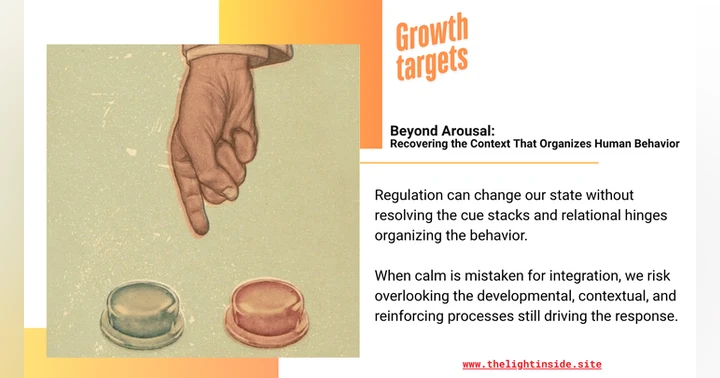
Beyond Arousal: Recovering the Context That Organizes Human Behavior