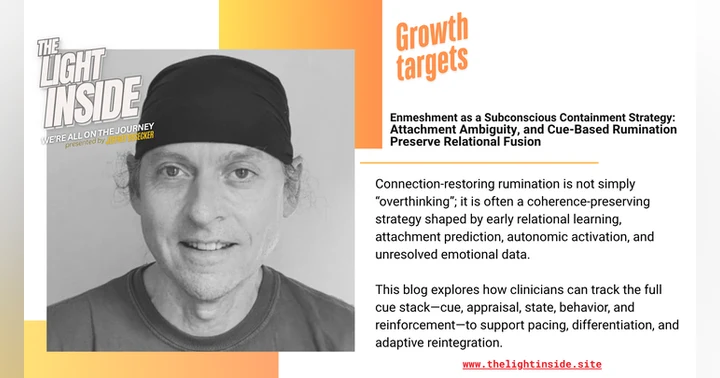
Enmeshment as a Subconscious Containment Strategy: How Early Learning and Bias Preserves Relational Fusion

Jeffrey Besecker is joined by Ben Oofana to delve into the complexities of relational ambiguity, separation, and unresolved grief. They discuss how these emotional states can trigger older attachment patterns, leading clients into a cycle of connection-restoring emotional rumination that often feels like repair but can actually reactivate past wounds. The conversation focuses on how clinicians can navigate care when grief, shame, longing, or relational threats dominate the emotional landscape.


In this episode of The Light Inside, host Jeffrey Besecker welcomes Ben Oofana for a deep dive into the complexities of relational ambiguity, separation, and unresolved grief. They discuss how these emotional states can activate older attachment patterns, leading clients into cycles of connection-restoring emotional rumination that mimic repair but often result in reactivation of past traumas.
The conversation emphasizes the importance for clinicians to formulate care strategies when clients are driven by grief, shame, longing, or relational threats. By understanding these dynamics, therapists can help clients move beyond fixed narratives and reclaim their agency, differentiation, and adaptive contact. Tune in to explore these transformative insights and more.
Timestamp
00:00:00 - Introduction to The Light Inside
00:00:22 - Relational Ambiguity and Emotional Rumination
00:01:10 - Mint Mobile Advertisement
00:02:24 - Early Attachment Learning and Emotional Rumination
00:03:28 - Clinician's Role in Addressing Rumination
00:04:06 - Ben Ofana's Background in Somatic Therapies
00:05:57 - Early Relational Patterns and Their Impact
00:09:08 - Transition from Implicit Learning to Narrative Identity
00:12:04 - Psychological Arousal and Relational Misinterpretation
00:14:08 - Emotional Processing and Cognitive Understanding
00:17:12 - Slowing Down and Holding the Field
00:19:14 - Relational Dynamics and Overextension
00:21:00 - Personal Reflections on Emotional Saturation
00:24:44 - Fear of Loss and Desperation in Relationships
00:25:55 - Constructive Work with Rumination
00:28:26 - Clinical Takeaways and Interventions
00:31:22 - Overthinking and Cognitive Cycles
00:34:09 - Healing Process and Letting Go of Unhealthy Attachments
00:35:26 - Relational Contact and Boundaries
00:38:27 - Personal Experience with Anger and Guilt-Shame Cycle
00:40:27 - Core Childhood Patterns and Activation
00:42:43 - Emotional States and Relationship Dynamics
00:44:02 - Biological Flooding and Regulation
00:45:19 - Skills for Deactivating Emotional States
00:46:51 - Insight and Internal Change
00:48:09 - Attunement and Empathy in Therapy
00:50:10 - Client Awareness and Emotional Processing
00:52:11 - Tracking and Metabolizing Bias in Therapy
Credits
- Host: Jeffrey Besecker
- Guest:Ben Oofana
- Executive Program Director: Anna Getz
- Production Team: Aloft Media Group
- Music: Courtesy of Aloft Media Group
Connect with host Jeffrey Besecker on LinkedIn.
What if many of the secondary behaviors we label as “seeking safety” are actually attempts to restore coherence at the deeper primary level?
Developmental and attachment research suggests that before children can reason about trust, risk, or safety, they are learning through load, responsiveness, attunement, and the capacity of caregivers to regulate environmental demands.
👉The stories we later repeat about danger, belonging, and self-worth may be secondary narratives layered onto earlier physiological and relational learning.
Why does this matter?
Because pacing and sequencing unresolved bio-physiological data may require us to look beyond the story and toward the coherence cue the system is still trying to resolve. When we intervene at the level of narrative before addressing disrupted capacity, unmet load, or relational incoherence, we risk treating the explanation while missing the organizing process beneath it.
The 'saftey' story is a learned response—culturally conditioned and selectively reinforced—then automatically recalled, rather than parsing from an 'in-the-moment' cue request.
READ THIS WEEKS BLOG: "Before Safety: How Children Learn Coherence, Not Risk"
Enmeshment as a Subconscious Containment Strategy: How Early Learning and Bias Preserves Relational Fusion
Jeffrey Besecker:
This is The Light Inside. I'm Jeffrey Biesecker. Executive function. Under relational strain and uncertainty, it becomes the bridge between self-sealing rumination and generative mutuality, helping the system pause automatic cue confirmation long enough to name the state, test the meaning, and keep relational ambiguity open. Today I'm joined by Ben Ofana for a conversation on how relational ambiguity, separation, and unresolved grief can activate older attachment learning, pulling clients into connection-restoring emotional rumination, a loop that may feel like repair but often functions as reactivation. This episode explores how clinicians can formulate care when grief, shame, longing, or relational threat are in the driver's seat of the Q-Stack. One where the system can defend a fixed post-hoc narrative rather than return to agency, differentiation, and adaptive contact. Tune in to find out how when we return to The Light Inside. When it comes to mobile service providers, many of the big-name networks leave a bad taste in your mouth, with their high-rate plans, extra fees, and hidden costs or expenses. Mint Mobile is a new flavor of mobile network service, sharing all the same reliable features of the big-name brands, yet at a fraction of the cost. I recently made the change to Mint Mobile, and I can't believe the monthly savings, allowing me to put more money in my pocket for all of the things which truly light me up inside. Making the switch to Mint Mobile is easy. Hosted on the T-Mobile 5G network, Mint gives you premium wireless service on the nation's largest 5G network, with bulk savings on flexible plan options. Mint offers three, six, and 12-month plans, and the more months you buy, the more you save. Plus, you can keep your current number or change to a new one if you like, and all of your contacts, apps, and photos will seamlessly and effortlessly follow you to your new low-cost Mint provider. Did I mention the best part? You keep more money in your pocket. And with Mint's referral plan, you can rescue more friends from big wireless bills while earning up to $90 for each referral. When relational ambiguity, loss, distance, or dissonance enters the field, the system often begins searching for repair well before the client has had time to process what has happened. Someone stops replying. Not forever, not dramatically, just long enough for the system to notice. A small pause becomes a signal. The stomach drops. The mind starts searching. What did I say? What changed? Are they pulling away? And before we know it, we are no longer responding to the moment in front of us. We're responding to an older relational prediction that has quietly taken the wheel. Clinically, this is where rumination can begin to look like repair. The person replays the interaction, scans for meaning, and keeps the emotional charge alive. Not simply because they are overthinking, but because some part of the system is trying to restore connection, certainty, and coherence. Today we're exploring how early attachment learning, identity roles, social conditioning, and autonomic activation can organize this loop before reflective cognition has time to intervene. And we'll ask, What changes when clinicians stop treating the pattern as a thought problem alone and begins tracking the full sequence? Cue, appraisal, state, behavior, and reinforcement. To help us explore how clients move from self-sealing rumination toward embodied processing, agency, and relational repair, I'm joined by Ben Afana to explore how clinicians can track the earliest cues of attachment-driven rumination. Ben, thanks for joining us today.
Ben Oofana: Thank you, Jeffrey. Good to join you.
Jeffrey Besecker: I'm excited to return to our previous discussion on emotional rumination and how clinicians can help bridge self-sealing reactivation with embodied pacing, relational attunement, and adaptive repair, as we discussed in our previous conversation. Before we jump in today, give our clinicians a little bit of your background in somatic therapies and your healing modalities.
Ben Oofana: From an early age, I was drawn to Native Americans and that fascination continued to grow. And when I learned about the traditional Native American doctors among the various tribes, I was thinking, if given the opportunity, this is what I'll do with my life. So by the time I was 17, I found myself and made it as far as Oklahoma. I was attending ceremonies with the native elders, and that's where I met my mentor, who is one of the last surviving traditional doctors among the Kiowa tribe. He transmitted portions of his healing gifts to me, and then a big part of our training involves the vision quest, which typically entails going four days and nights alone in the mountains without food and water. And so, I'm giving you the condensed version, but as I began to work, what was imparted to me, it had the effect of, it was like pouring hydrogen peroxide into an infected wound. And so, a lot of the traumas of my own childhood and adolescence began to resurface during that time. The very issue that we're addressing today, this rumination, often in a desperate attempt to secure or restore a connection, especially when there's the fear of loss, abandonment, all that, this is something I was dealing with firsthand, personally. And so healing that wound, dismantling that pattern, and building new foundations. So I'm excited to dive into this.
Jeffrey Besecker: So as you've just referenced, we often draw that pattern of rumination out from our early childhood relationships and experiences. Framing that as a point of clinical formulation, many relational patterns begin before narrative memory, shaped through early contingency learning and implicit relational signaling. that back-and-forth exchange within the relational field. These early patterns often organize how ambiguity and connection are interpreted long before conscious reasoning emerges. Leaning into that today, Ben, when a client experiences distance or uncertainty in a relationship, for instance, as we're going through a breakup or when there is a rupture and repair cycle in that relationship. How might early caregiver responses, patterns, and influences shape what the cue seems to mean in the moment?
Ben Oofana: Well, I think some of it's pre-narrative, as you said, but a lot of that continues to be the relational dynamics throughout childhood and adolescence. I mean, this is something that begins early for many of us, but as I experienced myself, I mean, this was an ongoing thing. It wasn't just something that happened way back before I could remember. But all these kinds of relational dynamics, anything from if we were subjected to whatever physical, emotional, verbal abuse, if we were sexual abuse, if we were subjected to a lot of criticism, if there was neglect, if there was parentification. And other experiences can feed into that as well. It's a compounding thing, but bullying even. Because we have all these complex relational dynamics we have with our parents and siblings, other family members and circle of friends or classmates, all that, it all feeds in together. And it has such a powerful effect at shaping us, because when we're going through these lived experiences, And especially in early childhood or even later childhood, even into our teens, a lot of these events occur. It's eliciting very powerful emotional responses regardless of the age. The earlier it occurs, we have fewer resources, fewer faculties with which to process or digest that lived experience to cope with what is happening. So we just internalize both that lived experience and our emotional responses to what is occurring. And so that resides inside of us. We carry that. And we may not fully understand or comprehend what is taking place, but there are these cognitive processes, some conscious, a lot of it outside of conscious awareness, And that shapes how we see ourselves, how we see other people, how we see the world, how we begin to relate or engage with others. We feel we're not good enough, that we're not worthy, we're not acceptable. So it instills all these framework of how we relate or engage to other people.
Jeffrey Besecker: Ben, unresolved psychological data often moves from implicit somatic encoding into narrative identity over time, cementing as neural imprinting and autonomic response. This transition creates rigid self-sealing habits and stories that organize perception. For example, a child who experiences repeated emotional neglect may form the identity belief, I'm too much, or if I'm not pleasing to others, I may not belong. In research by McAdams on narrative identity shows how autobiographical storytelling organizes self-concept and behavior. Framing it this way, at what point does implicit relational learning become narrative identity and how does that shift influence rigidity in meaning making?
Ben Oofana: Yeah, real quick, this is something I experienced firsthand. And a lot of it started with a lot of the attachment wounds, the physical and emotional abuse I suffered as a child and adolescence. Also, this whole performative thing about having to perform to receive love, the emotional volatility, all that. And so these are actually patterns that, through childhood and adolescence, it gets further reinforced. And I know some people who, they had parents who were loving, supportive, you know, reasonably good foundation, but even in those first romantic attachments in teens, early adulthood, if you form an attachment to someone who's very avoidant, very strong, narcissistic, or even borderline tendencies, that can leave some profoundly deep emotional wounding. So, for me, what's important is practical application. I worked with a psychotherapist for three years when this hit me in my mid-twenties, and I gained an enormous amount of cognitive understanding about why I was so weird. I kept going from there. I was just devouring clinical text. That was my steady diet. I just kept absorbing. But I ran into the limitations of what cognitive understanding would do. And one of the things I feel I can leave your community with is understandings as far as like the guidelines of working with some of these practices to get patients into their bodies and accessing the emotions, directly accessing their emotions, doing the deep level processing. you know, because we need to be able to digest our lived experiences and our emotional responses in order for this to change. If we're just staying at the realm of cognition or the level of cognition, then often this highly charged backlog of emotional residue is still held in the body. That creates the filters. We're interpreting our experiences through those filters. We're reacting through those filters. And so we need to get in and to be digesting, again, our lived experiences and emotional responses.
Jeffrey Besecker: Clinical research demonstrates how psychological arousal is often interpreted as meaning rather than signal. demonstrating how this can lead to premature conclusions about relational intent. For example, someone is blushing during a conversation and it's interpreted as guilt rather than autonomic activation. How does arousal misattribution contribute to belief formation before sufficient relational contact is established with another person? And how might that disrupt our pacing, sequencing, and how we relate within that relational field?
Ben Oofana: At whatever stage of our upbringing, whether it's even pre-narrative or childhood, adolescence, when we have these experiences, consciously, unconsciously, there's an interpretation of those experiences. And in a sense, we define ourselves in relation to others. We carry those narratives. Those narratives take shape. And so as we go forward into adolescence, adulthood, we're forming romantic attachments. And even outside of the realm of romance, whatever kind of experience that could show up in our professional lives, we're interacting with people, circumstance, situations, whatever they are. or whatever the people we're interacting with or saying or doing, it's going to trigger these parts of ourselves, parts of us that are vulnerable. And it's going to elicit these lived impressions that we carry of the lived experiences and the highly charged emotions attached to them. And so as that happens, that's going to project onto our present moment experience, situation, circumstance, the person we're interacting with. and we're going to be seeing through a filter. I catch myself, and when I work with people as well, I see when that's happening. And it's easy to get lost in that, or caught up in that, and we buy into the narrative as that's happening. I think it's critically important when we notice that happening. The more I've worked with my own emotions, doing the process I described and also making use of various therapeutic interventions, the stronger those emotions are, the more opaque. It's harder to see through them. It takes over us. We're consumed by it. But what I find is the more that we work with the emotions, work through that layering of all that emotion, there gets to be more of a transparency. It's like, I've gotten to where I can feel like, okay, here's this part of me that's being triggered, but I could feel that vulnerable part of me and yet here's more of this core. And I'm recognizing that, okay, this is the pattern. We need to be able to, as a therapist, and I do this as I'm working with people too, you challenge those narratives gently and to inquire, are there other possible meanings to this action? And this person didn't get back to us as quickly as we would like them to. They didn't respond to our text. any number of other events or occurrences that we tend to interpret, we need to challenge these narratives. There are other components too. I mean, there's a whole biochemical component that goes with this as well. So there's cognition, there's the emotional aspect, there's biochemical, and there's other interventions. So when we can bridge psychotherapy and these other interventions bring them in, pair them, we're going to get much more effective results in terms of moving your patients through this wounding, these patterns.
Jeffrey Besecker: Beyond the theme, it becomes an early imprinted, going back to the biology. We have a holistic approach through the community and we're expanding that approach Even where our framings become limited, we're looking back to what is the core cue or what is the core stimulus. Anywhere in that cycle and humanistically, we tend to find a way to lean into that ambiguity with certainty and try to target one specific point through different relational fields, different interactions, different points of pacing and sequencing even. A different cue might be active, especially what's in vivio, what's in the moment here and what are we drawing back from implicit bias. implicit reasoning framing. So we bring that all in. We don't tend to say, well, it's either all cognitive or it's all embodied. Well, expanding that frame out, you know, isn't the head also a part of the body can become an implicit framing that can kind of filter and distort that in some manner.
Ben Oofana: And again, as I work with the practice that I describe, what I find is that I'm able to process more of those charged emotions and it creates more of an openness so that there's less of that How do you say there's less of a grip of that narrative? There's more openness to just see what what actually is to observe instead of holding fixed to that narrative.
Jeffrey Besecker: So speaking to that, if I can pause for a moment here, I'm going to pause and hold the field because it's setting you and I up for a deeper level of connection. It's slowing the pacing of our conversation. And that's expanding, hopefully, our awareness of our present state. If I can ask you one request in this moment.
Ben Oofana: Yes.
Jeffrey Besecker: You and I take a moment. Take a deep breath. And hold that field together. Now, leaning into that breath. It's interesting to me to look at Schecter's and Singer's two-factor theory and how that demonstrates how arousal often disrupts that Q state, where we are at in that range of activation. For instance, illustrating how, if we have an implicit memory or an implicitly imprinted pattern, going out through conversation growing up where we felt like there was that impulse to have an answer, even within our response, that rush to explain things can often be that unconscious chain that we were talking about early that motivates us to rush ahead into that explanation. that feeling that I have to have the answer, I have to respond in order to feel connected and involved, to feel valid, to feel accepted. Itself can sometimes unconsciously motivate us and propel us impulsively to rush ahead into that explanation, to kind of forecast and predict what's to come. What comes up for you as we pause and hold that moment?
Ben Oofana: I feel myself in relation to different individuals who I'm interacting with, whether it be on a professional level, it could be a family member, it could be the person that I do have a connection with romantically, or others from the past. And a lot of it, the more that I've done this work, what I find is that there's a greater degree of sensitivity and I could feel myself in these very unhealthy stances in terms of how I relate. There are times where I felt myself overextended, giving too much, times trying to make a relationship work or fixing. I don't know if I'm coming up with all the best examples, but I would feel myself sometimes getting so far out of balance and I would stop and sometimes it feels Like emotionally, there can be anxiety, sometimes resentment. There's a feeling of being drained, feeling that overextension. And the more I can just, and it was good, the part where he said, let's slow down and begin to breathe. And I'll confess, I'm a little camera shy. So it helped me to move through some of that.
Jeffrey Besecker: I experienced that a little bit coming in today. Had a little bit of a break, really disrupted with some family interaction over the last weekend. We went away for a niece's graduation. So coming back, I'm having a little bit of disengagement or a little bit of dissociation with kind of getting back into my quote unquote normal routine. Very hyper engaged with family members, very kind of engaged with the drive to Maryland on an eight hour drive and all the stimulus of that. So I'm finding myself needing some space now as we lean into this week to kind of slow down, reorganize, re-attune. What kind of emotional debris, even though there was nothing really conflicting, just that emotional saturation and embodiment with that much emotional range going on. You know, so finding that space and not feeling that need to maybe rush in and say, but I've got to organize all of this together. You know, I've got to hurry up and get back on task.
Ben Oofana: You know, yeah. No, I was listening to another of your episodes just this morning, actually. And there are ways that we have these habitual ways of going into a relationship. And the therapist, God, what's her name again? I'm spacing the name right now. I saved her book on Amazon, though, to order.
Jeffrey Besecker: It'll surface when we're least expecting it.
Ben Oofana: Yeah.
Jeffrey Besecker: Let's hold that graciously." There again, do we have to have her name right in the moment?
Ben Oofana: But I can feel how I'm moving into a relationship, and there's this… I can feel when I'm thrown way off balance in the way I'm relating and I catch myself and I bring myself, I feel how I am, like the emotions that are surfacing, I feel how I'm overextending myself and off balance. But the more that I can just stay with that felt sense, all it's the feelings and the physical sensations and my body as a whole, it tends to, right itself, you know, bring me back to that stage of grounding. And a lot of times what I find myself doing is that instead of over-giving, making too much effort, I realize that, okay, I need to wait for this other person, maybe the person that I have this connection with, for instance, I need to just sit back and give her her time, you know, if she's able to meet me. at some point and be grounded in myself. And that's one thing that a lot of people who struggle with this rumination have a tremendous difficulty doing. It's like we're always in this off-balance state because there's a lot of what drives it is this fear of loss and fear of loss of the connection, that we're not gonna be accepted or loved or we're not worthwhile, that we're not gonna receive the approval all these things. And so what I find is by doing this too, there are times where there's that. OK, there are no guarantees. Maybe I'll just be alone. Maybe the connection will not work out. And being able to allow myself to be with that as well, instead of this desperation of, I have to make this work. Again, these are the kind of emotions operating beneath the surface that drive the rumination. And then, let's see, what else? My mind's going a little blank because there are just so many things at once.
Jeffrey Besecker: That's what we run into a lot of times. There again, where are we dealing with the ambiguity and complexity? I think one of the biggest gaps from my experience is just that idea of overthinking. Anytime we go into any kind of cognitive cycle, we can tend to slip into, well, now I'm overthinking because I'm thinking it all, or I'm trying to form any meaning at all. can become a very compressed and limiting defensive cycle. So it's holding those two with continuity and a little coherence.
Ben Oofana: The main thing is I want to impart a deeper understanding about, okay, you have these individuals coming in and they're struggling with these issues, you know, the rumination, the fixation, the obsessive love, all that. How do you actually work with it constructively?
Jeffrey Besecker: That's our symptom material most of the time. What's the underlying causal cue? You know, we're going back to the early learned imprint. Where do we have systemic relational over control? I'm taking on responsibility for my childhood still is a big one for what I work with a lot of times. Going back to that earliest pattern, even beyond the narrative of my safety in childhood, I had that burden of responsibility. I'm trying to manage the parent as a child. I'm trying to hold the whole context of the environment when I don't have the social emotional learning or any of the other reasonable risk factor of, I can't be responsible for this because I'm a kid. I don't have those resources and capacities.
undefined: Right.
Jeffrey Besecker: That's the earliest I go back to. It tends to be the core key. How do we get to that material and access it? And where do those patterns then start to fragment and create the dissonance basically throughout the whole system?
Ben Oofana: Right. So what I can do is, in addition to the understanding of how this originates, like how you can go about dismantling the patterns and, you know, Is it all about dismantling it?
Jeffrey Besecker: You know, sometimes is it just about holding it lightly and also accepting that I can inherently change that past?
Ben Oofana: You cannot change the past, but in the present, you can get to the point. I know from personal experience, my own and also working with individuals, you get to the point to where you're no longer suffering. You're in a more balanced, you're grounded place. You're letting go of those unhealthy attachments. You're recognizing when you're involved in a relationship or with a person who you can't win there. It's triggering that wounding. It's reinforcing that obsessive thought process, the rumination. It's generating the anxiety and you can't fix that. But as you go through your own healing process, what happens is that you're letting go of the unhealthy attachments, individuals, and you're forming, no relationship's ever perfect, but you're forming, you're getting to the place.
undefined: What is my wiggle room variance?
Ben Oofana: Yeah, you're developing the capacity that enables you to form attachments to people who are actually capable of reciprocal love. And you're in the more grounded state to where If things are not working out according to your desire, you're in a place where it's like you're at peace. You have your core, your foundation. You're not in this place of desperation, of longing, of just overwhelming need, of feeling that your life depends on this person. And so this is the change I facilitate in people I work with. And I think a lot of this, that as therapists, you know, those in your community gain this understanding that they'll be more effective, be able to work more effectively with their own patients.
Jeffrey Besecker: So looking at that, could you offer a preview or an overview of the clinical takeaway you hope the community is going to gain from this episode? What's our specific takeaway point? And is there a usable formulation or intervention that you would hang your model or your signature on? And how do we keep this from becoming that big, broad, let's go back to zero and do the whole philosophical overview? We tend to do that in podcasting a lot where we're regurgitating a lot of the very broad themes, yet one of the core clinical gaps is we're not starting to pinpoint those core cues or one core lesson. Sometimes we over explain it in the episode itself. Can we take one very simple cue and what are the core causal factors of that? That's a pretty broad ask and I just diffused it myself.
Ben Oofana: I think that's about maybe four or five questions all at once. Yes, it was.
Jeffrey Besecker: I compressed a lot there. I'm automatically trying to control the narrative here, and I can admit that and acknowledge that now.
Ben Oofana: Okay. So let me see how much of this I could remember.
Jeffrey Besecker: Let me back it back for you, because I did just load it up and did exactly what we're talking about. Let's clarify. The learned and conditioned language we inherit for emotion often determines how we process internal states. and limited emotional annotation can compress complex experiences into diffused and simplified meanings. This is my question. How does constrained or socially borrowed language, that language we learn through our upbringing, contribute to self-suing interpretations and relational dynamics?
Ben Oofana: Well, I feel what's important is to, one, there needs to be an in-depth understanding of the origins of how this originates, how this comes about, why the person is experiencing this rumination, why they're suffering. And it's more than rumination. They're overwhelmed. they're overwhelmed emotionally. It's the highly charged emotions that are driving the illumination and the biochemical components. So one is concise yet comprehensive of an understanding of what's involved in this phenomena. So that's the initial. Next thing is that, okay, how do we work with this constructively so I can impart that understanding about how to work with these emotions to get your patients, for instance, into their bodies, working with their emotions. And at the same time, as they're working with you, the therapist, you're imparting the understanding. And then possibly some other intervention as well, too, to balance that biochemical component as well, because all these things need to go together. And then, let's see, what else? My mind's going a little blank because there are just so many things I want to… I think it's what we run into a lot of times.
Jeffrey Besecker: There again, where are we dealing with the ambiguity and complexity? Sometimes I think one of the biggest gaps from my experience is just that idea of overthinking. Anytime we go into any kind of cognitive cycle, we can tend to slip into, well, now I'm overthinking because I'm thinking it all, or I'm trying to form any meaning at all, can become a very compressed and limiting defensive cycle.
Ben Oofana: The main thing is I want to impart a deeper understanding about, okay, you have these individuals coming in and they're struggling with these issues, you know, the rumination, the fixation, the obsessive love, all that. How do you actually work with it constructively?
Jeffrey Besecker: That's our symptom material most of the time. What's the underlying causal cue? You know, we're going back to the early learned imprint.
undefined: Yeah.
Jeffrey Besecker: Where do we have a systemic relational over control? I'm taking on responsibility from my childhood still is a big one for what I work with a lot of times. Going back to that earliest pattern, even beyond the narrative of my safety in childhood, I had that burden of responsibility. I'm trying to manage the parent as a child. I'm trying to hold the whole context of the environment when I don't have the social emotional learning or any of the other reasonable risk factor of, I can't be responsible for this because I'm a kid. I don't have those resources and capacities. That's the earliest I go back to, is that tends to be the core key. How do we get to that and access that? And where do those patterns then start to fragment and create the dissonance basically throughout the whole system?
Ben Oofana: Right. So what I can do is, in addition to the understanding of how this originates, like how you can go about dismantling the patterns,
Jeffrey Besecker: Is it all about dismantling the patterns rhetorically? You know, we are working from neurally imprinted patterns. Sometimes, is it just about holding it lightly and also accepting that I can't inherently change that past?
Ben Oofana: You know, that's a nuance. You can't change the past. You cannot change the past, but in the present, you can get to the point. I know from personal experience, my own, and also working with individuals, you get to the point to where you're no longer suffering, you're in a more balanced, grounded place, you're letting go of those unhealthy attachments, you're recognizing when you're involved in a relationship or with a person who you can't win there, it's triggering that wounding, it's reinforcing that obsessive thought process, the rumination, it's generating the anxiety, and you can't fix that.
Jeffrey Besecker: Yeah, it's going into those fixing patterns rather than accepting that this person has not metabolized and healed their own material. Are we going to get that point or how do we move?
Ben Oofana: Right. And as you go through your own healing process, what happens is that you're letting go of the unhealthy attachments, individuals, and you're forming no relationships ever perfect, but you're forming, you're getting to the place.
undefined: What is my wiggle room variance? Yeah.
Ben Oofana: You're developing the capacity to, you know, that foundation that enables you to form attachments to people who are actually capable of reciprocal love, and you're in the more grounded state to where if things are not working out according to your desire, you're in a place where it's like you're at peace, you have your core, your foundation, you're not in this place of desperation, of longing, of just overwhelming need, of feeling that your life depends on this person. And so this is the change I facilitate in people I work with. And I think a lot of this, that as therapists, you know, those in your community gain this understanding that they'll be more effective, be able to work more effectively with their own patients.
Jeffrey Besecker: So looking at the feedback, not only from myself and where Anna has kind of interjected feedback, she's got extensive background now and is continuing her background in looking at her therapeutic model. Her biggest strength is her background in research. And so she holds us to the reality truth of these are the things that are knowable. These are the things that are kind of oblique and where we're still a little uncertain. And this is how we hold the two. But going back to that, The clinical kind of thread that's going around through the community is where that relational contact becomes uncertain or ends, you know, first and foremost in a relationship. When do we have a rupture repair? When do we have a separation? When do we need to create that bridge sometimes to step back? From my own experience, my wife and I went through that. We had a nine-month gap. We're going to create a boundary and separate for the nine months to give you the space to work through whatever this lasting material is that you keep going through with anger cycles and how that creates the bridge and rupture in our relationship. She had the grace to extend that to me and say, I am willing to remain in contact with you and give you an opportunity to work through this one last time. Or it is that boundary. It was a very distant thing. We had ground rules. We had boundaries. It did finally force me to go into a deeper exploration of that. I went back into therapy, started walking through that. I was not finding the metabolic point, I'll say a metabolic point, to metabolize that because I had never finally fully connected with the guilt, shame, blame cycle that I was going through with my own internalization. where I would start hyper-vigilantly scanning that in every relationship I had. Now I'm monitoring for, you're only seeing anger cycles, you're not also seeing the deeper emotional root or the deeper pattern behind it. I didn't understand the deeper pattern behind it. There was a cognitive disconnect there. It was a skill and systemic understanding that had to happen before I could reconnect with the state. I didn't know what that cue-based trigger was, so for me it brought me back to that. And ultimately, that's what was my own material that brought me into the field, that gave me that deeper driver. There was a purpose behind it. How do I help others understand it? I didn't necessarily want validated and held when I went to therapy. I needed to find what that missing point or that missing connection was that allowed me. I knew what all the activation was. I knew what was coming up. I knew how I felt about it metabolically as far as, you know, I'm activated. I knew very well what all of the kind of physical manifestation of that was, but till I got to that point where I understood what that core childhood pattern was, and it wasn't that I just was immersed in an environment where anger was hyper normalized, that was embedded with our identity. I understood all of that because we were constantly reinforced that, well, that's just your hot-blooded German-ness was one of the kind of recursive loops that come back that validated it in the family system. I understood all that, but I had never kind of put my fingerprint on that idea of the guilt and shame cycle that I just wanted people to see me for the other emotions that were also available. They were scanning their environment as a protective model to look out for that. I had the responsibility of holding and managing how I expressed anger, but I didn't understand what that final loop was that kept reactivating it. And that was the kind of linchpin that I had to develop that skill. I knew all of the markers that were taking me up to that. I could tell when I was moving into that hyper-arousal. I even knew and understood the scanning, but it was like, what was that missing piece for me? Well, it was understanding how that relationship with the guilt-shame-blame cycle was fueling that internalization, and that kept me in that hyper-vigilant mode. that kept the system activated, that kept the loop going. So until I learned that and was able to go back with Grace and with my wife, now we have a completely different relationship with it. Very seldomly do we move into mild activation with each other. We can hold that mild contempt sometimes with each other. I am slightly miffed at you and it doesn't ever elevate to that point now. And it's not because we're bypassing. It's not because we've sublimated it. It's not completely because we've just surrendered to it. It's now we can recognize what those things are with the greater nuance and when we can step back and kind of hold that field in a different model now.
Ben Oofana: Yeah, I appreciate your sharing that. Where I can relate to that is there are times in the past where I would be triggered or activated and I would be, and was that the fear, the obsessive attachment, I'd be holding on to someone, other times being tenuously connected to someone and being triggered and fearing the loss again. One of the things that happened is the more I worked with these various practices and interventions is that what was outside of my conscious awareness, those emotional states, I was able to get deep down inside of them. And the more that I could work through a lot of this backlog of emotion, then there was a greater lucidity, like I would experience the emotions, and sometimes they did have quite a bit of force to them, tremendous power, but I still had this core, this grounding within, where I could experience the intensity of the emotion and not get lost in it altogether. And there's also the fact that as I've continued to do practice and all this intervention, there's this diffusing of more and more of that emotional intensity. So before it was all-consuming, And it completely obscured my view. I'm looking through these incredibly distorted filters. And then the more that foundation builds inside of me, what happens is that, okay, I can feel these emotions. And I realized that this is a part of me that's still unintegrated, a part that's still wounded, that it's showing me where I still have more processing, more work to do, but I still have that foundation. and I could allow the feelings, I can go ahead and do more processing with them and I could engage with this person and not just get, you know, not have that narrative totally take over me and create another disaster or big fire for me to clean up, if that makes sense.
Jeffrey Besecker: Totally. I can relate to that in comparison.
Ben Oofana: In response to what you were describing in your marriage, not totally derail the relationship. Because sometimes, like the trauma, the wounding that I carried was so pervasive that there were times where it overwhelmed the woman that I was seeing or partnered with at the time. And she's struggling with her own issues, her own challenges. It's like, you know, this is too much for me. This guy's too wounded. I can't rescue him. Well, better to just let him go. And I hope it works out for him eventually. I got to go on my own way, that sort of thing. But the more that I've progressed in my own healing, it's what I find is that Yeah, these vulnerabilities still come up at times and yet I'm able to just stay connected to my core and, you know, work through those emotions. And when there are ruptures, you know, just able to repair. And a lot of times I don't necessarily have to discuss anything or get into a big conversation and work it out with that person. It's just, it's like, okay, this is coming up. I can work through it and I can stay, relate much more.
Jeffrey Besecker: So holding your relational frame, I'm trying to lean into your relational frame here, let go of my more cognitive leaning frame sometimes. Okay. That biological flooding, we'll go back to biological, more bodily aware. What part of that equation would you like to address in this conversation to Find that intercept point regulating factor that did allow me to back down the activation, to allow it to subside rather than go into those defensive responses, rather to go into that kind of lyching out resolve. It was building up, building up, and then it would overflow. What do you want to bring to this conversation to impart upon that, to build on that kind of framing?
Ben Oofana: I think it's important, the actual skills themselves, like what steps do you take to deactivate? And at the same time, we need to bring in your patients working with you, that as you're able to deactivate the emotional states, because we need both to be able to diffuse the emotion, at the same time, we need the cognitive understanding to develop a more grounded framework from which to view our relationships, our interactions, the individuals we're partnered or involved with.
Jeffrey Besecker: So here's an interesting point to look at. Where do we allow that conversation in our communication? Do we reinforce known patterns? Is this just a conversation where, again, we reinforce and kind of double down on the importance of that regulation, that contact in the relational field? Or is there a new nugget from your perspective, just reading over what you might have gained in interactions or listen back maybe on an episode and gain? Here's where I see it. gap that you might bring to that.
Ben Oofana: Okay. What happens is, as you're working with this process, you gain a lot of insight. You're fundamentally, you're changing internally, your ability to be present, to engage, to relate at deeper, more intimate levels. And your perspective, instead of that narrative being frozen into your body and mind, intellectually, physiologically, you have that understanding intellectually, you're not experiencing that activation, or to a much lesser degree, and so you're able to relate at a deeper level, a healthier level. Does that make sense?
Jeffrey Besecker: Yeah. Relating that, and this is how I'm going to take that, and I'm going to hold it for a minute.
undefined: Okay.
Jeffrey Besecker: To make sure I'm not just rushing again into it. Okay. So relating to that, and I know that this is something that not only comes up for me, you know, again, where do we pause to have that access in Vivio like I just did? What's coming up for me in this moment, am I reflecting back and connecting with some past material? Can I hold that now? Can I simply identify? If you were to ask me what comes up right now is always an interesting point for me. So do we have that relational space and contact where we can watch and monitor in that and each other, especially as a clinician, one thing I'm studying right now is how we monitor what's going on in the field when we're looking at tracking and tracing, looking at posturing, looking at pausing, where somebody holds back and stops. where they rush forward into explanation. From your perspective, is that something you attune to and model in your own modalities? And how do you recognize that in a client? When we get to that point, anywhere in that interaction, can we stop with the client and do they have the capacity to say, well, what comes up for you in this moment? And do they rush into explaining that? Or can they explain the sensation in that in vivio biological contact?
Ben Oofana: I recognize it all the time as I'm working with individuals because of all the intensive practice I've done. Yeah.
Jeffrey Besecker: I can see that when I watch your communication on video. I can witness that. And I've kind of said, I think Ben might have an attunement there where he is watching that and tracking that rather… Constantly. Yeah.
Ben Oofana: And a big part of my training, having trained with a traditional Native American doctor, medicine man, part of the training involves going alone into the mountains four days and nights, no food and water to fast, and having gone dozens of times. And so each time I go, it keeps working deeper. a lot of it was working through a lot of the trauma that I carry, but then even adversity that I have faced along the way. And so what happens is that sensitivity grows and becoming more empathic. So I'm literally seeing and feeling down into people's bodies. Now, I could see and feel their emotional states and how they're struggling, say, whether it's a relationship or other issues that they're dealing with and what resources they possess to cope. And so I do that standing immediately in front of the person. But even when I'm sitting back, I'm feeling what the person's getting or not getting. I feel when they're caught up, say, in that narrative with that emotional backlog that's reinforcing it. I feel when they're actually processing, digesting. I feel when they've moved through it. I'm listening to them as they describe how they're interacting with their partner, or someone that they started seeing, or whatever kind of involvement. I'm always listening to like, okay, where is this individual at, at this point? And I know in my own experience, like I said, going back quite a ways and being so taken over by the distressing emotion that was fueling the rumination. not being able to let go of an individual or relationship, even though it was causing me a lot of pain. But the more I progress, what's happening is that there's an awareness of what's driving me. the thought processes that operate outside of conscious awareness, the emotions that are fueling it. And what I witness in the people I work with is that they're gaining that awareness. There are many instances where I'm working with someone and I have a very distinct sense of it wouldn't do any good to attempt to bring that to their awareness as of yet, you know, they're in the thick of it. And yet, so many, well, it's great, it's, what's the term, part of the course, or what I generally find that happens as I work with people, or those who are consistent with the work, let's say, what I find that happens is that, those awarenesses are coming, what they could not hear before, what I could not say and have them grasp or understand, they're coming back with this understanding, those realizations. They're recognizing the shame or the feeling that they have to perform in order to hold this person, to gain their love, to maintain their love. they're recognizing it, and as they work through those emotions and gain the understanding, I watch their bodies relax, and I watch their stance change in terms of how they engage, what they're no longer willing to tolerate, and how they communicate in healthier, more effective ways. Does that answer your question?
Jeffrey Besecker: I think we're right on track with that. I know I'm on track with that and I'm getting the sense that that might be tracking with where our community goes with it. Again, I'm going to lean back in from my perspective of how do we track that in ourselves to make sure, A, we're not over predicting. Let's go with that, A, before I go further. A, how we're not over predicting it. where we're not moving into our own biased reasoning, our own past. If we are, can we recognize that and also metabolize that in a way that is this client capacitated enough to share that field meaning, or is that something I hold for maybe a later time so my interpretation isn't rushing them to that point? That's a big one. I am really trying to handle with a lot more nuance and finesse now, even in people that are clinically aligned. comes up for you in a moment is a big thing. How does that land for you? A lot of times that shutdown model then steps in where if you're tracking and truly aligning, now it's me trying to move you past that point when you aren't ready to have the agency and the capacity to move forward. Does that make sense for you? It does. It becomes a broad ask again.
Ben Oofana: That's fine. I know for myself, there are times when I feel some of these layers come up and my mind goes in that direction of interpreting or predicting. And yet again, I'm more and more cognizant as I am able to work through these layers of emotion that are triggered in these instances. And the grounding part of me reminds me of like, okay, that's the wounded part, talking, and I don't know, you know, and just create that openness in terms of instead of a rigid, fixed interpretation, here's, well, that could be a possibility, but just. leave it open for now. And then as I'm working with people too, if they're holding that fixed projection of, this is what that means, here's their interpretation, and there's that strong emotional charge behind it, I'm feeling it. I hear what they say, but I'm also feeling it. I feel how rigid or fixed it is in their mind and their body both. And I know from feeling in my body, I'm very kinesthetic in the way I approach this, but I feel in my body it's not gonna do that much. I may say just a little, but I feel, in a sense, it feels like a pushback in a way. It's like, it's not landing. It's not going in. It's not registering. And so it's like, okay, don't waste your energy. Yeah.
Jeffrey Besecker: And- Now is not the time or the pace. Let's see how we revisit that. Here, Marquette.
Ben Oofana: Yeah.
Jeffrey Besecker: I think that speaks to where I'd like to go with it and what I'm seeing. So yeah.
Ben Oofana: So as I continue working with them, and as they're doing that deep level processing emotionally, and that creates that, it's diffusing that density, it's creating that potential for receptivity and flexibility. And at that point, that's when change begins to be possible. And the more they process through that, you I find in myself, and I see this in many people I work with, there gets to be a lot more lightness and ease around that area. There's less and less emotional charge, and there's just like, you know, and even if things are not working exactly the way they want them to, there's more of the ability to be in a space of acceptance. It's like, okay, here's this, either my partner or the person that I'm wanting to form an attachment or be with, or whatever kind of relational dynamic. And, you know, it could be in our work life. It could be with family members. It's there's a greater ease.
Jeffrey Besecker: And so relating that this is, I think, a good connecting point. You have probably observed it or you may have not necessarily consciously connected with it. But I'm sure you could see how red and flushed I get in conversation a lot of times.
Ben Oofana: Actually, I'm looking at the camera because if I look at you, I'm going to look like I have my eyes closed, but I can see the red and flesh now.
Jeffrey Besecker: I'll point that out because I know that's something that, A, is inherently connected to my neural imprinting. It's a biological response. I've kind of surrendered the need to define that. myself, that itself becomes kind of a hyper arousal monitoring, hyper control. I've accepted it as a biological trait that I've developed. I know that it can also be meaningful, that it does a lot of times crop up in association with arousal and activation. For me, it can be a signpost for those loops. I can feel it if I'm tuning in biologically and know when it starts to happen. I also witnessed that recently in an episode where I had a guest. who was hypertracking it. And he was able to identify that he was hypertracking it. Well, you're all red and it means this, this, and this. He said, well, let's look at that. That is our kind. It was in the pre-call we discovered that. I said, the pre-call is our conversation right here. Can we hold that field together and explore that in a pre-call? He said, yeah, let's do it. I think that's exciting. Let's go with it. Wow. And we were able to reveal a lot of things together through that. And I was like, I know when it happens. Do I need the understanding? And how do I monitor that to also realize when I flip that lens, when someone else is tracking it and hold that with looseness and ambiguity so it doesn't become me again, going into the guilt, shame, blame cycles. Now I'm having to justify it all the time and monitor it back myself. Can we mirror that and hold it loosely together becomes the relational field.
Ben Oofana: Yeah, for me to do podcasts, it's kind of interesting because if I just use the webcam from the computer, the image quality sucks.
Jeffrey Besecker: That's why I've surrendered doing video because we get so ingrained a lot of times on watching the video. It's like, is it really workable? And we talk so much about what's going on, what's authentic in the field. Well, we're already in kind of a performative mode. Are we focused on perfecting the video? What somebody is going to discover in a video? Are we accurately attuning even in video? You know, where are there gaps? It's something I've really kind of looked at just kind of with a loose nuance.
Ben Oofana: I have a Sony A6400 mirrorless camera, and it sits up above the computer. And early on, when I started doing podcasts, I had hosts yelling at me because there was a viewfinder right above, and my eyes initially went up there to look to see how I appeared. And if I look down at the screen, then it looks like my eyes are closed and I'm asleep as I'm talking. And so I've trained myself to look at the camera, but one disadvantage is that I can't see you as I'm looking at the camera. But in terms of the guests, people want to feel that You know, the eye contact is important.
Jeffrey Besecker: Do we oversell that sometimes is my question. I'm going to relate this before you. That's a radical question we're going to hold for a second. Yeah. You mentioned having that kinesthetic sense. I know from how I associate, how I learn, how I process, how I access contact within my embodied relational field. I tend to be more kinesthetic and I'm like searching literally. It's like watching them on the matrix where you're grabbing these pieces of awareness, consciousness, whatever, and sometimes organizing them in that structure.
undefined: Yeah.
Jeffrey Besecker: So I tend to kind of do that even with my eye tracking. That can be interpreted in a lot of ways. I know clinically we're trained sometimes to track eye movement, but when I do it, I'm looking. Sometimes it is the cognitive connect. Sometimes it is the connection where I'm tracing and tracking the cognition to also meet with what is coming up in vivio in the felt sense. So that can be interpreted in a lot of ways. Interpretive intrusion comes in. If you're the observer, what meaning do you predict and do you hold the prediction lightly? And do you allow the other individual to track and connect in their frame? That becomes my question, how do we do that with nuance and clinical discern in our formal interactions and in our everyday actions?
Ben Oofana: I definitely hold, there's a lightness in terms of how I hold what I'm taking in because there are people that I've worked with over years and even decades and I'm continually learning more. We're going further and further into the depths and there's so many instances as I'm working with an individual, especially I first see people and they're not necessarily revealing that much. And as I'm scanning their bodies, there's so much that cannot be seen initially. And so in the course of a few sessions time, there's so much emotion, so much memory surfacing, their bodies going through these various physiological processes. And so again, holding it lightly because I can't see that much initially. And so it's like I maintain this openness, like, OK, there's a lot more to understand here. And so if that makes sense.
Jeffrey Besecker: that holding that frame. I'm going to wrap up here because we've been going a while, but holding that frame. So as clinicians, how do we hold that gently so we aren't over-interpreting or misreading, sometimes rushing ahead, and track or monitor things like prosody, breath, Is the client holding? Are they bracing and see that kind of clenching down? Tracking eye movement where they might be searching or where they might suggest or imply that they struggle with that attachment with eye contact? Or body posturing when they lean back withdrawal? How do we monitor things like that with that kind of grace and intelligence, again, and then also engage by, as you mentioned, recognizing it and saying, if I am understanding you, if I am following you and tracking, how does this land with you?
Ben Oofana: As I work with people individually, initially I'll have the person standing in front of me and I scan their body and I'm looking and feeling, I'm sensing into the body. And before COVID, I was offering classes on a weekly basis in New York City and every other week in Boston. And as I had these people in front of me and I was seeing and feeling like a lot of the scarring, the emotional wounding, I could feel the actual emotions. I could feel their capacity, their ability to get into life and engage. And I would describe what I was seeing and feeling. But as I would do so, I would say, well, this is what I'm feeling. This is what it tends to indicate. But I want to note, I mean, I could be wrong. You know, it just, I wanna be careful here. Does this match with your experience? So I would get that confirmation and sometimes they might disagree a little bit and I'd be thinking and then I would come back and then we would hone in together, you know, and be like, they would, as they would describe what they were going through and say, okay, that makes sense now, you know, but I would always be very careful. And I maintain this openness. Part of it is curiosity, like the sense of like, I'm continually learning about this individual. And one of the things that I find happens is like when I first work with a person is that because people are not, again, digesting their lived experiences are their emotional responses to what they've gone through. People tend to accumulate so much of this residue, the stagnation in their body, and so initially it's a lot harder to see exactly what's going on. I can't see near as much, but in the course of working with someone, and more they're digesting what they're carrying, and there's much more clarity. and that field around their body, and I'm feeling down into the body, the organs, the tissues of their bodies are becoming more vital. And what I see happening too is that a lot of the core issues will present themselves. I'm actually feeling that. empathetically, empathically, it's very palpable to me, and so I'm watching this, I'm feeling it taking shape, and again I will relate it, and each time it's like, okay, here's what I'm feeling right now, and I'm checking back and forth with their experience. I can do that much better when I'm right there with the person. I'm scanning them, but sometimes even just stepping back from the distance. I cannot totally shut it off either. So I can just be out in town or just wherever. It makes it very difficult being on airplanes when you're packed in there like sardines because you feel all these people around you and everything they're carrying. toxic diets and drinking heavy or the medications they're on. So it does have its challenges there.
Jeffrey Besecker: I want to thank you for very openly and vulnerably sharing that space and connection with me and for sharing that with our audience. This truly has been a very eye-opening and enlightening conversation for me. And I want to thank you for the value and impact and care you bring to this work.
Ben Oofana: Thank you for giving me this opportunity and for being present with me and your inquisitive nature, the questions you present have given me the opportunity to bring this out and share what will, for therapists, for an opportunity to deepen the work you're doing with your patients and for those who are not therapists as well, that can further progress in their own healing by combining the most powerful practices and therapeutic interventions, because there's enormous work, growth to do. That's one thing I learned training with both the Native American doctor and Master from China, that one is continually developing, one is continually evolving, and so it's an ongoing process.
Jeffrey Besecker: I want to thank you also for that humble reminder to hold that nuance and that care loosely and to also recognize how others might engage and find that pathway through different models and modalities. Where can our listeners reach out to you, Ben, and learn more about your practices and how they might also gain deeper insight into that model?
Ben Oofana: My main website is just my name, benufana.com. There's a contact form to reach out to me. The Google voice number you can message me is 332-333-5155. I do respond to messages. Technology sometimes fails. If you don't hear back, assume I didn't get the message, because I will respond. And there's a blog. It just says articles at the top of my website with other tabs and lots of in-depth articles on my YouTube. There's in-depth long-form video where I go into great depth. You can find me on Instagram. Let's see, what else? teachmetomeditate.com because I developed this whole extensive system of meditation practices that are all about getting you more and more embodied and digesting your lived experiences. and your emotional responses to whatever you've gone through, and opening you up so that you're that much more present. And for those going through breakup or divorce, the acute stage, if you've been ghosted, Relationships blown apart. There's breakup first aid. It's getting you through the initial crash. And for the more deep dive, struggling with attachment wounds or abandonment, patterns of unrequited love, you keep finding yourself drawn to the same toxic relational dynamics. There's heal my heartache. That's where you can find me.
Jeffrey Besecker: I've truly, truly enjoyed digging through a lot of that material and exploring that somatic contact and how we embody and attune to that model. So thank you, thank you so much for being such a shining light and such a genuine, joyful source of contact and meaning.
Ben Oofana: Thank you so much, Jeffrey.
Jeffrey Besecker: I look forward to chatting again soon. Come back and join us. Thank you. Namaste, the light in me acknowledges the light in you. Have a wonderful day.
Ben Oofana: You too.
Jeffrey Besecker: Today, Ben and I want to leave you with this. When recursive attachment loops are active, the goal of intervention is not to win against the thought, suppress the feeling, or force insight faster than the body can carry it. Illustrating how the clinical task is to interpret the cue stack just enough to preserve contact, widen attention, and create a new learning opportunity before the system collapses back to familiar rumination, reassurance seeking, or self-sealing certain. And remember, when it comes to reintegrating the underlying data driving these responses, clinicians can use action-oriented, evidence-based interventions such as belief state labeling, orienting and paste exposure, relational repair statements, or somatic tools or interventions when assisting clients' ability to interrupt correction-restoring rumination without shaming its protective function. Finally, Ben and I leave you with three body-based practices clients can use in the moment to re-establish contact when rumination starts pulling them into a recursive feedback loop. A 20-second bullet point note. Name the state before the story. I noticed urgency, shame, or separation. Widen the field. Orient to the room. Soften the body. Lengthen the exhale. And finally, turn uncertainty into inquiry. This is one possible meaning. What do we actually know? The takeaway? Slow the loop enough for the client to sort body, story, and relational contact before rumination takes over control. We'd like to take a moment to thank you, our valued community of therapeutic professions, Your care and dedication to this work, and to the value you create for your clients, carries us forward in our educational mission. If you found value and meaning in this episode, please share it with a fellow practitioner or colleague. This has been The Light Inside. I'm Jeffrey Biesecker.

Somatic Practitioner / Spiritual Healer
From a very early age, Ben was drawn to indigenous cultures and their spiritual practices. He was particularly fascinated by the paranormal. As a people, many indigenous cultures lived with a foot in two worlds. Indigenous peoples throughout the world relied on the assistance of supernatural forces to assist them in their everyday lives.
By the age of 12 Ben was reading everything he could find about tribal cultures. Around the age of 14 Ben began to learn of the traditional medical, psychological and spiritual practices of a number of different tribes of North America. It was then that Ben decided that if he ever found the opportunity, he would train under a traditional American Indian doctor.
While still in high-school, at the age of 17, Ben decided to live among the people he loved and admired and moved to a community of predominantly Kiowa and Kiowa-Apache Indians. During this time, Ben immersed himself completely in the culture and participated in the tribal dances and spiritual and healing ceremonies. It was there that Ben met his mentor, Horace Daukei, the last surviving traditional Kiowa doctor (Medicine Man). He immediately recognized Ben’s capacity to become a healer. Ben felt very fortunate because very few apprentices are chosen during a doctor’s lifetime.
Ben formally began his apprenticeship under Horace at the age of 20 and continued for the next three years. As his assistant, Ben was able to see firsthand the phenomenal results of these traditional medical practices. Additionally, Ben furthered his education by going on vision que… Read More