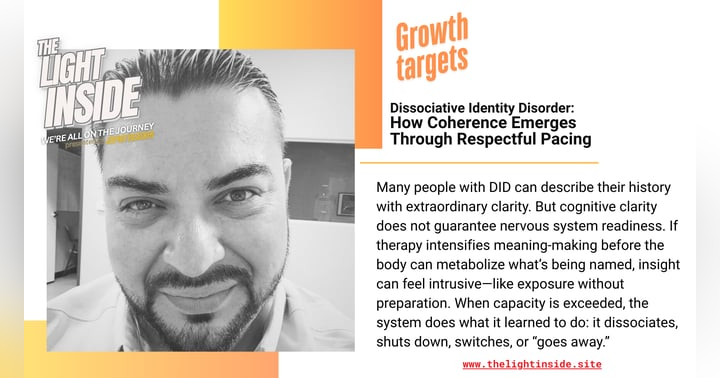
When Coherence Protects Too Much: Adaptive Dissociation, Self-Sealing, and Double-Loop Learning

We engage in a profound conversation with Mike Cuevas, who shares his lived experience with Dissociative Identity Disorder (DID). We delve into the concept of coherence and its critical role in the context of DID, emphasizing that coherence is not merely a goal but an embodiment within the therapeutic process.


In this episode of The Light inside, The discussion centered on Jeffrey Besecker's extensive experiences and insights related to trauma recovery, identity, and therapeutic practices. Besecker highlighted the importance of safety and coherence in the recovery process, noting that individuals often struggle with feelings of threat that can hinder their progress. He introduced the concept of double loop learning as a framework for adapting to experiences and emphasized the significance of pacing and sequencing in therapeutic interventions. The conversation aimed to explore how community support and individual experiences can enhance the healing journey.
Mike Cuevas shared his personal journey with dissociative identity disorder (DID), detailing the impact of misdiagnosis and the challenges he faced in understanding his identity. He recounted how silence became a coping mechanism during his formative years, leading to feelings of shame. The discussion underscored the need for a coherent approach to integrating insights about DID with the body's capacity to process those insights, emphasizing the importance of creating a safe therapeutic space for effective healing.
The conversation also delved into the role of the practitioner's state of mind and co-regulation in therapy. A conference room participant shared personal experiences and the development of mental exercises to manage emotional triggers, introducing the BAR technique as a tool for emotional regulation. Besecker and Mike explored the significance of recognizing bodily sensations in differentiating identity states, which can lead to greater clarity and peace. They discussed the transformative power of empathy in processing past traumas and the importance of adaptive containment in therapeutic relationships.
Mike reflected on how his personal development has influenced his parenting, particularly in managing stressful situations with his children. He shared an incident where he maintained calmness during a confrontation, demonstrating the value of mindfulness and emotional regulation. The discussion concluded with Besecker expressing gratitude for Mike's insights and the potential for future collaborations, highlighting the unique and revelatory nature of their conversation.
Time Stamps
00:00:00 - Introduction to Coherence and DID
00:01:13 - Sponsor Message: Mint Mobile
00:02:27 - Understanding Dissociative Identity Disorder
00:03:10 - Mike Cuevas Joins the Conversation
00:04:11 - Early Signs of Dissociation
00:05:26 - Insight vs. Capacity
00:06:38 - Adaptive Coping Patterns
00:07:43 - Shame and Guilt in Misdiagnosis.
00:09:09 - Therapeutic Journey Begins
00:10:24 - Boxing as a Therapeutic Outlet
00:12:03 - Stigmatization and Adaptive Survival
00:13:07 - Pacing and Sequencing in Therapy
00:14:38 - Visceral Trauma and Sensory Overload
00:16:47 - Connecting Boxing to Somatic Responses
00:18:46 - Learning to Feel Safe
00:20:19 - Somatic Attunement and Sensory Perception
00:22:05 - The B.A.R. Technique
00:24:45 - Double Loop Learning
00:26:11 - Identifying Distinct Identity Stateslf.
00:28:20 - Chaos as Opportunity
00:30:11 - Empathy vs. Sympathy
00:32:49 - Claiming Sovereignty
00:35:04 - Adaptive Containment
00:39:10 - Presence and Capacity
00:41:05 - Body Assigns Meaning
00:50:34 - The Role of Pause in Processing
Credits
- Host: Jeffrey Besecker
- Guest: Mike Cuevas
- Executive Program Director: Anna Getz
- Production Team: Aloft Media Group
- Music: Courtesy of Aloft Media Group
Connect with host Jeffrey Besecker on LinkedIn.
When Coherence Protects Too Much: Adaptive Dissociation, Self-Sealing, and Double-Loop Learning
Jeffrey Besecker:
This is The Light Inside. I'm Jeffrey Besecker. Coherence. Today we're exploring why it matters so deeply in the context of dissociative identity disorder, especially when coherence protects survival but can also quietly prevent integration when pacing and capacity aren't honored. In this segment, we're focusing on why sequencing, not insight alone, shapes outcomes and how somatic signals must inform narrative interpretation if dissociation is going to soften rather than seal it. I'm joined by Mike Cuevas, who brings grounded lived experience with DID and a powerful lens on how dissociation functions as an adaptive survival response. one that deserves respect, not reduction or stigma. If you work clinically with dissociation, trauma, or identity fragmentation, this conversation offers a vital reframe. Coherence isn't the goal, it's the embodiment within the process. Find out how the process unfolds in practice when we return to The Light Inside. When it comes to mobile service providers, many of the big-name networks leave a bad taste in your mouth, with their high-rate plans, extra fees, and hidden costs or expenses. Mint Mobile is a new flavor of mobile network service, sharing all the same reliable features of the big-name brands, yet at a fraction of the cost. I recently made the change to Mint Mobile, and I can't believe the monthly savings, allowing me to put more money in my pocket for all of the things which truly light me up inside. Making the switch to Mint Mobile is easy. Hosted on the T-Mobile 5G network, Mint gives you premium wireless service on the nation's largest 5G network, with bulk savings on flexible plan options. Mint offers three, six, and 12-month plans, and the more months you buy, the more you save. Plus, you can keep your current number or change to a new one if you like, and all of your contacts, apps, and photos will seamlessly and effortlessly follow you to your new low-cost Mint provider. Did I mention the best part? You keep more money in your pocket, and with Mint's referral plan, you can rescue more friends from big wireless bills while earning up to $90 for each referral. Today, we shed light on the lived experience that is Dissociative Identity Disorder, or DID, a trauma-linked dissociative adaptation that reorganizes memory, identity, and self-experience, one that is frequently missed or misformulated in clinical assessment. This episode doesn't rush to explain or fix Instead, it slows down to honor what dissociation protected and what it now asks to be gently integrated through three core threads – coherence over control, pacing over pressure, and capacity over performance. We explore how clarity emerges not from forcing unity, but from respecting the nervous system's timing. Joining us is Mike Cuevas, who shares his personal journey of living with DID, the confusion, the fear, and the gradual discovery that integration is not erasure, but relationship. Together, this conversation offers something rare, language that brings relief, perspective that restores dignity, and a path toward peace that is built slowly, honestly, and from the inside out. Mike, thanks for joining us today. How are you?
Mike Cuevas: I'm doing good, Jeffrey.
Jeffrey Besecker: How are you doing today? Fantastic. I'm excited to explore what happens when insight arrives before the nervous system has the capacity to receive it. How pacing restores coherence and why therapeutic work must meet the body where it is, not where we want it to be. So Mike, thank you for joining us. We greatly appreciate your willingness to explore your lived experience with DID with us.
Mike Cuevas: You're welcome and thank you for allowing a platform and a voice to be heard.
Jeffrey Besecker: You've been such an inspirational influence in my understanding of how I relate to DID and how that might apply to my therapeutic practices. So thank you for bringing that grounded insight to us.
Mike Cuevas: I'm so welcome. Honestly, I really appreciate the opportunity. And it's important to note off the bat that I really do interpret our experience, ours and me and my system. And I don't speak for other DID systems. We all have our unique experiences and our unique symptoms. And I'll do my best to interpret our lived experience to better whatever we can for our community.
Jeffrey Besecker: That's so integral to our talk today because that interpretive awareness has such a strong influence not only on where our body is going somatically, unconsciously, subconsciously, but where we also start to apply our identity associations throughout those interactions, throughout our lived experience. So before we dive too deep into that today, Mike, let's reel back a little bit. Can we go back around what age you recall these patterns in these responses first starting to emerge for you and what might have been going on for you in that time frame?
Mike Cuevas: Going back and recalling, I can distinctly recall around preteen to early teenage years of starting to dissociate. Now at that time, I spoke about what was going on and was misdiagnosed and had some consequences because of it to where I learned to stay in silence. Silence became safer for us than admitting the truth. So for years, we learned to cope in isolation. And it wasn't until our life now that we needed and understood we needed help, that we actually allowed ourselves to interpret and seek help, to be honest. I'm just thinking of the second part of your question is now the difference is having insight, right? I think the problem became was I had too much insight before my body actually had the capacity to understand what was going on. And I think that's where the somatic bridge comes into play is That insight came as such an intrusion to us. We didn't understand that the body needed permission to accept all the information that was being downloaded.
Jeffrey Besecker: Mike, I think for so many of us that tendency to want to understand can often muddy up that process of reconnecting, of reattuning, of how we integrate. Sometimes itself becomes that adaptive coping pattern of bypassing or suppressing even in its more heightened state sublimation where we start to find outlets, where we start to find adaptive mechanisms or coping patterns that themselves appear healthy, appear productive on the surface, quote unquote, yet they become one of those feedback loops and we'll get into those cycles of looping that perpetuate our own dissociation, our own dissonance, and some of those experiences we share with each other. Framing that today, Mike, how did what's commonly experienced as mislabeling of DID as an adaptive pattern or how it sometimes stigmatized impact how you first initially connected with that?
Mike Cuevas: person connected with that was shame and guilt. That was the first stigmatization that came behind the misdiagnosis. And it really sat with that for years and decades, really, because of that shame and guilt. So that adaptive survival became the new way of framing it. Because I understood that my system was surviving I was never taught how to feel safe with my own nervous system. Not having that safety, not having that awareness, kept allowing the old patterns to keep repeating itself, to keep constantly splitting, to keep constantly finding new ways to adapt and pivot into life, creating new identities to the environment around us. So now, having that awareness, how should we say it, at least allows us to slow things down, be able to interpret what is going on and decide, okay, not what identity or what story should we place in front of us, but how can we coherently move forward with each other in peace.
Jeffrey Besecker: So as you're first connecting with this, what was your first pathway? Did you experience going to therapy? Did you have someone in your environment or someone in your social system who kind of pointed out certain behaviors? How did that unfold for you, Mike?
Mike Cuevas: My son. I have two boys. I got an 11-year-old now and a 5-year-old. At the time when I first started, they were 9 and 3. And the love that I have for my boys is really sacred to us. It's why we decide to get up every morning to go to work, to do what we have to do, right? It's our boys. And I noticed that my nine-year-old was starting to dissociate himself from me because the way he would look at us, it really brought shame again and guilt. So we actually had to confront him. I'm like, Pop, what is wrong? And at that time, we weren't really prepared to hear what he had to say, but it really made a switch. Like, dude, we got to do something. We really got to find a way to face our quote-unquote demons to get better for our boy. So that is where I started our therapeutic journey again. This is where I decided to go back to therapy after decades of not returning. And even in therapy, I went for therapy for months before we actually decided to come out and say what was going on, because the stigmatization, the shame was still there. What actually finally made that switch was a boxing coach. We, after that day with our son. We truly became fragmented. My body started convulsing. My hands started shaking severely. My face glitching became so profound that my stuttering, I couldn't finish a sentence. So I heard or read somewhere that MMA is supposed to help with that. Because at that time, I was dealing with quote, unquote, CPTSD. And MMA, I started knocking on MMA doors. Nobody will open the doors to me. It's almost like everybody saw that movie, American Sniper. And they're like, no, we don't want none of that here. Please go somewhere else. And finally, I came and knocked on the boxing door, boxing gym. I wasn't looking for a fight, Jeffrey. I really wasn't. I wasn't looking to exercise. But that coach saw me and he asked me, can you get into that ring? As bad as shaky as I was, I'm like, I could get into that ring, coach. And as frantic as I was, I was in that ring. And the coach gave me five minutes. It was five minutes of presence. He didn't interrogate me. He didn't want to know my history. He just gave me five minutes of being in that ring in presence. He allowed my nervous system to calm down. And then when he realized that we were calm, he put his hand on my shoulder and pointed at that door that I walked in from. And he said, Mike, The man walking out that door is stronger than the man that walked in. Not because he changed, because you stayed. That made such a profound impact on us and our nervous system. Jeffrey, I'm not kidding.
Jeffrey Besecker: So often that label of disorder does become the stigmatizing factor and bringing it back to a dissociative adaptive condition where again, we're trying to adapt and evolve based on those stored traumas, based on those past experiences and to lean back into that to soften it a little bit. I think that's a core intervention even with working with clients, working with individuals as they're pacing through that, as they're finding that sequence. I'm introducing some of the clinical words and frameworks there that it's a little more accessible. We didn't have the capacity or as a person experiencing that identity dissociative outcome, that adaptive characteristic, have that full capacity to just move along and manage it, to kind of find that space. So it's going back to that sequence and pace of rediscovering that, of reintegrating those experiences, of finding that resolution to the things that were the triggers or the underlying causal patterns, and then bringing that back into who and what we are and how we evolve forward.
Mike Cuevas: our next therapy session, they were ready to come out. I was talking to my therapist, and one of these guys just put his hand on it. I'm talking, man, how's it going? All right, man. All right, the cat's out of the bag now, man. We got to tell her what's going on.
Jeffrey Besecker: Mike, as you've traveled through your awareness of DID, have you come into contact at all with the concept of visceral trauma? It's where basically our sensory overload is driving the traumatic response. It's fairly prevalent in PTSD situations or inherently in adaptive coping patterns where PTSD symptoms present themselves. You know, some of those triggers, some of those feedback loops and responses.
Mike Cuevas: No, but I promise to look into it, especially because I love learning and knowledge is power.
Jeffrey Besecker: So let's hold that just for a minute and look at that idea that inherently at its core, it's driven by sensory overload and rupture and repair loops in our ability to hold capacity. To me, it's interesting to see how reconnecting with something as visceral as boxing created such a viable outlet for you. It created an environment where it was okay to express that somatic response. Can you relate from that point how you might have connected with the boxing and where that created value and meaning for you in reconnecting with some of those experiences?
Mike Cuevas: Connecting in a value. Connection came from understanding, honestly, because once we did find out we were a system and dissociation was a symptom, we started to recall back memories from our past. And one distinctive memory was panic attacks, especially because I used to get them a lot. I was a traveling salesman, so I used to be stuck in the car all the time. So I had my fingers on the steering wheel, and I remember holding onto that steering wheel for dear life. My life depended on it. If I let go of that steering wheel, I was gonna die. The car was small. So for whatever reason, a part of us, our protector, turned on music, some rock music, and we had to mute that switch to have enough energy to get out of that parking lot and to proceed with the daily task. Now, what I didn't know at that time was that it's almost like When, you know, Pulp Fiction, when Uma Thurman is dying of overdose and John Travolta comes in with the adrenaline shot to revive her, it's almost that panic attack was us as Uma Thurman. And then our protector came in with the adrenaline shot, which really was anger, was strength, that rock music, and he just jolted it in front of us. What boxing did was to allow and connect it to our protector, to our aggressors, to our other parts of us that were able to stabilize our system at that time. Now, when we actually look back on that moment, it allowed for integration to regulate our nervous system. And that's what I love about that moment is really was the foundation of what we came to understand that He provided safety for us during that time where we had the capacity for it. Like I said, we had insight. We had the knowledge of what happened to us. We just didn't have the ability to stay safe in our nervous system. That's the value that came from that, was knowing that safety, calm, was a way for us to communicate with every aspect of ourselves. Slowly, the capacity started to expand from there.
Jeffrey Besecker: There had to be such an eye-opening and somewhat freeing state for you to finally be able to connect in itself, you know, reattune to some of that.
Mike Cuevas: You would think that, right? The freeing of it?
Jeffrey Besecker: Yeah, that's my own interpretive intrusion there.
Mike Cuevas: Yeah, because now we have insight, but we still don't have the knowledge. We were still stuck in old patterns. So even though we had that insight, we were something that I think we came across before in our talks before we actually recorded was we were never actually taught how to feel safe in our own nervous system. It wasn't taught with our culture. It wasn't taught in schools. It took a boxing coach to teach me that. And I was 40 years old by the time I actually learned how it's okay to feel safe in your nervous system. So as that insight became an understanding, We started to ask ourselves, what happened to us? Because prior to that boxing moment, we were still walking around with shame and guilt. What's wrong with us? What's wrong with us? What's wrong with me? When that moment happened, we started to ask ourselves, okay, what happened to us? So we can actually stay in that moment and be able to process it. And that's the learning that we had to do. That double loop came around because we now have new predictable patterns that our nervous systems can learn. that our identities can no longer have to, because something that we learned is that identities became a shortcut for us to process our environment. It became a way to, okay, I don't want to do everything all at once. Let me just deal with this and focus on this right now. Whereas in that awareness and over time and that capacity being able to expand, we've been able to slow things down using bar to actually be able to process what's going on.
Jeffrey Besecker: That's awesome. That's such an integral role, and I think that co-regulation, for one, you're learning to model those connections. You're learning to pace your exposure to the triggers, to the underlying patterns, to those things that are disintegrated unconsciously, subconsciously. bring them back in your awareness to have that frame of, here is the sequence of when I experienced this, as I adapt to that exposure, I expand that window of tolerance, I reconnect, I learn when I withdraw or when I disconnect, when I might lean in and project or defend, when I'm completely tuning out and especially, I think to our conversation, when that dissociation and that dissonance starts to become that core disconnect, where you do fragment, where the identity does split, where the compartmentalizations start to prioritize, and what starts coming forward. So I think that's integral to our conversation. I want to hang with that idea of somatic attunement, sensory perception. How you have learned, and we'll get into this a little deeper, to tune into those things and connect when that might signal you are starting to migrate toward that dissociation or when those triggers are coming up and you're starting to react and respond. So I think that's integral to our overall conversation and how you might've previously approached that or experienced that and how now you are evolving and learning to reintegrate that and reprocess those experiences.
Mike Cuevas: And I think that's integral because that's the biggest change, the differential, because I was living a reaction. I wasn't, was reacting to everything. Overreactions, underreacting, I mean now withdrawing, like you said, knowing that. And now having the ability to actually interpret and slow things down. Okay, my body's feeling this. Is it okay if I introduce the acronym B.A.R.?
Jeffrey Besecker: Yes, let's introduce that. I'm going to get your framing on that. So give me an introduction and we'll introduce it. And I'm sure I'm very systems oriented, so I'll be able to adapt that and bring it into the conversation. B.A.R. is basically B.A.R., right?
Mike Cuevas: Yes. Or you take a deep breath. you pause you become aware and you acknowledge which part of us actually got triggered or which one of us is getting triggered because something we realized is not all of us have the same emotions or same expressions to what is present going on so some of us get triggered while other ones don't really give a fuck so the ones that do get triggered we make aware breathe acknowledge. And once we acknowledge what part of us actually got triggered, we reframe the situation. In other words, like, okay, we understand you're triggered. We are in control. We have the capability to understand and process what's going on. Let's stay present. And that usually calms us down. Like you can see I'm not glitching as much right now. So BAR really does help us
Jeffrey Besecker: So how do you relate that then and make that bridge to the double loop learning, first and foremost, and then also hold both of those loops? Because, you know, from what I understand, how I frame double loop learning, we're looking at one feedback loop and also comparing or integrating another. So how do we hold that sensory trigger and then also hold the loop? or the feedbacks that are going on somatically going on with your narrative or your identity constructs. So first, let's define before we move to BAR if we can, Mike. Let's look at how DID, dissociative identity disorder, as it's commonly labeled, hinges on the surfacing of distinct identity states. So often we look at that idea of a core self. Yet that core self contains various personas, sub-personas, and roles. We all have roles we play. You know, you're a dad, you have a work career, you have, you know, you're a brother to a family member, you are a member of society in some way a lot of times, you know, a citizen as a role. So how would you relate to that idea of the distinct identity states? And I know you frequently talk to how those states can become fragmented or disintegrated and compartmentalized. It's pretty conceptually broad. Can I clean that up for you?
Mike Cuevas: No, you're good. You're good. Because the compartmentalizing, honestly, that's what arrives early in our system, right? Is being able to compartmentalize. That's where we learn how to put on our mask. That's how we develop our mask. I really didn't understand the first part of your question, because I guess I just dissociated to where our committee's at right now. So you got to forgive me for that, Jeffrey. It's not. It's actually narrowing and being more specific for the reason that that bridge from Barr to doing the expanding work, you become aware and tuned to our building parts.
SPEAKER_02: Yes.
Mike Cuevas: So that means we are able to have the ability to slow things down, right? Once we're able to do that, coherent steps of connection comes in with the story to kind of steady the nervous system. That's like going back to load management and load signaling, right? Yes. Creating options, the double loop learning. This is where the body awareness, being somatic and tune with ourselves. This is where we learn to feel safe in our nervous system. And that double loop learning process means that our body no longer has to follow old patterns. Being able to do barre remembers and it's almost like we're remembering. We have new patterns that we can follow. Our nervous system no longer has to follow old patterns anymore. That's why I understand what you mean by safety because you're right. In context and with relational consideration there. It really is. And that's something I wasn't really aware of until you brought it up because when we did our work, our video journals, we weren't in the safe space, quote unquote. That's why we had to leave and became homeless, because we needed that, quote unquote, safe space to be able to have the pacing. Another term that we came into through everything was rupture. We didn't know that term before.
Jeffrey Besecker: Yeah, that was pretty conceptually broad, Mike. So that's on me. There again, I'm not speaking directly to your language, your vernacular. So let me see if I can reel this back. Let me breathe into it a little bit and not overread my own interpretation, which is what's happening here as I'm starting again. I'm leaning into my own hindsight bias because I'm assuming you understand where I'm going with this, yet there's a different loop of association, a different loop of understanding going on now. When did you first start noticing first the checking out that typically goes on from what I'm perceiving? Did you experience that dissociation as a numbing and checking out? Let's go there. And how then did you start to relate that to different identities or different aspects of yourself or different roles?
Mike Cuevas: I think I understand the question now.
Jeffrey Besecker: It's broad, even in itself.
Mike Cuevas: No, I think that's because the link that couldn't or the bridge that couldn't make was somatic work. The somatic work is that bridge and the link for us understanding. of the self and identity, I guess, because we don't, the numbness, the withdrawing, that becomes a body communication with us to where we'll feel it somewhere in our body, whether it be the weight or the depression, or whether it be behind the tense and behind the shoulder, that lets us know who's, all right, who's actually fronting, who's hosting. That's, I think, where we can start to distinguish between identities and roles, because as a role, we are father first, and that's something that we all have in common, and that's why we try to stay calm, and so we can communicate with each other. is our role is father first, no matter who is fronting or no matter who is hosting. Also, I had to become aware that each one of us comes with their own emotions, their own feelings, and their own memories. Once I was able to distinguish that, I was able to distinguish the patterns in the somatic communications in my body, or this was communicating through my hip, or that was communicating through my shoulder, or this environment is triggering this identity, and that's why I feel it here. It's a lot of somatic work. That's why we love the EMR. It's a lot of learning.
Jeffrey Besecker: We do it normally. We're all through our normal identity associations, marrying and managing, you know, marrying just kind of slipped in there as a slip, marrying and managing those different identity roles, those different identity associations, those different personas, like you mentioned, you know, reeling that back. I lost my train of thought trying to dig into it, which illustrates how as we start to kind of parse through that, you know, we give ourselves grace, but it can be a lot to kind of corral, maybe not corral being the key word here, to just connect with and place attunement on.
Mike Cuevas: Definitely. Especially when attunement becomes so coherent, right? Because coherence should be so effortlessly It really should. When containment breeds control, and that means there's urgency. That's what we interpret as control. We need to control our state of mind. We need to control our identity. So there's urgency here. Whereas when we're in tune, you have some coherence, man. It just, it breeds curiosity. It breeds choices. It breeds options to where calmness really is. Like I said, once we're calm, All the boys are gonna be like, all right, look, man. This is how we see this. This is how we see that. That's how it is, you know? It really does create an abundance of choices, which brings in a safer awareness.
Jeffrey Besecker: In the context of clinical discernment, I'm going to put it this way, we're starting to maybe more broadly step up to it socially, that idea of effective forecasting. We're predicting what our current somatic state is. We're starting to predict the patterns and actions of others. We're starting to marry again All of these shared cycles of response, all these feedback loops, everything from what we ascribe to energy in our systems to what we profess and project to know about another, we're starting to form social assumptions and social rules and interactions, all starts to mash and mix in that bigger soup of who and what we are, not only as ourselves, but collectively. I'm trying to bring all the broadness in here and still cover bases without diluting it down. Can be so much to manage. I've even lost again.
Mike Cuevas: You might have a row with that, Jeffrey.
Jeffrey Besecker: Yes. Let's roll with that.
Mike Cuevas: We can go with that, Mike. Because there really is a bunch of chaos. Yeah. Chaos. Chaos is the name of the game when it comes to DID. And we don't mind it because once we understood that we were able to slow things down. and understand that our system is built for adaptive survival responses. Once we understood that and the shame was moved away from that, chaos no longer became a fog. It really became a door of opportunity for us. We're like, okay, we see the chaos, Let me sit with it. Let me deal with it. And this is where our video journals came into play that we introduced you about. That even though once we knew we were a DID system, I had a list of questions for all the parts of me. And at that time, we only knew about six parts. So we had a list of questions for all six parts and I locked in my stuff in the room. every day for one hour into the laptop asking ourselves these questions. That chaos starts to calm down. The fire started to dim themselves down and clarity started to come up. And when that clarity came, so did freedom, so did peace. We were no longer obligated to the pressures. We were no longer obligated to the rules that society put for us, the shame and guilt. We were okay and proudful knowing that we had an adaptive survival system that kept us alive because we were worth protecting.
Jeffrey Besecker: So Mike, I want to point out something here if I may, if you feel safe for me to express this, with trust. I find it very curious how you can now confidently express your identity with associations of we, they, kind of a pluralism. That gently acknowledges all of those different roles, subpersonas, all those parts. What's that journey been like for you? And is that something now that you hold within your identity construct, you know, let's associate that with where culturally we might be with normalizing pronouns of we, they, us. Something I've started to do, I don't maybe openly express it enough. I tend to refer to myself as we, they, us, associate with that, understanding those parts more. How has that unfolded for you?
Mike Cuevas: Unfolded as pride. I became prideful of what we have. I understood that what we have is truly a superpower that we can tap into at any time. And it's a superpower that our nervous system developed as an adaptive way to survive. So the discovery process of learning who we are and really understanding that we did have CTPSD, even though we were in denial for so many, for so long, when we started to do our sovereign work, was when I started to write my second book because I needed to write daily mantras and I really had to do daily mental exercises. And this is why I walk around with bar every damn day because doing the sovereign work allowed me to understand that nobody else's perception is no longer ours. We stand by our experience. We stand by our feelings. And we understand that no one other than ourselves can truly understand what's going on in here other than ourselves. So we're no longer subject to somebody else's interpretation of what's going on in here. Now, doesn't mean that we don't need help. And I think this is why I advocate so much for peer support groups, because that co-regulation with another nervous system is so imperative. And it became so much faster for us in our healing, because we learn new predictive patterns while sharing our stories.
Jeffrey Besecker: If I can pause a moment here with you and I, Mike, Barr's coming back up again. Do we want to revisit that? Is there something you feel we can add there by revisiting it now?
Mike Cuevas: Definitely, because I think it became a part of claiming our sovereignty, right?
Jeffrey Besecker: So let's roll that in. Give us a reconnect. We discussed earlier that pattern of bar or that processor tool of bar. Give us a real quick revisit explanation of what bar is as an adaptive tool to reconnect with that capacity and create pacing.
Mike Cuevas: is the perfect tool for us to expand capacity, to become aware. Because by pausing and taking a deep breath, bar B, breath, awareness, reframe, we're able to increase our capacity in real time. Taking that deep breath to pause We're no longer living in reaction, which is what happens when we do an identity is that the shortcut to framing what's going on, we bypass us. That's that double loop learning in real time. Breathe. And once we become aware whether what part of our body is communicating with us through the somatic work, we communicate with that identity. We acknowledge that identity in us that got triggered. That is that nervous system learning that it's okay. to be safe within itself. It's a nervous system learning to understand you don't have to carry the entire load. We are here with you and we can divide and conquer this together. That's how we reframe our to walk together with compassion and empathy in real time.
Jeffrey Besecker: So as you frame that with your tendency or strategy, the pattern of dissociation, when you start to feel overloaded, how do you feel that that recentering and that recontacting, you know, it's all about exposure and contact with that overload, how does that tend to unfold for you and where have you found it most meaningful to utilize that as that reentry point?
Mike Cuevas: I think I'm going to start with the second part of your question on where I found it meaningful, because it's back to my why. Why I started to do everything, and that's with my boys. Being able to give them this new wisdom, quote unquote, I've been able to stay present with them. I no longer dissociate as much. Like, even though I still switch, that's not going anywhere. But being able to switch with control to where they feel safe and we'll feel safe and imagination and love and honestly, fun and joy flourish. It's really truly been amazing because that's where I see them most. There was an incident that happened, I think last week, where we walked to 7-Eleven to get a Slurpee. Now, when we went in there, there was a cashier and a customer that were pulling at each other's throats. They were really, they were about to go through both. And my 11-year-old, I could sense him getting frantic. And then I saw a medic work, let me know, hey, something's going on here. I took a deep breath. I noticed my son. I acknowledged what's going on with us. Pop, that doesn't concern you. Stay with me. Stay in this calmness. I got you, homie. Ain't nothing gonna happen to you. At the same time, I had a five-year-old who was the complete opposite. And I was just like, hey, what's going on over there? And I had to kind of hold him on my leash. But this was our work. in real time, and that's the value, and that's the difference. Whereas in before, I probably would have been frantic. I probably would have been alongside, like, let me know, let's get, hurry up, I'm out of there. You don't have to do that no more. We can stay present. We can process what's going on. Now, I say that because that was a good day. We all have our bad days too, and there's days where I don't want to do the mental exercises. And that's when my glitching and my face glitching really becomes at the forefront. And that's when I have my five-year-old remind me, hey, dad, you're glitching again. But it also reminds me to do my mental exercises, you know?
Jeffrey Besecker: You know, to me, that speaks so much to risk variables. You know, we all have risk variables, that ability to handle loaded capacity, and how preconditional priors, you know, all of those situations, all those past experiences influence that interaction. Again, you know, not to find means to guilt or shame, not to find means to kind of restrict that. The ultimate goal is to tune into where our present state of capacity and awareness is and realize when we're floating a little bit out of that window, you know, it's a very floaty thing. Sometimes it's a very sudden thing. And again, calling back into that bar tool that we can all utilize daily to reattune us to those somatic responses, reattune to those sensations and try to find that bearing again. Bearing again.
Mike Cuevas: I love that because it does bring us back to the presence, right?
Jeffrey Besecker: Yes.
Mike Cuevas: I mean, one thing I love about life is it really is a blessing. I mean, it really is. We talked about earlier, there's always so much chaos going on inside of us.
Jeffrey Besecker: This could be, you know, so much chaos. We mentioned that double loop learning, you know, and so often it's more than multiplicity of double loop. There are an endless amount of feedback loops we can interact with in any given instance. That itself can become a very overwhelming concept, thought, somatic experience to hold.
Mike Cuevas: I gotta ask you, Jeffrey, holding. A lot of our work right now is currently learning how to hold within those experiences. How to not only hold it, to accept it, and not put self-blame back.
Jeffrey Besecker: Pause and be with you. We put so much motivation so often in certain circumstances. I'm trying to back myself out of becoming loaded even in how I'm expressing that. We don't allow ourselves that grace to just pause and be with, to be present.
Mike Cuevas: I'm curious, have you seen the video on TED Talk with the difference between sympathy and empathy?
Jeffrey Besecker: I have, but let's keep that fresh and bring your experience here and convey how that's created meaning for you for our audience.
Mike Cuevas: Because empathy and a lot of compassion. having that insight of, okay, what happened to us? Going back to the video journals, we started reliving those traumatic experiences, re-memory came back to us that we didn't always remember. So there was a lot of shame, guilt, whereas an empathy started to arrive towards ourselves and our past experiences and our parts. Then when empathy truly arrived, calmness arrived. And I wasn't until empathy truly arrived and the safety that we learned that timing and pacing was okay. That's why I asked you, how do you know when you're holding with yourself? I think when you're holding and accepting, that's when you have the capacity to move forward. That's when you know timing is okay for insight to arrive. Because now we have curious, we have, okay, and that happened to us. And okay, that happened to us. What else did I experience? can live with, what else did I experience that I know that we lived through, it made me stronger because I'm still here today.
Jeffrey Besecker: So let's step that back, if we might here, Mike, to our three top takeaways today. Let's look at that idea of containment and how that precedes change. Not as containment as holding or controlling. You know, we often think of containment as holding and controlling. Yet at an adaptive level, containment is not avoidance. It's not deflection. It's not that urge to project. It's establishing that relational and somatic connection to create the conditions that make exposure informative rather than overwhelming and allowing it to become adaptive or transformative.
Mike Cuevas: I love when you have the perfect words to interpret what I have to say.
Jeffrey Besecker: You know what, the interesting thing is that so often we look at, again, I was setting up that experience, and when you break down the core patterns, now I'm just relating to how you're experiencing it. I don't have the perfect words. I have an aligned and attuned awareness. I'm starting now to reflect how you're holding that and honoring that space with how I'm relating to it. I'm sensing your attunement, your trust. So now I'm just merely sharing that as feedback. It becomes another double loop learning experience. Let's bring that back just a step here and re-relate. How do you define a double loop learning system from what you've gathered and learned in your experience? And how does that relate here?
Mike Cuevas: The loop learning awareness allows me to hold capacity to expand my insight. I love that. And that's what our work is on.
Jeffrey Besecker: I'm going to reiterate adaptive containment, which is both our personal experience, both holding that container of relationship together. We're in kind of a theoretic box or room together here, and we're trying to adapt together to share that experience and move into a pattern that we're not avoiding, we're not suppressing, we're not hopefully trying to project too much, although we will inherently project our past experience or present perception. Hopefully we do that in a more, again, attuned, adaptive manner. Why that matters? Sequencing shapes outcome. if we can hold that container or room, that box. So often we struggle with that idea of being boxed in, yet we're all kind of sharing a much broader room or box of existence. Going real conceptually broad there. Why sequencing shapes outcomes? Because it influences how we can relate to that container. The pacing determines whether exposure expands capacity or whether it hardens into defensive coherence and identity structure in any way. That becomes very broad. How then do we start to relate becomes a part of how we're associating our identity, who we are in this moment, how we relate to this moment, how we believe We're representing who and what we are. It's very broad and I'm leaning towards that. I'm trying not to interpret too much beyond that. How would you associate with how that influences how your experience of DID surfaces and how you then start to relate to your various parts?
Mike Cuevas: I honor them. And that's why I love when you said honor. That honor is something that really, as a society, I don't hear too much anymore. We do honor our parts. We do walk in alignment with them. I think that's why the state of mind is key, is the hidden factor as to what progress is even available. I've tried not to get stuck in the whole container ship of it, because a container, right? I love how we're holding space. For us, it's always about having options and having choices. So right now, having to explain containment is, I don't know what part of us just locked into that, that probably got in defensive mode, that put on guard mode. Now I'm really trying to do some internal work and be like, they're not containing us, he just wants to explain containment.
Jeffrey Besecker: Now there it's labeling. How do we allow that to become adaptive coherence rather than a restrictive or repressive coherence? As long as we are being open and trusting, as long as we are showing that empathy and capacity, hopefully we're modeling that we don't have ill intent. We're not being harsh. We're not being harmful. We don't seek to demoralize you. Hopefully we're not seeking to pigeonhole and stigmatize you. You know, invariably that's a very subtle, nuanced context because just the relational values, certain words, certain interpretations themselves can become triggering, even though we're well-meaning. Stigmatization is very nuanced.
Mike Cuevas: And I think because we do have this level of respect, there is this trust and there's the safe factor that we are able to communicate what's going on in real time with you. Yes. So that's why I love this back and forth and recall going back, slowing things down. And we do understand that you're not trying to be dismissive, you're not intentionally doing anything, and that's what makes it okay. That's a safe space, right? That's why we talked about this earlier, you and I, about the state of mind that the clinician is in really determines the pacing and the capacity us as patients can have before we even walk into the room.
SPEAKER_02: Yes.
Mike Cuevas: The clinician's nervous system really determines how we are going to react in real time before we even walk through that door, before we even get to that container. So having control of your state of mind as a practitioner helps us. And I just want to throw that out there.
Jeffrey Besecker: Thank you. Thank you. Thank you from the bottom of my heart. So tying that in, if I might here, let me relate to that a little bit. We talk about state of mind so often, yet again, you've brought in nervous system, which is interceptive tracking, interceptive variance. What's going on with our sensory inputs? What's going on with our embodied below the neck inputs? You know, so often that itself becomes a double feedback loop of learning. Not only that, it becomes, a much more expansive loop of not only kind of binary feedback, we always label it top down, bottom up, yet in any given instance, it might be a more expanded loop going to different areas of your brain, different areas of your body. It's measuring interceptive awareness, what's going on with my body posture unconsciously. You don't always sense consciously with kind of a narrative and meaning when you're tensing up. Usually that happens an instant after it happens, even when it happens, you don't have that full present attunement. Even when we lean into the bar, it takes a moment for all of those processes to kind of catch up and meet a connecting point. There again, it illustrates how bar, the awareness part, the breathe part, is sometimes the disrupt. Sometimes that brief part is the reconnect. Sometimes the brief part is that safe distance when you need a healthy boundary. Let me breathe here a minute. Sometimes we're rushing so far ahead based on that stress and anxiety that we're trying to push forward, we're trying to control, we're trying to over respond not to guilt and shame because we're trying to find an adaptive ground where we can move into that adaptive containment and sequence how that narrative is going to unfold or create the pacing to determine how much exposure again We have the capacity before it hardens into defensive coherence and identity, rigidity, identity structures, identity feedback.
Mike Cuevas: You touched on something in the bottom-up learning, the top-down learning, and I smirked at it when you said it because while doing our work and processing, that bottom-up theory, it was just something that we understood is that body assigns meaning. before we're able to interpret language. And that's just, like I said, this is our interpretation of our symptoms and this is my lived experience, is that our body assigns meaning. And I think that's why we're somatic, and that's why the breath does help, because it is a pattern disruptor.
Jeffrey Besecker: So what's interesting to look at there for me, you know, this is something I've become very engrossed in because we do a lot of times, you know, this is a bit stigmatizing and a bit harsh judgmental. We don't fully consider what's going on biologically. We don't fully consider sometimes how quickly that interaction is, for one, the body's peening past memory in different areas of the brain, whether or not it's engaged with kind of amygdala-centered response that is more afferent, it's more immediate, just looking for basic arousal cues or whether we have that bar moment of pause to bring in the role of logic and reasoning in the prefrontal. Now, narrative still inherently, we talk so often about embodied state being bottomed down in the nervous system, yet the amygdala is a key center of narrative interpretation. The whole anterior cortex is a part of the nervous system. is a very much central command part or a central interactive part of the nervous system. That's happening so rapid fire that we struggle to pinpoint it, and that's part of our defensive control is trying to define exactly when, where, and why it's happening and what sequence. where it's coherent when it's incoherent so what do we start to do from my perspective we're already starting to create a subconscious script or narrative that kind of pins it in and illustrates well it's only in the body well isn't the head a part of the body? Why do we start to create this narrative now that we're dissociated between the head and the body itself? How would you relate to that? There's a mild form of quote-unquote dissociation based in dissonance or discomfort with that idea or with the experience itself that we start to create this narrative now, just in looking at the body process, not even how we're bringing in the identity association, even though the two are inherently tied.
Mike Cuevas: because, like I said, the body does create meaning, right? So the first one that does create meaning, the first thing you switch into is a why. Why are we, why is this going on? Why are we switching into this when Having that high arousal, man, narrowing down to our identity really became so, that's what became a stress factor to us. That's when we realized that pressure. That's when we realized anxiety started to live in our chest, is that high arousal. And that still comes up and that shows up in our chest. And that's how we incinerate. And that's how we're able to slow down the attributions that we're actually interpreting what's going on. slowing down. And once we're able to slowing down, instead of asking why, where are we? What story can we go on? And I think that's the difference. Yes.
Jeffrey Besecker: In your studies, in your therapy work, have you come into contact with the concept of self-sealing as an adaptive dissociation, self-sealing?
Mike Cuevas: No, probably because Our therapist is very well aware of a certain part of us. Yes. That if you put ceiling or probably that's probably why containment was such a self-defensive mechanism is that that there shouldn't ever be a ceiling capacity for us. So that's probably why she hasn't brought it up. But if you want to explain it to us, we're open to it.
Jeffrey Besecker: relying on your experience, put on your own bias spin on it, which is inherently adaptive, how that connects to containment. When we think of a container that's sealing, what's it doing? It's kind of keeping everything in and together. It's kind of also sometimes protecting what might enter the equation, what might enter the story, what might experience entering our room, you know, so to speak, whether that be our environment, whether that be our introspective room, whether that be the introspective feedback. room in the loop. So that self-sealing containment again is that adaptive containment that's seeking to defend, protect, avoid. We're creating that adaptive loop to move through where we're maybe over-resourced or over-capacitated to bring that back into a gentle, paced, softened, vulnerable titration to simply acknowledge that its goal is ultimately to find that adaptation. Yet sometimes it becomes self-sealing, whether that's a narrative self-sealing, whether that's a somatic self-sealing. Anytime we move into bypass, suppression, sublimation, where we start to find a way to, you know, this is one behavior. Here's a for instance, being the person that's experiencing this. Say I struggle with the stress of career overload. I might create a self-sealing identity structure where now I create a new identity. I might lean into hyper or over-performing as kind of the mask or adaptive trait. Now, in order to contain the experience in an adaptive way, I have this alter ego or alter role persona, sub-persona over here, equating that to internal family systems. Is that a manager persona that's trying to adapt and manage and keep things kind of paced and sequenced and contained? Is that a firefighter I'm trying to defend or avoid or adapt to the underlying trigger or the underlying relationship? is that an exiled part that's self-sealing and containing. Over here is the sealed off part that is masking to try to avoid or defend against The guilt and shame, the somatic overload, the incoherence in narrative when part of me says I'm very bold and confident, yet there's a contained part that says I am struggling to just accept and breathe in with that pattern of bar to the part of me that's a little bit over-resourced and overloaded.
Mike Cuevas: I've been smiling the whole time you've been talking. Sometimes we get so caught up in labeling and terminology that because we do so much work, it's easier for us to interpret our work than it is to remember terminology and just labels. That's why we do it.
Jeffrey Besecker: Inherently, it is a shortcut. That is one of the key aspects, is we are trying to find what meets the moment, what creates the capacity in sequencing. There again, so we avoid somewhat, hopefully, the stigmatization, the projection of the guilt and shame, the narrative intrusion where we're kind of narrowing where someone else might experience it more than anything. That becomes self-sealing itself sometimes. It's based on my interpretive biases. Again, you know, that there are like 280 different biases we have, but they're all adaptive inherently at their core. We can label them, we can utilize them. Recognizing them is probably a more adaptive goal than saying, yes, let's eliminate all of them, because inherently they're all a part of that adaptive containment.
Mike Cuevas: That's why when you said it, I smiled because we're allowing ourselves. I love it. Our work. So we have going back to my second book when I was trying to, I shouldn't say, uh, he'll repair it because they're just living with CPTSD. Sometimes it's great. Sometimes it's not, but that sovereignty is really key for us. So with that self-sealing. now that I've learned through you, is we have what we call our internal truth. And we walk around, so to speak, like it was the Ten Commandments. We have done so much work within ourselves that it is like a post-it note pinned in the back of our head. And these are the internal truths that we speak ourselves and how we keep our sovereignty. It allows us to acknowledge what parts are being triggered or acknowledge which parts are taking over, right? The management part, the one that's over here in isolation. It doesn't mean that they're not going to come up. It's not going to mean that they're not going to host, or they're not going to front. These internal truths, these self-ceiling helps us communicate with whoever's hosting, with whoever's fronting. Because even though I might be here later on during the day, I might be in back of the fucking room, sorry, and not have control over exactly my language.
Jeffrey Besecker: Let's be honest with this, if we're coming up, let's hold that, you know?
Mike Cuevas: It's not having that shame or guilt to express ourselves, to be true to ourselves. It's our self-sealing that tells us someone else's shame does not brand our soul. Somebody else's rejection did not diminish our worth. These are internal truths that we speak to ourselves, and this becomes our self-sealing to be able to walk, I shouldn't say with ourselves, because we stand by who we are. We are a walking embodiment of DID. I am Mike in the community, and I have no shame for that. I live with proud because of it, and it's made me a better father because I honor that truth.
Jeffrey Besecker: Mike, I want to take a moment to just honor you with complete respect, awe, and joy, how you've been able to find that space to just hold yourself with that gentle capacity. As we wrap up here today, we'll look at that and put the bullet point in here, how that allows us to reframe stigmatized pathology with permission, permission to just hold with capacity and attunement who and what we are and what comes up. So naming protection in that regard must, you know, must being kind of a loose Requests there include trajectory. Where are we traveling with this and where have we been? Otherwise, validation freezes that change. It creates that self-containment. With that in mind, Mike, I'm going to wrap up today. If you can give us a final tip on how you've learned to utilize those concepts. How do we honor adapting? How do we honor getting the words out and messing it up a little? How do we honor an adaptation without reinforcing that avoidance of dissociation?
Mike Cuevas: by honoring the effort sometimes. And I learned this through boxing because in boxing, our coach really taps into the different parts of us. Our fighting styles are unique. So he knows exactly who he's facing because our face changes as far as so does our fighting stance. But he names the effort. All right, you're not doing as well today. This is our weakness show. What do we do when we're weak? What do we do? So he honors the effort always, not the road. Adaptive survival is a strength and should be honored as such.
Jeffrey Besecker: So as we wrap up here today, Mike, and as we honor that space, we all tend throughout our experience to sometimes lean into that dissociation of numbing or tuning out, that bypassing. If you were to share with us from your experience, three tips to recognize when that's occurring and how to resequence and repace that, what might those be?
Mike Cuevas: Tip number one for us would probably be be in tune with the body. Your body will always let you know first. Always. That's something that I have something I truly learned is that body does attach meaning before anything process. Number two is bar. This really has changed my life for the better. It allows me to process everything and have compassion and empathy for myself. Number three is honor the work we do. The boxing lesson that coach taught me, I do walk in that every day, where the version of us that wakes up is always stronger than the version of us who fell asleep. It's not louder, it's not tougher, but it is stronger, even if we don't feel it yet.
Jeffrey Besecker: Mike, I want to thank you so much for vulnerably and very openly sharing your experience with us. I am truly honored to call you friend, and I am so proud of where you've traveled in life.
Mike Cuevas: I appreciate it, Jeffrey. Thank you.
Jeffrey Besecker: That means so much. I truly, truly have a very special space in my heart for you, Mike. Thank you so much for sharing your wise insight with us today. Let's do it again soon. Yes, sir. Reflecting back on our conversation with Mike, one point remains salient and poignantly true. Our deepest reintegration, what we collectively label as healing, happens not with the greatest of effort, but within the simple confines of grace. That ability to meet our most profound injuries and to simply hold them, to nurture and love. Mike and I also reflected on the role pacing and sequencing play throughout that journey of reintegration, demonstrating how self-sealing containment often becomes a pivotal piece of that puzzle. Finally, we looked at why acceptance far outweighs speed when it comes to digesting our past emotional turmoil and pain. We hope this shared insight has an impact on your daily therapeutic practice. If you found value and meaning in this episode, please share it with a friend or fellow colleague. And as always, we're grateful for you, our dedicated community of therapeutic professionals. This has been The Light Inside. I'm Jeffrey Besecker.

Author / Storyteller / Mental Health Advocate
Mike Cuevas is a mental health advocate, keynote speaker, and the author of The Many Faces of Me. As someone living with Dissociative Identity Disorder (DID), Mike shares his transformative journey through trauma recovery, self-discovery, and embracing fragmented identities. His powerful storytelling provides valuable insights into the complexities of DID, offering hope and healing to those struggling with mental health challenges.
Mike’s journey has shaped his role as a key voice for mental health and trauma recovery. Through his work, he inspires others to embrace all parts of themselves, promoting acceptance, resilience, and self-compassion. As a public speaker, Mike addresses mental health awareness and stigma reduction, using his platform to advocate for trauma-informed understanding and support.
Drawing on his personal experiences and deep insights into living with multiple identities, Mike’s work blends lived experience with mental health advocacy. His memoir, The Many Faces of Me, serves as both a guide and an inspiration for those navigating their own healing journeys. Mike continues to empower his readers by encouraging vulnerability, promoting self-acceptance, and providing the tools necessary to navigate the complexities of mental health and trauma recovery.
Recognition & Impact
Mike Cuevas has become a leading voice in mental health advocacy, recognized for his tireless efforts to educate about DID and his unwavering support for those facing mental health challenges. His work not only raises awareness but also provides a …Read More